

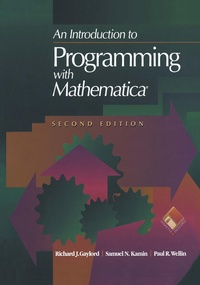
An Introduction to Programming with Mathematica®
2nd Edition
Published on 12. October 1995
Book
Hardback
XXIII, 452 pages
978-0-387-94434-0 (ISBN)
Description
Accompanying the book, as with all TELOS sponsored publications, is an electronic component. In this case it is a DOS-Diskette produced by one of the coauthors, Paul Wellin. This diskette consists of
Mathematica
notebooks and packages which contain the codes for all examples and exercises in the book, as well as additional materials intended to extend many ideas covered in the text. It is of great value to teachers, students, and others using this book to learn how to effectively program with
Mathematica
.
More details
Edition
Second Edition 1996
Language
English
Place of publication
New York
United States
Target group
Professional and scholarly
Professional/practitioner
Edition type
New edition
Illustrations
XXIII, 452 p.
Dimensions
Height: 241 mm
Width: 183 mm
Thickness: 31 mm
Weight
1011 gr
ISBN-13
978-0-387-94434-0 (9780387944340)
DOI
10.1007/978-1-4612-2322-1
Schweitzer Classification
Other editions
Additional editions
Richard J. Gaylord | Samuel N. Kamin | Paul R. Wellin
An Introduction to Programming with Mathematica®
E-Book
12/2012
2nd Edition
Springer
€53.49
Available for download
Richard J. Gaylord | Samuel N. Kamin | Paul R. Wellin
An Introduction to Programming with Mathematica®
Book
09/2011
2nd Edition
Springer
€53.49
Shipment within 15-20 days
Previous edition

Richard Gaylord | Paul Wellin | Sam Kamin
Introduction to Programming with Mathematica
Book
08/1993
Springer
€36.75
Article exhausted; check for reprint
Content
1 Preliminaries.- 1.1 Introduction.- 1.2 Using Mathematica.- 1.3 The Mathematica Language.- 1.4 The Mathematica Interface.- 2 A Brief Overview of Mathematica.- 2.1 Numerical and Symbolic Computations.- 2.2 Functions.- 2.3 Graphics.- 2.4 Representation of Data.- 2.5 Programming.- 3 List Manipulation.- 3.1 Introduction.- 3.2 Creating and Measuring Lists.- 3.3 Working With the Elements of a List.- 3.4 Working with Several Lists.- 3.5 Higher-Order Functions.- 3.6 Applying Functions to Lists Repeatedly.- 3.7 Strings and Characters.- 4 Functions.- 4.1 Introduction.- 4.2 Programs as Functions.- 4.3 User-Defined Functions.- 4.4 Auxiliary Functions.- 4.5 Anonymous Functions.- 4.6 One-Liners.- 5 Evaluation of Expressions.- 5.1 Introduction.- 5.2 Creating Rewrite Rules.- 5.3 Expressions.- 5.4 Patterns.- 5.5 Term Rewriting.- 5.6 Transformation Rules.- 6 Conditional Function Definitions.- 6.1 Introduction.- 6.2 Conditional Functions.- 6.3 Example-Classifying Points.- 7 Recursion.- 7.1 Fibonacci Numbers.- 7.2 List Functions.- 7.3 Thinking Recursively.- 7.4 Recursion and Symbolic Computations.- 7.5 Gaussian Elimination.- 7.6 Trees.- 7.7 Dynamic Programming.- 7.8 Higher-Order Functions and Recursion.- 7.9 Debugging.- 8 Iteration.- 8.1 Newtons Method.- 8.2 Vectors and Matrices.- 8.3 Passing Arrays to Functions.- 8.4 Gaussian Elimination Revisited.- 9 Numerics.- 9.1 Types of Numbers.- 9.2 Random Numbers.- 9.3 Precision and Accuracy.- 9.4 Numerical Computations.- 10 Graphics Programming.- 10.1 Graphics Primitives.- 10.2 Graphics Directives and Options.- 10.3 Built-in Graphics Functions.- 10.4 Graphics Programming.- 10.5 Sound.- 11 Applications.- 11.1 The Random Walk.- 11.2 The Game of Life.- 11.3 Implementing Languages.- 12 Contexts and Packages.- 12.1 Introduction.- 12.2 UsingPackages.- 12.3 Contexts.- 12.4 Packages.- 12.5 Avoiding Name Collisions.- 12.6 The BaseConvert Package.- 12.7 The RandomWalks Package.- References.