

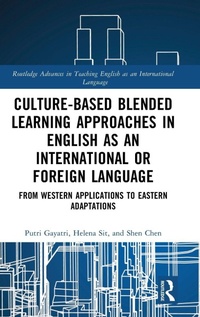
Culture-Based Blended Learning Approaches in English as an International or Foreign Language
From Western Applications to Eastern Adaptations
1st Edition
Published on 1. September 2025
Book
Hardback
160 pages
978-1-032-91637-8 (ISBN)
Description
This book provides rich information about the historical development and progress of blended learning with a focus on the field of English as an International Language (EIL) or English as a Foreign Language (EFL) area.
The authors examine various models of blended learning used in the USA, UK, Australia, and Asia before establishing a comprehensive model in accordance with the socio-cultural context of a country. The book further investigates the implementation of the model in EIL/EFL classrooms. The research was conducted using a library research method to collect rich data, enabling extensive international literature to be critically reviewed by the authors for an Asian setting. The book concludes by providing readers with constructive recommendations for future practice of blended learning in EIL/EFL in Asia and other non- English speaking countries.
This volume will be of value to researchers, educators, and higher degree students who are interested in second and foreign language education and English as an International Language or a Foreign Language. It will also be a valuable resource for EIL/EFL and other foreign language teachers, particularly in an Asian cultural context.
The authors examine various models of blended learning used in the USA, UK, Australia, and Asia before establishing a comprehensive model in accordance with the socio-cultural context of a country. The book further investigates the implementation of the model in EIL/EFL classrooms. The research was conducted using a library research method to collect rich data, enabling extensive international literature to be critically reviewed by the authors for an Asian setting. The book concludes by providing readers with constructive recommendations for future practice of blended learning in EIL/EFL in Asia and other non- English speaking countries.
This volume will be of value to researchers, educators, and higher degree students who are interested in second and foreign language education and English as an International Language or a Foreign Language. It will also be a valuable resource for EIL/EFL and other foreign language teachers, particularly in an Asian cultural context.
More details
Series
Language
English
Place of publication
London
United Kingdom
Publishing group
Taylor & Francis Ltd
Target group
College/higher education
ELT/ESL
Postgraduate
Illustrations
6 s/w Abbildungen, 6 s/w Zeichnungen, 2 s/w Tabellen
2 Tables, black and white; 6 Line drawings, black and white; 6 Illustrations, black and white
Dimensions
Height: 240 mm
Width: 161 mm
Thickness: 14 mm
Weight
429 gr
ISBN-13
978-1-032-91637-8 (9781032916378)
Copyright in bibliographic data and cover images is held by Nielsen Book Services Limited or by the publishers or by their respective licensors: all rights reserved.
Schweitzer Classification
Other editions
Additional editions
Putri Gayatri | Helena Sit | Shen Chen
Culture-Based Blended Learning Approaches in English as an International or Foreign Language
From Western Applications to Eastern Adaptations
E-Book
09/2025
Routledge
€60.99
Available for download
Putri Gayatri | Helena Sit | Shen Chen
Culture-Based Blended Learning Approaches in English as an International or Foreign Language
From Western Applications to Eastern Adaptations
E-Book
09/2025
Routledge
€60.99
Available for download
Persons
Putri Gayatri is a lecturer at Universitas Brawijaya, Indonesia. Her research interest focuses on blended learning, computer-assisted language learning (CALL), and technology integration in English as a Foreign Language (EFL) instruction. Currently, she serves as the Head of the English Language Service Unit at the Faculty of Agriculture, Universitas Brawijaya.
Helena Sit is a teacher educator and PhD supervisor at the University of Newcastle, Australia, specialising in Teaching English to Speakers of Other Languages (TESOL) and teacher education. Recognised nationally and internationally, she has received the College Excellence Award for Research Supervision. She serves as an executive for the Applied Linguistics Association of Australia and as program co-chair for the Hong Kong Association for Education and Technology.
Shen Chen is an honorary professor in the School of Education at the University of Newcastle, Australia. In addition, he has been a research fellow and a visiting professor in Cambridge University, UK; Warwick University, UK; University of California, Berkeley, USA; University of British Columbia, Canada; and the University of Hong Kong, Nanjing University, and Beijing Language and Culture University, China.
Helena Sit is a teacher educator and PhD supervisor at the University of Newcastle, Australia, specialising in Teaching English to Speakers of Other Languages (TESOL) and teacher education. Recognised nationally and internationally, she has received the College Excellence Award for Research Supervision. She serves as an executive for the Applied Linguistics Association of Australia and as program co-chair for the Hong Kong Association for Education and Technology.
Shen Chen is an honorary professor in the School of Education at the University of Newcastle, Australia. In addition, he has been a research fellow and a visiting professor in Cambridge University, UK; Warwick University, UK; University of California, Berkeley, USA; University of British Columbia, Canada; and the University of Hong Kong, Nanjing University, and Beijing Language and Culture University, China.
Content
Table of Contents
More about the Authors
Series Foreword
1. Introduction: Blended Learning For EFL/EIL - Universal or Unique?
2. The Development of Blended Learning
3. Possibility and Feasibility of Blended Learning For EFL/EIL Teaching in Non-Western Countries
4. The Technology-Based Model
5. The Participants-Based Model
6. The Context-Based Model
7. Cultural Circles and Local Consideration
8.Conclusion: Towards a Culture-based Paradigm
Index
More about the Authors
Series Foreword
1. Introduction: Blended Learning For EFL/EIL - Universal or Unique?
2. The Development of Blended Learning
3. Possibility and Feasibility of Blended Learning For EFL/EIL Teaching in Non-Western Countries
4. The Technology-Based Model
5. The Participants-Based Model
6. The Context-Based Model
7. Cultural Circles and Local Consideration
8.Conclusion: Towards a Culture-based Paradigm
Index