

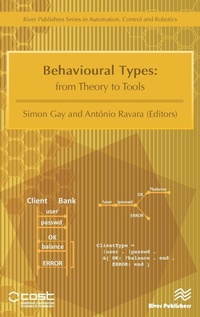
Behavioural Types
From Theory to Tools
1st Edition
Published on 31. July 2017
Book
Hardback
410 pages
978-87-93519-82-4 (ISBN)
Description
Behavioural type systems in programming languages support the specification and verification of properties of programs beyond the traditional use of type systems to describe data processing. A major example of such a property is correctness of communication in concurrent and distributed systems, motivated by the importance of structured communication in modern software. Behavioural Types: from Theory to Tools presents programming languages and software tools produced by members of COST Action IC1201: Behavioural Types for Reliable Large-Scale Software Systems, a European research network that was funded from October 2012 to October 2016. As a survey of the most recent developments in the application of behavioural type systems, it is a valuable reference for researchers in the field, as well as an introduction to the area for graduate students and software developers.
More details
Language
English
Place of publication
Gistrup
Denmark
Target group
College/higher education
Professional and scholarly
Academic
Dimensions
Height: 240 mm
Width: 161 mm
Thickness: 27 mm
Weight
778 gr
ISBN-13
978-87-93519-82-4 (9788793519824)
Copyright in bibliographic data and cover images is held by Nielsen Book Services Limited or by the publishers or by their respective licensors: all rights reserved.
Schweitzer Classification
Other editions
Additional editions
Book
10/2024
1st Edition
River Publishers
€48.00
Article not available for order
E-Book
09/2022
1st Edition
Taylor & Francis
from
€83.99
Available for download
E-Book
09/2022
1st Edition
Taylor & Francis
from
€83.99
Available for download
E-Book
07/2017
River Publishers
€117.99
Available for download
Persons
Simon Gay, António Ravara
Content
Preface; 1. Contract-oriented design of distributed applications: a tutorial; 2. Contract-oriented programming with timed session types; 3. A runtime monitoring tool for actor-based systems; 4. How to Verify Your Python Conversations; 5. The DCR Workbench: Declarative Choreographies for Collaborative Processes; 6. A tool for choreography-based analysis of message-passing software; 7. Programming adaptive microservice systems; an AIOCJ tutorial; 8. JaDA - the Java Deadlock Analyzer; 9. Type-Based Analysis of Linear Communications; 10. Session types with linearity in Haskell; 11. An OCaml Implementation of Binary Sessions; 12. Lightweight functional session types; 13. Distributed programming using Java APIs generated from Session Types; 14. Mungo and StMungo: Tools for Typechecking Protocols in Java; 15. Protocol-driven MPI program generation; 16. Protocol Verification of MPI Programs