

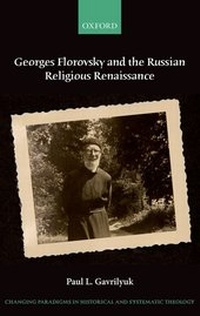
Georges Florovsky and the Russian Religious Renaissance
Published on 19. December 2013
Book
Hardback
314 pages
978-0-19-870158-3 (ISBN)
Description
Georges Florovsky is the mastermind of a 'return to the Church Fathers' in twentieth-century Orthodox theology. His theological vision-the neopatristic synthesis-became the main paradigm of Orthodox theology and the golden standard of Eastern Orthodox identity in the West. Focusing on Florovsky's European period (1920-1948), this study analyses how Florovsky's evolving interpretation of Russian religious thought, particularly Vladimir Solovyov and Sergius Bulgakov, informed his approach to patristic sources. Paul Gavrilyuk offers a new reading of Florovsky's neopatristic theology, by closely considering its ontological, epistemological and ecclesiological foundations.
It is common to contrast Florovsky's neopatristic theology with the 'modernist' religious philosophies of Pavel Florensky, Sergius Bulgakov, and other representatives of the Russian Religious Renaissance. Gavrilyuk argues that the standard narrative of twentieth-century Orthodox theology, based on this polarization, must be reconsidered. The author demonstrates Florovsky's critical appropriation of the main themes of the Russian Religious Renaissance, including theological antinomies, the meaning of history, and the nature of personhood. The distinctive features of Florovsky's neopatristic theology--Christological focus, 'ecclesial experience', personalism, and 'Christian Hellenism'--are best understood against the background of the main problematic of the Renaissance. Specifically, it is shown that Bulgakov's sophiology provided a polemical subtext for Florovsky's theology of creation. It is argued that the use of the patristic norm in application to modern Russian theology represents Florovsky's theological signature.
Drawing on unpublished archival material and correspondence, this study sheds new light on such aspects of Florovsky's career as his family background, his participation in the Eurasian movement, his dissertation on Alexander Herzen, his lectures on Vladimir Solovyov, and his involvement in Bulgakov's Brotherhood of St Sophia.
It is common to contrast Florovsky's neopatristic theology with the 'modernist' religious philosophies of Pavel Florensky, Sergius Bulgakov, and other representatives of the Russian Religious Renaissance. Gavrilyuk argues that the standard narrative of twentieth-century Orthodox theology, based on this polarization, must be reconsidered. The author demonstrates Florovsky's critical appropriation of the main themes of the Russian Religious Renaissance, including theological antinomies, the meaning of history, and the nature of personhood. The distinctive features of Florovsky's neopatristic theology--Christological focus, 'ecclesial experience', personalism, and 'Christian Hellenism'--are best understood against the background of the main problematic of the Renaissance. Specifically, it is shown that Bulgakov's sophiology provided a polemical subtext for Florovsky's theology of creation. It is argued that the use of the patristic norm in application to modern Russian theology represents Florovsky's theological signature.
Drawing on unpublished archival material and correspondence, this study sheds new light on such aspects of Florovsky's career as his family background, his participation in the Eurasian movement, his dissertation on Alexander Herzen, his lectures on Vladimir Solovyov, and his involvement in Bulgakov's Brotherhood of St Sophia.
Reviews / Votes
Excellent and lucid new book ... [a] critical appraisal of Florovsky * Ruth Coates, Times Literary Supplement, * Paul Gavrilyuks meticulously documented book is a model study of the intellectual development of one of the most significant and intriguing personalities of modern Orthodoxy, a masterly undertaking which will influence any further reflection on the complex development and interrelationships among the various strands of modern Orthodox theology. The book does justice to Florovsky, not as uncritical hagiography, but as a lucid, informed account of his intellectual development and his place in the history of modern Orthodox thought * Paul Ladouceur, St Vladimirs Theological Quarterly * It will not be possible, from now on, to read Russian theologian Georges Florovskys work or for that matter, anything about him without reference to Paul Gavrilyuks truly groundbreaking study and reassessment * Michael Plekon, Logos * Gavrilyuks study provides us with the most comprehensive, broad, and critical consideration of the complex and not yet fully understood relationship between Florovsky and the Renaissance movement * Nikolaos Asproulis, Journal of Theological Studies *More details
Series
Language
English
Place of publication
Oxford
United Kingdom
Target group
College/higher education
Professional and scholarly
Dimensions
Height: 240 mm
Width: 162 mm
Thickness: 27 mm
Weight
638 gr
ISBN-13
978-0-19-870158-3 (9780198701583)
Copyright in bibliographic data and cover images is held by Nielsen Book Services Limited or by the publishers or by their respective licensors: all rights reserved.
Schweitzer Classification
Other editions
Additional editions
Paul L. Gavrilyuk
Georges Florovsky and the Russian Religious Renaissance
Book
10/2015
Oxford University Press
€54.46
Shipment within 15-20 days
Paul L. Gavrilyuk
Georges Florovsky and the Russian Religious Renaissance
E-Book
12/2013
1st Edition
OUP eBook
€27.49
Available for download
Person
Paul L. Gavrilyuk holds the Aquinas Chair in Theology and Philosophy at the Theology Department of the University of St Thomas, St Paul, Minnesota, United States. Born in Kiev, Ukraine, he studied physics at the Moscow Institute of Physics and Technology in Russia. He was one of the first scholars from the former Soviet Union to come to the United States to pursue graduate work in theology. An Eastern Orthodox historian and theologian, Gavrilyuk specializes in early Christian theology and Russian religious thought. Translated into five languages, his books include The Suffering of the Impassible God: The Dialectics of Patristic Thought, Histoire du catechumenat dans l'eglise ancienne [A History of the Catechumenate in the Early Church], and The Spiritual Senses: Perceiving God in Western Christianity, co-edited with Sarah Coakley.
Content
Preface ; Introduction ; 1. The Russian Religious Renaissance before the Revolution ; 2. Early Encounters with the Renaissance ; 3. The Fathers and Children of the Renaissance in the Dispersion ; 4. The Eurasian Temptation ; 5. Philosophy of History ; 6. Reevaluation of Solovyov ; 7. Bulgakov s Antipode ; 8. The Sophiological Subtext of Neopatristic Synthesis ; 9. How The Ways of Russian Theology Came to Be Written ; 10. The Patristic Norm and the Western Pseudomorphosis of Russian Theology ; 11. The Early Reception of The Ways of Russian Theology ; 12. Christian Hellenism as Philosophia Perennis ; 13. The Ecclesiological and Epistemological Contours of the Neopatristic Synthesis ; 14. The Reception of Florovsky in Orthodox Theology ; 15. Beyond the Polarizing Narrative