

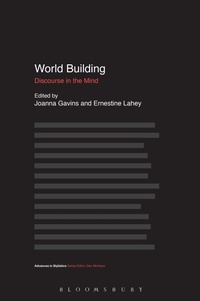
World Building
Discourse in the Mind
Published on 30. June 2016
Book
Hardback
312 pages
978-1-4725-8653-7 (ISBN)
Description
World Building represents the state-of-the-discipline in worlds-based approaches to discourse, collected together for the first time. Over the last 40 years the 'text-as-world' metaphor has become one of the most prevalent and productive means of describing the experiencing of producing and receiving discourse. This has been the case in a range of disciplines, including stylistics, cognitive poetics, narratology, discourse analysis and literary theory.
The metaphor has enabled analysts to formulate a variety of frameworks for describing and examining the textual and conceptual mechanics involved in human communication, articulating these variously through such concepts as 'possible worlds', 'text-worlds' and 'storyworlds'. Each of these key approaches shares an understanding of discourse as a logically grounded, cognitively and pragmatically complex phenomenon. Discourse in this sense is capable of producing highly immersive and emotionally affecting conceptual spaces in the minds of discourse participants.
The chapters examine how best to document and analyze this and this is an essential collection for stylisticians, linguists and narrative theorists.
The metaphor has enabled analysts to formulate a variety of frameworks for describing and examining the textual and conceptual mechanics involved in human communication, articulating these variously through such concepts as 'possible worlds', 'text-worlds' and 'storyworlds'. Each of these key approaches shares an understanding of discourse as a logically grounded, cognitively and pragmatically complex phenomenon. Discourse in this sense is capable of producing highly immersive and emotionally affecting conceptual spaces in the minds of discourse participants.
The chapters examine how best to document and analyze this and this is an essential collection for stylisticians, linguists and narrative theorists.
Reviews / Votes
This collection represents the state of the art in the study of world-building as central to the comprehension of discourse generally and literature in particular. It is innovative and diverse both in terms of theory and applications: a real treat for discourse analysts, cognitive linguists and literary scholars. -- Elena Semino, Head of Department of Linguistics and English Language, Lancaster University, UK This fascinating volume explores the unexpected but orderly complexity of the mental construction of meaning. It shows us the cognitive poetics not just of texts but of everyday life. -- Mark Turner, Institute Professor and Professor of Cognitive Science, Case Western Reserve University, USA There is a pervasive sense of coherence throughout the entire volume which makes reading the entire volume a seamless experience ... World Building: Discourse in the Mind is an immensely important contribution to the study of the interrelation between narrative, discourse, and cognition ... Needless to say, the volume will primarily appeal to cognitively oriented researchers within these fields, but I would encourage researchers and postgraduate students alike within these fields more generally to engage with the volume even if cognition is not their primary research interest. * The Linguist List *More details
Series
Language
English
Place of publication
London
United Kingdom
Publishing group
Bloomsbury Publishing PLC
Target group
College/higher education
Dimensions
Height: 240 mm
Width: 161 mm
Thickness: 21 mm
Weight
631 gr
ISBN-13
978-1-4725-8653-7 (9781472586537)
Copyright in bibliographic data and cover images is held by Nielsen Book Services Limited or by the publishers or by their respective licensors: all rights reserved.
Schweitzer Classification
Other editions
Additional editions
E-Book
06/2016
1st Edition
Bloomsbury Academic
€39.99
Available for download
Persons
Joanna Gavins is Reader in Literary Linguistics at the University of Sheffield, UK. She is the author of Reading the Absurd (EUP, 2013) and Text World Theory: An Introduction (EUP, 2007).
Ernestine Lahey is Assistant Professor in Linguistics and Stylistics at University College Roosevelt. She has published widely on subjects relating to (cognitive) stylistics, Text World Theory and Canadian literature and culture.
Ernestine Lahey is Assistant Professor in Linguistics and Stylistics at University College Roosevelt. She has published widely on subjects relating to (cognitive) stylistics, Text World Theory and Canadian literature and culture.
Content
Notes on Contributors
1. World Building in Discourse, Joanna Gavins and Ernestine Lahey
2. 'I felt like I'd stepped out of a different reality': Possible Worlds Theory, Metalepsis and Digital Fiction, Alice Bell
3. Author-Character Ethos in Dan Brown's Langdon-Series Novels, Ernestine Lahey
4. Building More-Than-Human Worlds: Umwelt Modelling in Animal Narratives, David Herman
5. Building Hollywood in Paddington: Text World Theory, Immersive Theatre, and Punchdrunk's The Drowned Man, Alison Gibbons
6. Speaker Enactors in Oral Narrative, Isabelle van der Bom
7. Text World Theory as Cognitive Grammatics: a Pedagogical Application in the Secondary Classroom, Marcello Giovanelli
8. Worlds from Words: Theories of World-building as Creative Writing Toolbox, Jeremy Scott
9. The Texture of Authorial Intention, Peter Stockwell
10. Building Resonant Worlds: Experiencing the Text-Worlds of The Unconsoled, Sara Whiteley
11. 'This is not the end of the world': Situating Metaphor in the Text-Worlds of the 2008 British Financial Crisis, Sam Browse
12. The Humorous Worlds of Film Comedy, Agnes Marszalek
13. Spanglish Dialogue in You and Me: An Absurd World and Senile Mind Style, Jane Lugea
14. Autofocus and Remote Text-World Building in the Earliest English Narrative Poetry, Antonina Harbus
15. Into the Futures of their Makers: A Cognitive Poetic Analysis of Reversals, Accelerations and Shifts in Time in the Poems of Eavan Boland, Nigel McLoughlin
16. Stylistic Interanimation and Apophatic Poetics in Jacob Polley's 'Hide and Seek', Joanna Gavins
Index
1. World Building in Discourse, Joanna Gavins and Ernestine Lahey
2. 'I felt like I'd stepped out of a different reality': Possible Worlds Theory, Metalepsis and Digital Fiction, Alice Bell
3. Author-Character Ethos in Dan Brown's Langdon-Series Novels, Ernestine Lahey
4. Building More-Than-Human Worlds: Umwelt Modelling in Animal Narratives, David Herman
5. Building Hollywood in Paddington: Text World Theory, Immersive Theatre, and Punchdrunk's The Drowned Man, Alison Gibbons
6. Speaker Enactors in Oral Narrative, Isabelle van der Bom
7. Text World Theory as Cognitive Grammatics: a Pedagogical Application in the Secondary Classroom, Marcello Giovanelli
8. Worlds from Words: Theories of World-building as Creative Writing Toolbox, Jeremy Scott
9. The Texture of Authorial Intention, Peter Stockwell
10. Building Resonant Worlds: Experiencing the Text-Worlds of The Unconsoled, Sara Whiteley
11. 'This is not the end of the world': Situating Metaphor in the Text-Worlds of the 2008 British Financial Crisis, Sam Browse
12. The Humorous Worlds of Film Comedy, Agnes Marszalek
13. Spanglish Dialogue in You and Me: An Absurd World and Senile Mind Style, Jane Lugea
14. Autofocus and Remote Text-World Building in the Earliest English Narrative Poetry, Antonina Harbus
15. Into the Futures of their Makers: A Cognitive Poetic Analysis of Reversals, Accelerations and Shifts in Time in the Poems of Eavan Boland, Nigel McLoughlin
16. Stylistic Interanimation and Apophatic Poetics in Jacob Polley's 'Hide and Seek', Joanna Gavins
Index