

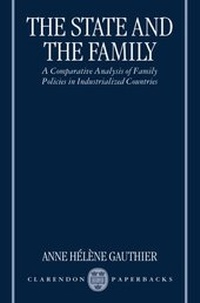
The State and the Family
A Comparative Analysis of Family Policies in Industrialized Countries
Published on 19. November 1998
Book
Paperback/Softback
248 pages
978-0-19-829499-3 (ISBN)
Description
In a number of industrialized countries, on the assumption that fertility remains at or close to present levels, populations will start to decline, in some cases quite rapidly in the near to medium future. Many governments are alarmed by this prospect, especially since it goes hand in hand with a further and acute ageing of the population. From the fears in the 1930s about population and family decline, to the fears in the 1970s about over-population, and contemporary talk of `family-friendly' policies, governments' attitudes towards and interventions in family policy have changed considerably. What is today referred to as family policy differs widely from the first forms of government support before the Second World War.
This book argues that demographic changes have been a major force in bringing population and family issues on to the political agenda. The decline in fertility, the increase in divorce rates and lone-parenthood, and the entry of women into the labour force have all reduced the relevance of systems of state support aimed at traditional families. From this perspective, the author examines the changes that have affected families over the past 100 years, and the policies that have been adopted by different governments in response to these changes. Data from twenty-two industrialized countries is used to provide an original analysis of legislation, initiatives, and measures aimed at better supporting families. The book assembles arguments from demography, sociology, and economics to explain population policies, their origins and aims. It shows that despite major similarities across countries in the ways family policy has evolved, and in the ways governments have viewed and supported families, there are major dissimilarities shaped by country-specific events, ideologies, and circumstances. It concludes by drawing a typology of models of family policy bases on these inter-country differences.
This book argues that demographic changes have been a major force in bringing population and family issues on to the political agenda. The decline in fertility, the increase in divorce rates and lone-parenthood, and the entry of women into the labour force have all reduced the relevance of systems of state support aimed at traditional families. From this perspective, the author examines the changes that have affected families over the past 100 years, and the policies that have been adopted by different governments in response to these changes. Data from twenty-two industrialized countries is used to provide an original analysis of legislation, initiatives, and measures aimed at better supporting families. The book assembles arguments from demography, sociology, and economics to explain population policies, their origins and aims. It shows that despite major similarities across countries in the ways family policy has evolved, and in the ways governments have viewed and supported families, there are major dissimilarities shaped by country-specific events, ideologies, and circumstances. It concludes by drawing a typology of models of family policy bases on these inter-country differences.
Reviews / Votes
A major contribution to the comparative sociology of the state and family policy. ChoiceMore details
Language
English
Place of publication
Oxford
United Kingdom
Publishing group
Oxford University Press
Target group
Professional and scholarly
Illustrations
line figures, tables
Dimensions
Height: 234 mm
Width: 155 mm
Thickness: 15 mm
Weight
393 gr
ISBN-13
978-0-19-829499-3 (9780198294993)
Copyright in bibliographic data and cover images is held by Nielsen Book Services Limited or by the publishers or by their respective licensors: all rights reserved.
Schweitzer Classification
Content
1. Introduction ; 2. Early Fears of Population Decline ; 3. First Elements of Family Policies ; 4. The Expansion of State Support ; 5. The Rediscovery of Poverty ; 6. Women's Issues: Second Wave ; 7. Renewed Demographic Concerns ; 8. The New Population Question ; 9. The Family as a Political Issue ; 10. Recent Trends in State Support ; 11. Conclusion ; Appendix A. Sources of Data ; Appendix B. Technical Notes