

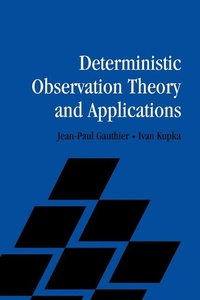
Deterministic Observation Theory and Applications
Published on 8. October 2001
Book
Hardback
240 pages
978-0-521-80593-3 (ISBN)
Description
This 2001 book presents a general theory as well as a constructive methodology to solve 'observation problems', that is, reconstructing the full information about a dynamical process on the basis of partial observed data. A general methodology to control processes on the basis of the observations is also developed. Illustrative but also practical applications in the chemical and petroleum industries are shown. This book is intended for use by scientists in the areas of automatic control, mathematics, chemical engineering and physics.
Reviews / Votes
Review of the hardback: '... an extraordinary book, establishing a new paradigm in the observability theory of nonlinear systems.' Zentrallblatt MATHMore details
Language
English
Place of publication
Cambridge
United Kingdom
Target group
Professional and scholarly
Illustrations
2 line figures
Dimensions
Height: 235 mm
Width: 157 mm
Thickness: 19 mm
Weight
546 gr
ISBN-13
978-0-521-80593-3 (9780521805933)
Copyright in bibliographic data and cover images is held by Nielsen Book Services Limited or by the publishers or by their respective licensors: all rights reserved.
Schweitzer Classification
Other editions
Additional editions
Jean-Paul Gauthier | Ivan Kupka
Deterministic Observation Theory and Applications
Book
02/2011
Cambridge University Press
€54.50
Shipment within 15-20 days
Jean-Paul Gauthier | Ivan Kupka
Deterministic Observation Theory and Applications
E-Book
01/2005
1st Edition
Cambridge University Press
€36.99
Available for download
Persons
Content
1. Introduction; Part I. Observability and Observers: 2. Observability concepts; 3. The case dy ? du; 4. The case of dy < du; 5. Singular state-output mappings; 6. Observers: the high-gain construction; Part II. Dynamic Output Stabilization and Applications: 7. Dynamic output stabilization; 8. Applications; 9. Appendix; 10. Solutions to the exercises of Part I; Bibliography; Index.