

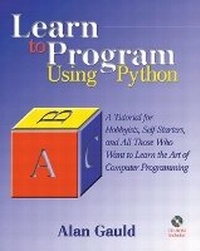
Learn to Program Using Python
A Tutorial for Hobbyists, Self-Starters, and All Who Want to Learn the Art of Computer Programming
Published on 4. January 2001
Book
Mixed media product
288 pages
978-0-201-70938-4 (ISBN)
Description
Learn to Program Using Python is a rarity in today's marketplace: a great introduction to programming for true beginners. It started as a hugely popular Web tutorial; reflecting comments from learners worldwide, author Alan Gauld has extended it into book form, adding new material, deeper explanations, and more code examples. Gauld introduces programming through Python, an extremely popular language that's easy to start with, available on virtually every platform, and is powerful enough to serve your needs for years to come. He starts with the absolute basics: what programming is, and the character and mindset of a successful programmer. Next, he introduces the concepts of data, operations, sequences, and loops; and shows how to interact with users. Gauld then walks through branching, modules, functions, file handling, error handling, and recursion. Once you've mastered the basics, he introduces object-oriented programming, and more advanced techniques. The book concludes with two detailed object-oriented case studies. For all beginning programmers, power users, and users of other programming languages who want to learn Python.
More details
Language
English
Place of publication
Boston
United States
Publishing group
Pearson Education (US)
Target group
College/higher education
Dimensions
Height: 187 mm
Width: 234 mm
Thickness: 19 mm
Weight
494 gr
ISBN-13
978-0-201-70938-4 (9780201709384)
Copyright in bibliographic data and cover images is held by Nielsen Book Services Limited or by the publishers or by their respective licensors: all rights reserved.
Schweitzer Classification
Person
Alan Gauld is a professional programmer with a gift for explaining complex concepts. His 25-year career has encompassed numerous programming languages, operating systems, and application development projects, from embedded microcontrollers through mainframe billing systems.
0201709384AB04062001
0201709384AB04062001
Content
Preface.
I. INTRODUCTION.
1. Who, What, and How?
2. What Do I Need?
3. What Is Programming?
4. Getting Started.
II. PROGRAMMING FUNDAMENTALS.
5. Simple Sequences.
6. The Raw Materials.
7. More Sequences and Other Things.
8. Looping, or the Art of Repeating Oneself.
9. Decisions, Decisions.
10. Conversing with the User.
11. Modular Programming.
12. Handling Files and Text.
13. A Touch of Style.
14. Handling Errors.
III. Advanced Topics.
15. Recursion.
16. Namespaces.
17. Object-Oriented Programming.
18. Event-Driven Programming.
19. Regular Expressions.
20. Debugging.
21. Designing a Solution.
IV. Case Studies.
22. Grammar Counter.
23. Guessing Games.
Epilogue.
Appendix A. Installing and Testing Python.
Appendix B. Some Interesting Programming Languages.
Appendix C. Resources.
Glossary.
Index.
I. INTRODUCTION.
1. Who, What, and How?
2. What Do I Need?
3. What Is Programming?
4. Getting Started.
II. PROGRAMMING FUNDAMENTALS.
5. Simple Sequences.
6. The Raw Materials.
7. More Sequences and Other Things.
8. Looping, or the Art of Repeating Oneself.
9. Decisions, Decisions.
10. Conversing with the User.
11. Modular Programming.
12. Handling Files and Text.
13. A Touch of Style.
14. Handling Errors.
III. Advanced Topics.
15. Recursion.
16. Namespaces.
17. Object-Oriented Programming.
18. Event-Driven Programming.
19. Regular Expressions.
20. Debugging.
21. Designing a Solution.
IV. Case Studies.
22. Grammar Counter.
23. Guessing Games.
Epilogue.
Appendix A. Installing and Testing Python.
Appendix B. Some Interesting Programming Languages.
Appendix C. Resources.
Glossary.
Index.