

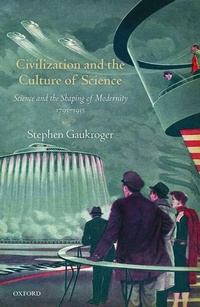
Civilization and the Culture of Science
Science and the Shaping of Modernity, 1795-1935
Published on 3. March 2020
Book
Hardback
535 pages
978-0-19-884907-0 (ISBN)
Description
How did science come to have such a central place in Western culture? How did cognitive values--and subsequently moral, political, and social ones--come to be modelled around scientific values? In Civilization and the Culture of Science, Stephen Gaukroger explores how these values were shaped and how they began, in turn, to shape those of society. The core nineteenth- and twentieth-century development is that in which science comes to take centre stage in determining ideas of civilization, displacing Christianity in this role. Christianity had provided a unifying thread in the study of the world, however, and science had to match this, which it did through the project of the unity of the sciences. The standing of science came to rest or fall on this question, which the book sets out to show in detail is essentially ideological, not something that arose from developments within the sciences, which remained pluralistic and modular. A crucial ingredient in this process was a fundamental rethinking of the relations between science and ethics, economics, philosophy, and engineering. In his engaging description of this transition to a scientific modernity, Gaukroger examines five of the issues which underpinned this shift in detail: changes in the understanding of civilization; the push to unify the sciences; the rise of the idea of the limits of scientific understanding; the concepts of 'applied' and 'popular' science; and the way in which the public was shaped in a scientific image.
Reviews / Votes
This is a remarkable work of scholarship and the fifty-page bibliography is a testament to the author's breadth of knowledge and reading, which forms the scientific basis for his outstanding contribution to the field. * Dr. Arpan K. Banerjee, Hektoen International * Recommended. Lower-level undergraduates through faculty. * C. D. Kay, Wofford College, CHOICE * The question the author has set out to answer is, on the face of it, quite simple: How is it that science, utterly marginal in Europe's medieval culture, has become central to our modern culture? It is this very question that, for many a historian but also philosopher or sociologist of science, has stood in the background or even at the forefront of their decision to become one. Yet no one so far has had the courage, and the stamina, and the scholarly experience, and the vast erudition, and the organizing power, and the familiarity with a number of indispensable languages that Stephen Gaukroger displays and that are needed to engage the question on anything like the scale it deserves. . . . there are many reasons for profoundly admiring Gaukroger's achievement. * H. Floris Cohen, Isis * This is the much-awaited fourth volume of a series, Science and the Shaping of Modernity, that canvasses the history of science with a keen eye to the broader cultural context.... The erudition and dense attention to detail are breathtaking at times. I marvel to think that one scholar could command so much knowledge of the subject, both primary and secondary sources, and bring to bear such sophisticated philosophical judgment. * Margaret Schabas, University of British Columbia * This is a remarkable work of scholarship and the fifty-page bibliography is a testament to the author's breadth of knowledge and reading, which forms the scientific basis for his outstanding contribution to the field. * Arpan Banerjee, Hektoen International Journal *More details
Series
Language
English
Place of publication
Oxford
United Kingdom
Target group
Professional and scholarly
Product notice
sewn/stitched
Cloth over boards
Dimensions
Height: 241 mm
Width: 159 mm
Thickness: 50 mm
Weight
813 gr
ISBN-13
978-0-19-884907-0 (9780198849070)
Copyright in bibliographic data and cover images is held by Nielsen Book Services Limited or by the publishers or by their respective licensors: all rights reserved.
Schweitzer Classification
Other editions
Additional editions
Stephen Gaukroger
Civilization and the Culture of Science
Science and the Shaping of Modernity, 1795-1935
E-Book
02/2020
1st Edition
OUP eBook
€16.49
Available for download
Stephen Gaukroger
Civilization and the Culture of Science
Science and the Shaping of Modernity, 1795-1935
E-Book
02/2020
1st Edition
OUP eBook
€16.49
Available for download
Person
Stephen Gaukroger, who was educated at the University of London and the University of Cambridge, is Emeritus Professor of History of Philosophy and History of Science at the University of Sydney. He is author of fourteen books and the editor of nine collections of essays. His recent publications include The Emergence of a Scientific Culture: Science and the Shaping of Modernity, 1210-1685 (Oxford 2006), The Collapse of Mechanism and the Rise of Sensibility: Science and the Shaping of Modernity, 1680-1760 (Oxford 2010), and The Natural and the Human: Science and the Shaping of Modernity, 1739-1841 (Oxford 2016). His work has been translated into Arabic, Chinese, French, German, Italian, Portuguese, and Russian.
Content
Part I: Civilization
1: Science and the Origins of Civilization
2: The Evolution of Civilization
Part II: The Unity of Science
3: The Promotion of Unification
4: The Unity of the Physical Sciences
5: The Autonomy of the Material Sciences
6: The Autonomy of the Life Sciences
7: The Unity of the Life Sciences
Part III: The Expansion of Scientific Understanding
8: The Problem of the Human Sciences
9: Understanding the World: Science or Philosophy?
Part IV: The Pursuit of Science by Other Means: 'Applied' and 'Popular Science'
10: Technology and the Limits of Scientific Theorizing
11: Science for and by the Public
Part V: Science and the Civilizing Process
12: The Modernization of the Population: Accommodating the Human to the Scientific Image
Conclusion
13: Science and the Shaping of Modernity
1: Science and the Origins of Civilization
2: The Evolution of Civilization
Part II: The Unity of Science
3: The Promotion of Unification
4: The Unity of the Physical Sciences
5: The Autonomy of the Material Sciences
6: The Autonomy of the Life Sciences
7: The Unity of the Life Sciences
Part III: The Expansion of Scientific Understanding
8: The Problem of the Human Sciences
9: Understanding the World: Science or Philosophy?
Part IV: The Pursuit of Science by Other Means: 'Applied' and 'Popular Science'
10: Technology and the Limits of Scientific Theorizing
11: Science for and by the Public
Part V: Science and the Civilizing Process
12: The Modernization of the Population: Accommodating the Human to the Scientific Image
Conclusion
13: Science and the Shaping of Modernity