

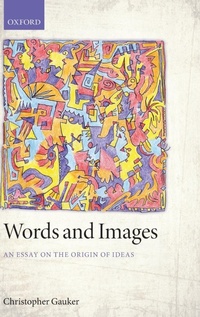
Words and Images
An Essay on the Origin of Ideas
1st Edition
Published on 30. June 2011
Book
Hardback
316 pages
978-0-19-959946-2 (ISBN)
Description
At least since Locke, philosophers and psychologists have usually held that concepts arise out of sensory perceptions, thoughts are built from concepts, and language enables speakers to convey their thoughts to hearers. Christopher Gauker holds that this tradition is mistaken about both concepts and language. The mind cannot abstract the building blocks of thoughts from perceptual representations. More generally, we have no account of the origin of concepts that grants them the requisite independence from language. Gauker's alternative is to show that much of cognition consists in thinking by means of mental imagery, without the help of concepts, and that language is a tool by which interlocutors coordinate their actions in pursuit of shared goals. Imagistic cognition supports the acquisition and use of this tool, and when the use of this tool is internalized, it becomes the very medium of conceptual thought.
Reviews / Votes
Gauker has written a rich and thought-provoking book deserving of careful study. I fully agree with him that philosophers of mind have tended to underestimate or even to overlook the powers of nonconceptual, imagistic cognition. The investigation of imaginative and perception-based forms of reasoning contained in Words and Images is a valuable step in the right direction. * Robert Briscoe, Mind * Christopher Gauker's new book is a rich and innovative study of the nature of conceptual thought, its relation to language, the relation between concepts and perception, and the place of imagistic thinking in cognition ... There is much to like in Words and Images. It is ambitious and deals with a fundamental question in the philosophy of mind ... It is full of bold, iconoclastic views ... detailed arguments for these views and against competing ones, and careful discussion of possible objections. It moves swiftly between philosophical arguments and psychological hypotheses and results, which is very fitting for the topic. * Edouard Machery, Notre Dame Philosophical Reviews * [Gauker's] new book offers a mind-boggling effort to overthrow many philosophical orthodoxies and received wisdoms. ... [it] is also noteworthy for the broad scope of problems covered ... It is a book definitely worth reading * Jaroslav Peregrin, Organon *More details
Language
English
Place of publication
Oxford
United Kingdom
Target group
College/higher education
Scholars and advanced students in the philosophy of mind and language, psycholinguists, psychologists working on concepts and language.
Dimensions
Height: 240 mm
Width: 161 mm
Thickness: 22 mm
Weight
640 gr
ISBN-13
978-0-19-959946-2 (9780199599462)
Copyright in bibliographic data and cover images is held by Nielsen Book Services Limited or by the publishers or by their respective licensors: all rights reserved.
Schweitzer Classification
Other editions
Additional editions
Book
08/2013
Oxford University Press
€58.40
Shipment within 15-20 days
E-Book
06/2011
OUP eBook
€20.99
Available for download
Person
Christopher Gauker is Professor of Philosophy at the University of Cincinnati. He works in both the philosophy of language and the philosophy of mind. His prior books include Words without Meaning (2003) and Conditionals in Context (2005).
Content
Preface ; Introduction: Defining the Question ; 1. The Lockean Theory ; 2. The Kantian Theory ; 3. Regions of Similarity Space ; 4. The Sellarsian Theory ; 5. Imagistic Cognition ; 6. Similarity without Concepts ; 7. Cooperation by Means of Words ; 8. Thinking in Language ; References ; Index