

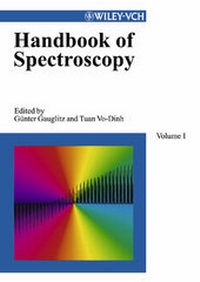
Handbook of Spectroscopy
1st Edition
Published on 12. September 2003
Book
Hardback
XXXII, 1136 pages
978-3-527-29782-5 (ISBN)
Description
This handbook provides a straightforward introduction to spectroscopy, showing what it can do and how it does it, together with a clear, integrated and objective account of the wealth of information that can be derived from spectra. The sequence of chapters covers a wide range of the electromagnetic spectrum, and the physical processes involved, from nuclear phenomena to molecular rotation processes.
- A day-by-day laboratory guide: its design based on practical knowledge of spectroscopists at universities, industries and research institutes
- A well-structured information source containing methods and applications sections framed by sections on general topics
- Guides users to a decision about which spectroscopic method and which instrumentation will be the most appropriate to solve their own practical problem
- Rapid access to essential information
- Correct analysis of a huge number of measured spectra data and smart use of such information sources as databases and spectra libraries
- A day-by-day laboratory guide: its design based on practical knowledge of spectroscopists at universities, industries and research institutes
- A well-structured information source containing methods and applications sections framed by sections on general topics
- Guides users to a decision about which spectroscopic method and which instrumentation will be the most appropriate to solve their own practical problem
- Rapid access to essential information
- Correct analysis of a huge number of measured spectra data and smart use of such information sources as databases and spectra libraries
Reviews / Votes
"...an up-to-date, authoritative, comprehensive reference source providing rapid access to essential information for a wide audience..." (The Chemical Educator, May/June 2005) "...an up-to-date, authoritative, comprehensive reference source providing rapid access to essential information for a wide audience involved in the research, teaching, learning and practice...both to newcomers as well as to advanced practitioners." (The Chemical Educator, Vol. 10, No. 3. 2005) "...this two-volume handbook provides comprehensive coverage on a variety of modern spectroscopic techniques...is a suitable reference book for any practitioner in spectroscopic analysis, and we would recommended it for any scientific library." (Journal of the American Chemical Society, July 21, 2004) "...collections that seek comprehensiveness in spectroscopy, will find this a collection of practical and generally well-written articles on analytical techniques of spectroscopy." (E-Streams, Vol. 7, No. 6) "...very comprehensive treatment of spectroscopy...highly recommended..." (Choice, Vol. 41, No. 8, April 2004)More details
Edition
1., Auflage
Language
English
Place of publication
Weinheim
Germany
Target group
Professional and scholarly
Spektroskopiker, Analytiker, Chemiker, Biologen, Physiker
Illustrations
407
59 s/w Tabellen, 407 s/w Abbildungen
Illustrations
Dimensions
Height: 24 cm
Width: 17 cm
Thickness: 65 mm
Weight
2550 gr
ISBN-13
978-3-527-29782-5 (9783527297825)
Schweitzer Classification
Other editions
Additional editions
Günter Gauglitz | Tuan Vo-Dinh
Handbook of Spectroscopy
E-Book
03/2006
1st Edition
Wiley-VCH
€512.99
Available for download
Content
Sample preparation and sample pretreatment
Methods 1: Optical (UV/VIS/NIR/IR/Raman/Luminescence)
Methods 2: Nuclear magnetic resonance
Methods 3: Mass spectrometry
Methods 4: Elemental analysis (AAS/AES/X-ray fluorescence)
Methods 5: Surface analysis techniques
Applications 1: bioanalysis
Applications 2: environmental analysis
Applications 3: process control
Hyphenated techniques (GC-MS, LC-MS, GC-IR, LC-IR, TLC-IR.)
General Data Treatment: Databases/Spectra Libraries
Methods 1: Optical (UV/VIS/NIR/IR/Raman/Luminescence)
Methods 2: Nuclear magnetic resonance
Methods 3: Mass spectrometry
Methods 4: Elemental analysis (AAS/AES/X-ray fluorescence)
Methods 5: Surface analysis techniques
Applications 1: bioanalysis
Applications 2: environmental analysis
Applications 3: process control
Hyphenated techniques (GC-MS, LC-MS, GC-IR, LC-IR, TLC-IR.)
General Data Treatment: Databases/Spectra Libraries