

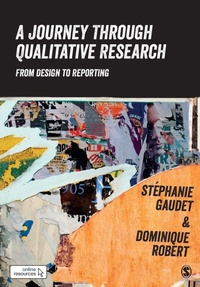
A Journey Through Qualitative Research
From Design to Reporting
1st Edition
Published on 27. February 2018
Book
Paperback/Softback
264 pages
978-1-4462-6713-4 (ISBN)
Description
This hands-on guide takes students from start-to-finish through the research process while showcasing the complexities and interrelationships of different methods, schools of thought, and associated analytical strategies.
Encouraging students to think of qualitative research as a flexible, cyclical process rather than a linear one, this book offers a panoramic strategy and dynamic approach to qualitative research that accommodates the fluid nature of research and accounts for lessons learned through lived experience. With an emphasis on the analysis stage-within case, across case, and the dialogue between these insights and existing literature-it uses concrete applications to show how your methodological decisions translate into practice.
It covers:
Forming, defending, and evaluating research questions
Choosing a research approach
Ensuring ethically sound research
Collecting quality data
Analyzing data in layers
Reporting research results
Through a conversational tone that unpacks key vocabulary and acts as a companion supervisor, this book equips you to traverse every step of the qualitative research journey.
Encouraging students to think of qualitative research as a flexible, cyclical process rather than a linear one, this book offers a panoramic strategy and dynamic approach to qualitative research that accommodates the fluid nature of research and accounts for lessons learned through lived experience. With an emphasis on the analysis stage-within case, across case, and the dialogue between these insights and existing literature-it uses concrete applications to show how your methodological decisions translate into practice.
It covers:
Forming, defending, and evaluating research questions
Choosing a research approach
Ensuring ethically sound research
Collecting quality data
Analyzing data in layers
Reporting research results
Through a conversational tone that unpacks key vocabulary and acts as a companion supervisor, this book equips you to traverse every step of the qualitative research journey.
Reviews / Votes
This book is a must for new researchers who want to succeed in qualitative inquiry.-- Pranee Liamputtong The real coup de maitre is the way the authors compare qualitative research to a palimpsest and subsequently sketch the phases of data analysis with suitable examples. Qualitative researchers...have a read! -- Lakshmi Balachandran Nair This book goes significantly beyond "how to do research" and a recipe approach found in many textbooks. Rather it encourages engagement with "being" a researcher and uses project checklists to prompt reflexivity. -- Jo Ferrie In this book Gaudet and Robert do a number of revealing things. First, they take the powerful metaphor of journey to help illuminate the process of inquiry. Second, they take key markers of quality and provide pointers to these 'topographical features' that help provide surety on the way. Following on, the authors make accessible key concepts and ideas and illustrate how they animate and reveal key decision-making points. Each of these key features build richer understandings and induct researchers new to qualitative inquiry in order to make a difference. -- Peter Wright The most valuable sections are the three chapters on analysis of qualitative data, which go through two texts step by- step to give students a hands-on feel for a three-layer analysis that the authors imagine as a palimpsest - because 'a new creation can arise from original materials that had been repeatedly deconstructed and reconstructed'. The texts chosen are engaging, and the close analysis is interesting -- Hannah Grene * SRA Research Matters *
More details
Edition
First Edition
Language
English
Place of publication
London
United Kingdom
Target group
College/higher education
Dimensions
Height: 244 mm
Width: 170 mm
Thickness: 15 mm
Weight
465 gr
ISBN-13
978-1-4462-6713-4 (9781446267134)
Copyright in bibliographic data and cover images is held by Nielsen Book Services Limited or by the publishers or by their respective licensors: all rights reserved.
Schweitzer Classification
Other editions
Additional editions
Book
02/2018
1st Edition
SAGE Publications Ltd
€168.10
Shipment within 15-20 days
E-Book
02/2018
1st Edition
SAGE Publications Ltd
€78.99
Available for download
E-Book
02/2018
1st Edition
SAGE Publications Ltd
€78.99
Available for download
Persons
Stéphanie Gaudet is Full Professor and Director of the Centre for Interdisciplinary Research on Citizenship and Minorities (CIRCEM) at the University of Ottawa. She works on social and political participation, particularly that of young people, life courses and qualitative methodology. She leads a partnership research project (SSHRC) on citizenship education experiences in community and associative settings (educationetdemocratie.ca) and a research project on youth social and political engagement pathways (SSHRC).
Content
Chapter 1: Choosing qualitative inquiry
The knowledge production process
Qualitative research design
Realm of qualitative epistemologies
Chapter 2: Designing an iterative research project
Designing the research
The writing of a research project
Chapter 3: Choosing an Approach to Guide Methodological Decisions
Phenomenology
Grounded theory
Discourse analysis
Narrative analysis
Ethnography
Chapter 4: Choosing Tools for Your Fieldwork
Observation
Interviews
Documents
Chapter 5: Ethical challenges in qualitative research
Procedural Ethics
Making an Application to the REB
Concerns at the Heart of Research Relationships
Chapter 6: Preparing for analysis and validity requirements
The palimpsest as a metaphor for principles of analysis
Vertical analysis: The first stratum of the palimpsest
Horizontal analysis: The second stratum of the palimpsest
Theoretical analysis: The third stratum of the palimpsest
Initial project
Chapter 7: Vertical Analysis
Contextualizing condensation
Semantic condensation
Chapter 8: Horizontal analysis
Horizontal analysis using discourse analysis through interpretative repertoires
Horizontal analysis using a mixed approached inspired by grounded theory and narrative analysis
Chapter 9: Theorizing and presenting the results
Classification by Typology
Bringing out contrasting characters
Establishing a dialogue to enrich concepts
Ensuring the quality of the study
The knowledge production process
Qualitative research design
Realm of qualitative epistemologies
Chapter 2: Designing an iterative research project
Designing the research
The writing of a research project
Chapter 3: Choosing an Approach to Guide Methodological Decisions
Phenomenology
Grounded theory
Discourse analysis
Narrative analysis
Ethnography
Chapter 4: Choosing Tools for Your Fieldwork
Observation
Interviews
Documents
Chapter 5: Ethical challenges in qualitative research
Procedural Ethics
Making an Application to the REB
Concerns at the Heart of Research Relationships
Chapter 6: Preparing for analysis and validity requirements
The palimpsest as a metaphor for principles of analysis
Vertical analysis: The first stratum of the palimpsest
Horizontal analysis: The second stratum of the palimpsest
Theoretical analysis: The third stratum of the palimpsest
Initial project
Chapter 7: Vertical Analysis
Contextualizing condensation
Semantic condensation
Chapter 8: Horizontal analysis
Horizontal analysis using discourse analysis through interpretative repertoires
Horizontal analysis using a mixed approached inspired by grounded theory and narrative analysis
Chapter 9: Theorizing and presenting the results
Classification by Typology
Bringing out contrasting characters
Establishing a dialogue to enrich concepts
Ensuring the quality of the study