

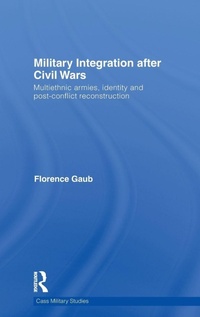
Military Integration after Civil Wars
Multiethnic Armies, Identity and Post-Conflict Reconstruction
1st Edition
Published on 2. September 2010
Book
Hardback
192 pages
978-0-415-58094-6 (ISBN)
Description
This book examines the role of multiethnic armies in post-conflict reconstruction, and demonstrates how they can promote peacebuilding efforts.
The author challenges the assumption that multiethnic composition leads to weakness of the military, and shows how a multiethnic army is frequently the impetus for peacemaking in multiethnic societies. Three case studies (Nigeria, Lebanon and Bosnia-Herzegovina) determine that rather than external factors, it is the internal structures that make or break the military institution in a socially challenging environment. The book finds that where the political will is present, the multiethnic military can become a symbol of reconciliation and coexistence. Furthermore, it shows that the military as a professional identity can supersede ethnic considerations and thus facilitates cooperation within the armed forces despite a hostile post-conflict setting. In this, the book challenges widespread theories about ethnic identities and puts professional identities on an equal footing with them.
The book will be of great interest to students of military studies, ethnic conflict, conflict studies and peacebuilding, and IR in general
Florence Gaub is a Researcher and Lecturer at the NATO Defence College in Rome. She holds a PhD in International Politics from Humboldt University, Berlin.
The author challenges the assumption that multiethnic composition leads to weakness of the military, and shows how a multiethnic army is frequently the impetus for peacemaking in multiethnic societies. Three case studies (Nigeria, Lebanon and Bosnia-Herzegovina) determine that rather than external factors, it is the internal structures that make or break the military institution in a socially challenging environment. The book finds that where the political will is present, the multiethnic military can become a symbol of reconciliation and coexistence. Furthermore, it shows that the military as a professional identity can supersede ethnic considerations and thus facilitates cooperation within the armed forces despite a hostile post-conflict setting. In this, the book challenges widespread theories about ethnic identities and puts professional identities on an equal footing with them.
The book will be of great interest to students of military studies, ethnic conflict, conflict studies and peacebuilding, and IR in general
Florence Gaub is a Researcher and Lecturer at the NATO Defence College in Rome. She holds a PhD in International Politics from Humboldt University, Berlin.
More details
Series
Language
English
Place of publication
London
United Kingdom
Publishing group
Taylor & Francis Ltd
Target group
College/higher education
Professional and scholarly
Illustrations
2 s/w Zeichnungen, 14 s/w Tabellen
14 Tables, black and white; 2 Line drawings, black and white
Dimensions
Height: 240 mm
Width: 161 mm
Thickness: 15 mm
Weight
458 gr
ISBN-13
978-0-415-58094-6 (9780415580946)
Copyright in bibliographic data and cover images is held by Nielsen Book Services Limited or by the publishers or by their respective licensors: all rights reserved.
Schweitzer Classification
Other editions
Additional editions
Florence Gaub
Military Integration after Civil Wars
Multiethnic Armies, Identity and Post-Conflict Reconstruction
Book
05/2012
1st Edition
Routledge
€82.20
Shipment within 15-20 days
Florence Gaub
Military Integration after Civil Wars
Multiethnic Armies, Identity and Post-Conflict Reconstruction
E-Book
09/2010
Routledge
€76.49
Available for download
Florence Gaub
Military Integration after Civil Wars
Multiethnic Armies, Identity and Post-Conflict Reconstruction
E-Book
09/2010
Routledge
€76.49
Available for download
Person
Florence Gaub is a Researcher and Lecturer at the NATO Defence College in Rome. She holds a PhD in International Politics from Humboldt University, Berlin.
Content
Introduction 1. The Armed Forces as a Social Agent 2. Case Study Nigerian Army: From Colonial to Political 3. Case Study Lebanese Armed Forces: From Powerlessness to Integration? 4. Case Study Armies of Bosnia-Herzegovina: A State in Transit 5. Military Integration after Civil War: An Assessment. Conclusion