

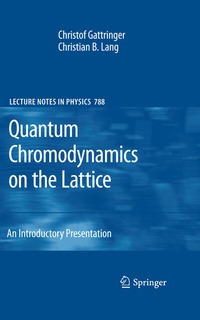
Quantum Chromodynamics on the Lattice
An Introductory Presentation
1st Edition
Published on 16. October 2009
Book
Hardback
XV, 343 pages
978-3-642-01849-7 (ISBN)
Description
Quantum chromodynamics (QCD) is the fundamental quantum ?eld theory of quarks and gluons. In order to discuss it in a mathematically well-de?ned way, the theory has to be regularized. Replacing space-time by a Euclidean lattice has proven to be an e?cient approach which allows for both theor- ical understanding and computational analysis. Lattice QCD has become a standard tool in elementary particle physics. Asthetitlealreadysays:thisbookisintroductory!Thetextisintendedfor newcomerstothe?eld,servingasastartingpoint.Wesimplywantedtohavea bookwhichwecanputintothehandsofanadvancedstudentfora?rstreading on lattice QCD. This imaginary student brings as a prerequisite knowledge of higher quantum mechanics, some continuum quantum ?eld theory, and basic facts of elementary particle physics phenomenology. In view of the wealth of applications in current research the topics p- sented here are limited and we had to make some painful choices. We discuss QCD but omit most other lattice ?eld theory applications like scalar th- ries, gauge-Higgs models, or electroweak theory.
Although we try to lead the reader up to present day understanding, we cannot possibly address all on- ing activities, in particular concerning the role of QCD in electroweak theory. Subjects like glueballs, topological excitations, and approaches like chiral p- turbation theory are mentioned only brie?y. This allows us to cover the other topics quite explicitly, including detailed derivations of key equations. The ?eld is rapidly developing. The proceedings of the annual lattice conferences provide information on newer directions and up-to-date results.
Although we try to lead the reader up to present day understanding, we cannot possibly address all on- ing activities, in particular concerning the role of QCD in electroweak theory. Subjects like glueballs, topological excitations, and approaches like chiral p- turbation theory are mentioned only brie?y. This allows us to cover the other topics quite explicitly, including detailed derivations of key equations. The ?eld is rapidly developing. The proceedings of the annual lattice conferences provide information on newer directions and up-to-date results.
Reviews / Votes
From the reviews:
"This is a very nice and readable book on lattice gauge theories. It is conceived for non-specialists in the field and is quite self-contained. . It is a modern, updated introduction to lattice gauge theory, very easy to consult and conceived in a modern way. This is an excellent textbook for students or anyone wishing to be introduced to the subject." (Giuseppe Nardelli, Mathematical Reviews, Issue 2010 k)More details
Series
Language
English
Place of publication
Berlin
Germany
Publishing group
Springer Berlin
Target group
Primary & secondary/elementary & high school
Graduate
Illustrations
34 s/w Abbildungen
XV, 343 p. 34 illus.
Dimensions
Height: 241 mm
Width: 160 mm
Thickness: 25 mm
Weight
705 gr
ISBN-13
978-3-642-01849-7 (9783642018497)
DOI
10.1007/978-3-642-01850-3
Schweitzer Classification
Other editions
Additional editions
Christof Gattringer | Christian B. Lang
Quantum Chromodynamics on the Lattice
An Introductory Presentation
Book
03/2012
1st Edition
Springer
€60.98
Shipment within 7-9 days
Christof Gattringer | Christian B. Lang
Quantum Chromodynamics on the Lattice
An Introductory Presentation
E-Book
10/2009
Springer
€60.98
Available for download
Persons
Content
The path integral on the lattice.- The path integral on the lattice.- QCD on the lattice - a first look.- QCD on the lattice - a first look.- Pure gauge theory on the lattice.- Pure gauge theory on the lattice.- Numerical simulation of pure gauge theory.- Numerical simulation of pure gauge theory.- Fermions on the lattice.- Fermions on the lattice.- Hadron spectroscopy.- Hadron spectroscopy.- Chiral symmetry on the lattice.- Chiral symmetry on the lattice.- Dynamical fermions.- Dynamical fermions.- Symanzik improvement and RG actions.- Symanzik improvement and RG actions.- More about lattice fermions.- More about lattice fermions.- Hadron structure.- Hadron structure.- Temperature and chemical potential.- Temperature and chemical potential.