

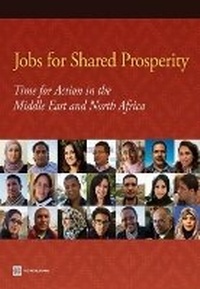
Jobs for Shared Prosperity
Time for Action in the Middle East and North Africa
Will be published approx. on 30. April 2013
Book
Paperback/Softback
348 pages
978-0-8213-9719-0 (ISBN)
Description
In the aftermath of the Arab Spring, when thousands of young women and men fought for the opportunity to realise their aspirations and potential, the question of jobs continues to be crucial in the Middle East and North Africa region. This report uses jobs as a lens to weave together the complex dynamics of employment creation, skills supply, and the institutional environment of labour markets.
Consistent with the framework of the 2013 World Development Report on jobs, of which this report is the regional companion, this work goes beyond the traditional links between jobs, productivity, and living standards to include an understanding of how jobs matter for individual dignity and expectations - an aspect that was clearly central to the Arab Spring. Just as important, this report complements the economic perspective with an analysis of political economy equilibrium, with a view to identifying mechanisms that would trigger a reform process.
As such, the report has three objectives:
1. It seeks to provide an in-depth characterisation of the dynamics of labour markets in the Middle East and North Africa and to analyse the barriers to the creation of more and better jobs. It does so by taking a cross-sectoral approach and identifying the distortions and incentives that the many actors, firms, governments, workers, students, education, and training systems currently face, and which ultimately determine the equilibrium in labour markets.
2. It proposes a medium term roadmap of policy options that could promote the robust and inclusive growth needed to tackle the structural employment challenge for the region.
3. It aims to inform and open up a platform for debate on jobs among a broad set of stakeholders, with the ultimate goal of contributing to reach a shared view of the employment challenges and the reform path ahead.
Consistent with the framework of the 2013 World Development Report on jobs, of which this report is the regional companion, this work goes beyond the traditional links between jobs, productivity, and living standards to include an understanding of how jobs matter for individual dignity and expectations - an aspect that was clearly central to the Arab Spring. Just as important, this report complements the economic perspective with an analysis of political economy equilibrium, with a view to identifying mechanisms that would trigger a reform process.
As such, the report has three objectives:
1. It seeks to provide an in-depth characterisation of the dynamics of labour markets in the Middle East and North Africa and to analyse the barriers to the creation of more and better jobs. It does so by taking a cross-sectoral approach and identifying the distortions and incentives that the many actors, firms, governments, workers, students, education, and training systems currently face, and which ultimately determine the equilibrium in labour markets.
2. It proposes a medium term roadmap of policy options that could promote the robust and inclusive growth needed to tackle the structural employment challenge for the region.
3. It aims to inform and open up a platform for debate on jobs among a broad set of stakeholders, with the ultimate goal of contributing to reach a shared view of the employment challenges and the reform path ahead.
More details
Language
English
Place of publication
Washington
United States
Target group
College/higher education
Professional and scholarly
Dimensions
Height: 266 mm
Width: 203 mm
Thickness: 20 mm
Weight
1060 gr
ISBN-13
978-0-8213-9719-0 (9780821397190)
Copyright in bibliographic data and cover images is held by Nielsen Book Services Limited or by the publishers or by their respective licensors: all rights reserved.
Schweitzer Classification