

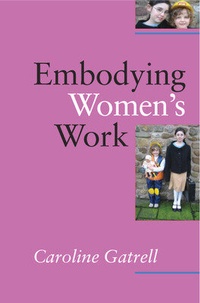
Embodying Women's Work
Published on 16. October 2008
Book
Paperback/Softback
224 pages
978-0-335-21990-2 (ISBN)
Description
What is the relationship between women's reproductive bodies and women's productive work?How does women's potential for maternity affect women's workplace opportunity?How far can women 'choose' and maintain their own embodied boundaries in relation to work and working practices?
This fascinating and topical book evaluates the growing debate on gender, women's bodies, and work. Through the lens of the body - and from a feminist perspective - Gatrell considers women's work from two angles, the first conceptualizing the labour of maternity as women's work, the second exploring the dynamics between women's bodies and employment.The author suggests that maternity constitutes women's work, with some women 'expected' to produce children, while others are criticised for giving birth. She calls for the re-conceptualization of pregnancy, birth and breastfeeding as forms of labour - asserting that mothers are required to perform particular forms of body work in order to comply with ideals of 'good' mothering and norms of the workplace. The book observes that these are conflicting requirements, which place irreconcilable demands on women and constrain women's choice.At the heart of Embodying Women's Work is the idea that women's bodies are central to gendered power relations, and remain a negotiated site of power between men and women within late modern society. The book considers women's bodies in the context of different forms of paid work, discussing how far women remain at an economic disadvantage in comparison with male workers. Embodying Women's Work is of key interest for students and academics of sociology, social welfare and women's studies.
This fascinating and topical book evaluates the growing debate on gender, women's bodies, and work. Through the lens of the body - and from a feminist perspective - Gatrell considers women's work from two angles, the first conceptualizing the labour of maternity as women's work, the second exploring the dynamics between women's bodies and employment.The author suggests that maternity constitutes women's work, with some women 'expected' to produce children, while others are criticised for giving birth. She calls for the re-conceptualization of pregnancy, birth and breastfeeding as forms of labour - asserting that mothers are required to perform particular forms of body work in order to comply with ideals of 'good' mothering and norms of the workplace. The book observes that these are conflicting requirements, which place irreconcilable demands on women and constrain women's choice.At the heart of Embodying Women's Work is the idea that women's bodies are central to gendered power relations, and remain a negotiated site of power between men and women within late modern society. The book considers women's bodies in the context of different forms of paid work, discussing how far women remain at an economic disadvantage in comparison with male workers. Embodying Women's Work is of key interest for students and academics of sociology, social welfare and women's studies.
More details
Person
Caroline Gatrell is Lecturer in Management Learning and Leadership in the Management School at Lancaster University, UK. She is author of Hard Labour: The Sociology of Parenthood (Open University Press, 2005) and Managing Part-time Study (Open University Press, 2006).
Content
1Introduction 'Embodying Women's Work'
2Positioning Women's Bodies within Sociology
3Who May Labour? Reproduction and the 'right' body
4Pregnancy Work: Narratives of 'good' mothering and the embodied norms of the workplace
5Love is Not Enough: Birth, breastfeeding and employment
6To Honour and Obey: An overview of women's productive work
7Angels in The House: Politicians and professionals
8Angels in the house: Cleaning and caring
9I'm Mandy, Fly Me: Women, sexuality and paid work
10A Force to be Reckoned With: Women in uniform
11 Conclusions
2Positioning Women's Bodies within Sociology
3Who May Labour? Reproduction and the 'right' body
4Pregnancy Work: Narratives of 'good' mothering and the embodied norms of the workplace
5Love is Not Enough: Birth, breastfeeding and employment
6To Honour and Obey: An overview of women's productive work
7Angels in The House: Politicians and professionals
8Angels in the house: Cleaning and caring
9I'm Mandy, Fly Me: Women, sexuality and paid work
10A Force to be Reckoned With: Women in uniform
11 Conclusions