

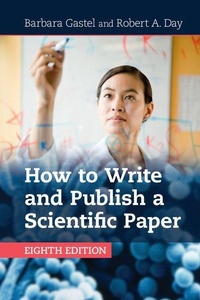
How to Write and Publish a Scientific Paper
8th Edition
Published on 2. March 2017
Book
Paperback/Softback
344 pages
978-1-316-64043-2 (ISBN)
Description
An essential guide for succeeding in today's competitive environment, this book provides beginning scientists and experienced researchers with practical advice on writing about their work and getting published. This brand new, updated edition also includes a new chapter on editing one's own work, a section on publicizing and archiving one's paper, and updates on authorship, including information on new authorship criteria and on the author identification number ORCID. The book guides readers through the processes involved in writing for and publishing in scientific journals, from choosing a suitable journal, to writing each part of the paper, to submitting the paper and responding to peer review, through checking the proofs. It covers ethical issues in scientific publishing, explains rights and permissions, and discusses writing grant proposals, giving presentations and writing for general audiences.
Reviews / Votes
'The evolution of digital publishing has revolutionized the scientific publishing landscape, which made a new revised edition necessary (the previous one is from 2011). New items are, for example, the ORCID (that is a unique digital identifier distinguishing an author from any other researcher), the archiving of your (published) paper, warnings against predatory journals, digital poster presentations. There is also a new chapter on editing your own work before publishing ... The intended readership is obviously the community of students who did not publish before, so the whole process is explained including the selection of a journal, submitting your paper, the refereeing, and how to react to it, and finally the post-refereeing stage of proofreading and publishing. ... Also how to write a book review, give an interview, or write a book proposal. And for the really ambitious, how to become a science communicator.' Adhemar Bultheel, European Mathematical SocietyMore details
Edition
8th Revised edition
Language
English
Place of publication
Cambridge
United Kingdom
Target group
Professional and scholarly
Edition type
Revised edition
Product notice
Paperback (trade)
Illustrations
Worked examples or Exercises; 27 Line drawings, black and white
Dimensions
Height: 229 mm
Width: 152 mm
Thickness: 19 mm
Weight
508 gr
ISBN-13
978-1-316-64043-2 (9781316640432)
Copyright in bibliographic data and cover images is held by Nielsen Book Services Limited or by the publishers or by their respective licensors: all rights reserved.
Schweitzer Classification
Other editions
New editions
Barbara Gastel | Robert A. Day
How to Write and Publish a Scientific Paper
Book
04/2024
9th Edition
Cambridge University Press
€37.90
Shipment within 15-20 days
Previous edition
Robert A. Day | Barbara Gastel
How to Write and Publish a Scientific Paper
Book
06/2012
7th Edition
Cambridge University Press
€40.84
Article exhausted; check for reprint
Persons
Barbara Gastel is Professor of Veterinary Integrative Biosciences, Humanities in Medicine, and Biotechnology at Texas A & M University. She has received awards and recognitions from the American Medical Writers Association, the Board of Editors in the Life Sciences, the Council of Science Editors, and Sigma Xi: The Scientific Research Society. Robert A. Day is Professor Emeritus of English at the University of Delaware, where he taught graduate and undergraduate courses in scientific writing. He has directed the publishing program of the American Society for Microbiology and served as managing editor of the Journal of Bacteriology. He also has been president of the Society for Scholarly Publishing and chairman of the Council of Biology Editors.
Content
Preface; A word to international readers; Acknowledgments; Part I. Some Preliminaries: 1. What is scientific writing?; 2. Historical perspectives; 3. Approaching a writing project; 4. What is a scientific paper?; 5. Ethics in scientific publishing; 6. Where to submit your manuscript; Part II. Preparing the Text: 7. How to prepare the title; 8. How to list the authors and addresses; 9. How to prepare the abstract; 10. How to write the introduction; 11. How to write the materials and methods section; 12. How to write the results; 13. How to write the discussion; 14. How to state the acknowledgments; 15. How to cite the references; Part III. Preparing the Tables and Figures: 16. How to design effective tables; 17. How to prepare effective graphs; 18. How to prepare effective photographs; Part IV. Publishing the Paper: 19. Rights and permissions; 20. How to submit the manuscript; 21. The review process (how to deal with editors); 22. The publishing process (how to deal with proofs) - and after publication; Part V. Doing Other Writing for Publication: 23. How to write a review paper; 24. How to write opinion (letters to the editor, editorials, and book reviews); 25. How to write a book chapter or a book; 26. How to write for the public; Part VI. Conference Communications: 27. How to present a paper orally; 28. How to prepare a poster; 29. How to write a conference report; Part VII. Scientific Style: 30. Use and misuse of English; 31. Avoiding jargon; 32. How and when to use abbreviations; 33. Writing clearly across cultures and media; 34. How to write science in English as a foreign language; Part VIII. Other Topics in Scientific Communication: 35. How to write a thesis; 36. How to prepare a curriculum vitae, cover letter, and personal statement; 37. How to prepare grant proposals and progress reports; 38. How to write a recommendation letter - and how to ask for one; 39. How to work with the media; 40. How to provide peer review; 41. How to edit your own work; 42. How to seek a scientific-communication career; Appendix 1. Selected journal title word abbreviations; Appendix 2. Words and expressions to avoid; Appendix 3. SI (Systeme International) prefixes and their abbreviations; Appendix 4. Some helpful websites; Glossary; References; Index.