

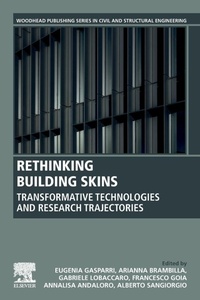
Rethinking Building Skins
Transformative Technologies and Research Trajectories
Published on 8. December 2021
Book
Paperback/Softback
594 pages
978-0-12-822477-9 (ISBN)
Description
Rethinking Building Skins: Transformative Technologies and Research Trajectories provides a comprehensive collection of the most relevant and forward-looking research in the field of facade design and construction today, with a focus on both product and process innovation. The book brings together the expertise, creativity, and critical thinking of more than fifty global innovators from both academia and industry, to guide the reader in translating research into practice. It identifies new opportunities for the construction sector to respond to present challenges, towards a more sustainable, efficient, connected, and safe future.
More details
Series
Language
English
Place of publication
United States
Publishing group
Elsevier Science Publishing Co Inc
Target group
Professional and scholarly
Product notice
Paperback (trade)
Illustrations
13 illustrations (8 in full color); Illustrations
Dimensions
Height: 226 mm
Width: 150 mm
Thickness: 30 mm
Weight
942 gr
ISBN-13
978-0-12-822477-9 (9780128224779)
Copyright in bibliographic data and cover images is held by Nielsen Book Services Limited or by the publishers or by their respective licensors: all rights reserved.
Schweitzer Classification
Other editions
Additional editions
Eugenia Gasparri | Arianna Brambilla | Gabriele Lobaccaro
Rethinking Building Skins
Transformative Technologies and Research Trajectories
E-Book
12/2021
Woodhead Publishing
€155.00
Available for download
Persons
Eugenia Gasparri is a Lecturer in Architectural Technologies at the University of Sydney. Her research experience is in the field of sustainable construction with a focus on envelope design, building prefabrication, and mass-timber technologies. Arianna Brambilla is a Lecturer in Architecture at the University of Sydney. Her research draws upon architecture, building physics, and engineering to assess and interpret construction as a holistic concept, with a strong focus on sustainability. Gabriele is an emerging researcher in renewable energy, with a focus on the
digitalization of solar energy in the built environment. His background is
grounded on building engineer and architecture knowledge and his expertise
convers solar energy systems integration at building and district level, urban
energy planning, smart cities, climate-based solutions, mitigation, and adaptation
strategies, and environmental, microclimate, and energy analyses.
He is contributing to advance the state-of-the-art of solar energy exploration
and integration through the definition of solar neighborhoods' archetypes,
approaches, methods, and tools to accelerate the use of solar energy in
built environments. Gabriele coordinated the Subtask C "Case studies and
action research? in the IEA Task 51 Solar Energy in Urban Planning and
now he is coordinating the Subtask D "Case studies? in the IEA Task 63
Solar Neighbourhood Planning and the activity A3 - BIPV in our society
within IEA PVPS Task 15 - Enabling Framework for the Development of
BIPV. Gabriele has experienced in several national (REINVENT and
HELIOS), European (Exploit4InnoMat, RAMSES, and CoSSMic), and international
research projects (SEniC, SiNoPSE, and iSTAR). Gabriele has co-/
author of more than 65 publications, including research and review articles
in international high-impact peer-reviewed journals, national and international
conference proceedings, book chapters, and books. Francesco Goia is a Professor of Building Physics at the Norwegian University of Science and Technology. His research focuses on advanced building envelopes and services providing high energy efficiency and indoor climate performance. Annalisa Andaloro is a Senior Researcher at the Institute for Renewable Energy in EURAC, focusing on system integration and project economics. She coordinates an executive international training course on facade architecture, construction, and engineering (FACE). Alberto Sangiorgio is an Associate at Grimshaw Architects (Sydney) where he operates as facade engineer and sustainability manager. He has extensive international experience in the design, optimization, and construction of high-performing building envelopes.
digitalization of solar energy in the built environment. His background is
grounded on building engineer and architecture knowledge and his expertise
convers solar energy systems integration at building and district level, urban
energy planning, smart cities, climate-based solutions, mitigation, and adaptation
strategies, and environmental, microclimate, and energy analyses.
He is contributing to advance the state-of-the-art of solar energy exploration
and integration through the definition of solar neighborhoods' archetypes,
approaches, methods, and tools to accelerate the use of solar energy in
built environments. Gabriele coordinated the Subtask C "Case studies and
action research? in the IEA Task 51 Solar Energy in Urban Planning and
now he is coordinating the Subtask D "Case studies? in the IEA Task 63
Solar Neighbourhood Planning and the activity A3 - BIPV in our society
within IEA PVPS Task 15 - Enabling Framework for the Development of
BIPV. Gabriele has experienced in several national (REINVENT and
HELIOS), European (Exploit4InnoMat, RAMSES, and CoSSMic), and international
research projects (SEniC, SiNoPSE, and iSTAR). Gabriele has co-/
author of more than 65 publications, including research and review articles
in international high-impact peer-reviewed journals, national and international
conference proceedings, book chapters, and books. Francesco Goia is a Professor of Building Physics at the Norwegian University of Science and Technology. His research focuses on advanced building envelopes and services providing high energy efficiency and indoor climate performance. Annalisa Andaloro is a Senior Researcher at the Institute for Renewable Energy in EURAC, focusing on system integration and project economics. She coordinates an executive international training course on facade architecture, construction, and engineering (FACE). Alberto Sangiorgio is an Associate at Grimshaw Architects (Sydney) where he operates as facade engineer and sustainability manager. He has extensive international experience in the design, optimization, and construction of high-performing building envelopes.
Editor
Lecturer in Architectural Technologies, School of Architecture, Design, and Planning, University of Sydney, NSW, Australia
Lecturer in Architecture, School of Architecture, Design, and Planning, University of Sydney, NSW, Australia.
Associate Professor, Department of Civil and Environmental Engineering, Norwegian University of Science and Technology (NTNU), Norway
Professor, Building Physics, Faculty of Architecture and Design, Norwegian University of Science and Technology (NTNU), Trondheim, Norway
Senior Researcher, Institute for Renewable Energy, EURAC Research, Bolzano, Italy.
Associate and Sustainability Manager, Grimshaw Architects, Sydney, NSW, Australia
Content
1. Facade Innovation: Past, Present, Future
2. Facade Innovation: An Industry Perspective
Part A: Product Innovation
3. New and Innovative Cool Coatings for Urban Overheating Mitigation through Facades
4. The Pursuit of Transparency
5. Advanced Fenestration: Technologies, Performance, and Building Integration
6. Embedding Intelligence to Control Adaptive Building Envelope
7. Biomimetic Adaptive Building Skins: Design and Performance
8. Building Integrated Photovoltaic Facades: Challenges, Opportunities, and Innovations
9. Unitised Timber Envelopes: The Future Generation of Industrialised, High-Performance, Sustainable Facades for Construction Decarbonisation
10. Industrialised Building Envelopes for Renovation: Realizing the Potential to Decarbonise the European Building Stock
11. Vertical Farming on Facades: Transforming Building Skins for Urban Food Security
12. Interactive Media Facades: Research Prototypes, Application Areas, and Future Directions
Part B: Process Innovation
13. The Building Envelope: Failing to Understand Complexity in Tall Building Design
14. Resilience by Design: Building Facades for Tomorrow
15. Inverse Design for Advanced Building Envelope Materials, Systems, and Operation
16. Towards Automated Design: Knowledge Based Engineering in Facades
17. Additive Manufacturing in Skin Systems: Trends and Future Perspectives
18. Mass-Customization as the Convergent Vision for the Digital Transformation of the Manufacturing and the Building Industry
19. Automation and Robotic Technologies in the Construction Context: Research Experience in Prefabricated Facade Modules
20. Life Cycle Assessment in Facade Design
21. Circular Economy in Facades
22. Facades-as-a-Service: A Business and Supply-Chain Model for the Implementation of a Circular Facade Economy
2. Facade Innovation: An Industry Perspective
Part A: Product Innovation
3. New and Innovative Cool Coatings for Urban Overheating Mitigation through Facades
4. The Pursuit of Transparency
5. Advanced Fenestration: Technologies, Performance, and Building Integration
6. Embedding Intelligence to Control Adaptive Building Envelope
7. Biomimetic Adaptive Building Skins: Design and Performance
8. Building Integrated Photovoltaic Facades: Challenges, Opportunities, and Innovations
9. Unitised Timber Envelopes: The Future Generation of Industrialised, High-Performance, Sustainable Facades for Construction Decarbonisation
10. Industrialised Building Envelopes for Renovation: Realizing the Potential to Decarbonise the European Building Stock
11. Vertical Farming on Facades: Transforming Building Skins for Urban Food Security
12. Interactive Media Facades: Research Prototypes, Application Areas, and Future Directions
Part B: Process Innovation
13. The Building Envelope: Failing to Understand Complexity in Tall Building Design
14. Resilience by Design: Building Facades for Tomorrow
15. Inverse Design for Advanced Building Envelope Materials, Systems, and Operation
16. Towards Automated Design: Knowledge Based Engineering in Facades
17. Additive Manufacturing in Skin Systems: Trends and Future Perspectives
18. Mass-Customization as the Convergent Vision for the Digital Transformation of the Manufacturing and the Building Industry
19. Automation and Robotic Technologies in the Construction Context: Research Experience in Prefabricated Facade Modules
20. Life Cycle Assessment in Facade Design
21. Circular Economy in Facades
22. Facades-as-a-Service: A Business and Supply-Chain Model for the Implementation of a Circular Facade Economy