

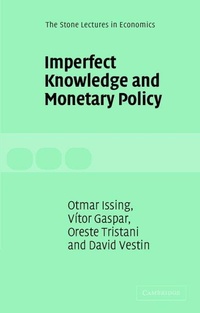
Imperfect Knowledge and Monetary Policy
Published on 16. February 2006
Book
Paperback/Softback
152 pages
978-0-521-67107-1 (ISBN)
Description
Based on lectures given as part of The Stone Lectures in Economics, this book discusses the problem of formulating monetary policy in practice, under the uncertain circumstances which characterize the real world. The first lecture highlights the limitations of decision rules suggested by the academic literature and recommends an approach involving, first, a firm reliance on the few fundamental and robust results of monetary economics and, secondly, a pragmatic attitude to policy implementation, taking into consideration lessons from central banking experience. The second lecture revisits Milton Friedman's questions about the effects of active stabilization policies on business cycle fluctuations. It explores the implications of a simple model where the policy maker has imperfect knowledge about potential output and the private sector forms expectations according to adaptive learning. This lecture shows that imperfect knowledge limits the scope for active stabilization policy and strengthens the case for conservatism.
Reviews / Votes
'Uncertainty is the one constant facing central bankers. In this fascinating discussion of monetary policy making under uncertainty, Otmar Issing and Vitor Gaspar expose the limitations of much academic thinking on the subject and show how the ECB's monetary strategy represents a pragmatic response to the problems thrown up by our inevitably imperfect knowledge of the economy.' Charles Bean, Chief Economist and Executive Director, Bank of England ' ... the book is commendable in its attempt to explain, through examples, the actual application of monetary policy and how real problems are tackled.' De EconomistMore details
Series
Language
English
Place of publication
Cambridge
United Kingdom
Target group
Professional and scholarly
Product notice
Paperback (trade)
Illustrations
1 Tables, unspecified
Dimensions
Height: 216 mm
Width: 140 mm
Thickness: 8 mm
Weight
201 gr
ISBN-13
978-0-521-67107-1 (9780521671071)
Copyright in bibliographic data and cover images is held by Nielsen Book Services Limited or by the publishers or by their respective licensors: all rights reserved.
Schweitzer Classification
Other editions
Additional editions
Vitor Gaspar | Otmar Issing | Oreste Tristani
Imperfect Knowledge and Monetary Policy
E-Book
04/2006
1st Edition
Cambridge University Press
€32.49
Available for download
Persons
Otmar Issing is a member of the Executive Board, European Central Bank. Vitor Gaspar is Special Advisor, Banco de Portugal. Oreste Tristani is Principal Economist, DG Research, European Central Bank. David Vestin is Economist, DG Research, European Central Bank.
Content
Acknowledgments; Introduction; Outline of the two lectures; First lecture: Monetary Policy in Uncharted Territory. 1. Introduction; 2. Uncharted territory: unique historical events; 3. Achieving price stability; 4. Avoiding excess volatility in inflation, output and the interest rate; 5. Pragmatic monetarism: The Bundesbank; 6. A stability-oriented strategy: the ECB; 7. Conclusions; Second lecture: Imperfect Knowledge, Learning and Conservatism. 1. Introduction; 2. Time inconsistency, cost-push shocks and Rogoff's conservatism; 3. Empirical output gap uncertainty; 4. Output gap uncertainty, learning and conservatism; 5. Different degrees of CB's knowledge and information; 6. Conclusions; References.