

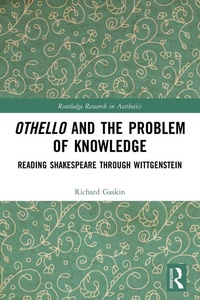
Othello and the Problem of Knowledge
Reading Shakespeare through Wittgenstein
1st Edition
Published on 26. August 2024
Book
Paperback/Softback
140 pages
978-1-032-42494-1 (ISBN)
Description
This book analyses the epistemological problems that Shakespeare explores in Othello. In particular, it uses the methods of analytic philosophy, especially the work of the later Wittgenstein, to characterize these problems and the play.
Shakespeare's Othello is often thought to connect with traditional sceptical problems, and in particular with the problem of other minds. In this book, Richard Gaskin argues that the play does indeed connect in interesting-but also in surprising and so far relatively unexplored-ways with traditional epistemological concerns. Shakespeare presupposes a generally Wittgensteinian model of mind as revealed in behaviour, and communication as necessarily successful in general. Gaskin examines different epistemological models of the tragedy, and argues that it is useful to apply materials from Wittgenstein's On Certainty to the analysis of Othello's loss of confidence in Desdemona's fidelity: Othello treats Desdemona's fidelity as a 'hinge certainty', something that is so fundamental to the language-game that abandoning it results-so Wittgenstein predicts-in chaos and madness. The tragedy arises, Gaskin suggests, from treating the wrong kind of thing as a hinge certainty.
Othello and the Problem of Knowledge will appeal to scholars and advanced students interested in aesthetics, epistemology, philosophy of literature, Shakespeare, and Wittgenstein.
Shakespeare's Othello is often thought to connect with traditional sceptical problems, and in particular with the problem of other minds. In this book, Richard Gaskin argues that the play does indeed connect in interesting-but also in surprising and so far relatively unexplored-ways with traditional epistemological concerns. Shakespeare presupposes a generally Wittgensteinian model of mind as revealed in behaviour, and communication as necessarily successful in general. Gaskin examines different epistemological models of the tragedy, and argues that it is useful to apply materials from Wittgenstein's On Certainty to the analysis of Othello's loss of confidence in Desdemona's fidelity: Othello treats Desdemona's fidelity as a 'hinge certainty', something that is so fundamental to the language-game that abandoning it results-so Wittgenstein predicts-in chaos and madness. The tragedy arises, Gaskin suggests, from treating the wrong kind of thing as a hinge certainty.
Othello and the Problem of Knowledge will appeal to scholars and advanced students interested in aesthetics, epistemology, philosophy of literature, Shakespeare, and Wittgenstein.
More details
Series
Language
English
Place of publication
London
United Kingdom
Publishing group
Taylor & Francis Ltd
Target group
College/higher education
Professional and scholarly
Academic, Postgraduate, and Undergraduate Advanced
Dimensions
Height: 229 mm
Width: 152 mm
Thickness: 8 mm
Weight
228 gr
ISBN-13
978-1-032-42494-1 (9781032424941)
Copyright in bibliographic data and cover images is held by Nielsen Book Services Limited or by the publishers or by their respective licensors: all rights reserved.
Schweitzer Classification
Other editions
Additional editions
Book
03/2023
1st Edition
Routledge
€185.50
Shipment within 10-20 days
E-Book
03/2023
1st Edition
Routledge
€53.99
Available for download
E-Book
03/2023
1st Edition
Routledge
€53.99
Available for download
Person
Richard Gaskin is Professor of Philosophy at the University of Liverpool, UK. He has published extensively in metaphysics, philosophy of language, philosophy of literature, literary theory and criticism, and the classical tradition. His books include Language and World: A Defence of Linguistic Idealism (Routledge, 2020), Tragedy and Redress in Western Literature: A Philosophical Perspective (Routledge, 2018), and Language, Truth, and Literature: A Defence of Literary Humanism (2013).
Content
1. Shakespeare, Descartes, and Scepticism 2. Mind, Communication, and Deception 3. Deception, Soliloquy, and Knowledge 4. Epistemological Models of the Tragedy (I): Loss of Knowledge 5. Context, Scepticism, and the Philosophy Room 6. Epistemological Models of the Tragedy (II): Loss of Certainty 7. Certainty, Hinges, and the Counterfactual 8. Epilogue