

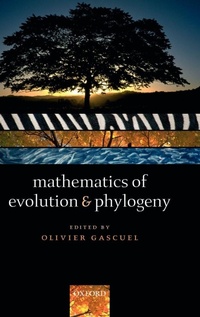
Mathematics of Evolution and Phylogeny
Published on 24. February 2005
Book
Hardback
444 pages
978-0-19-856610-6 (ISBN)
Description
This book considers evolution at different scales: sequences, genes, gene families, organelles, genomes and species. The focus is on the mathematical and computational tools and concepts, which form an essential basis of evolutionary studies, indicate their limitations, and give them orientation. Recent years have witnessed rapid progress in the mathematics of evolution and phylogeny, with models and methods becoming more realistic, powerful, and complex.
Aimed at graduates and researchers in phylogenetics, mathematicians, computer scientists and biologists, and including chapters by leading scientists: A. Bergeron, D. Bertrand, D. Bryant, R. Desper, O. Elemento, N. El-Mabrouk, N. Galtier, O. Gascuel, M. Hendy, S. Holmes, K. Huber, A. Meade, J. Mixtacki, B. Moret, E. Mossel, V. Moulton, M. Pagel, M.-A. Poursat, D. Sankoff, M. Steel, J. Stoye, J. Tang, L.-S. Wang, T. Warnow, Z. Yang, this book of contributed chapters explains the basis and covers the recent results in this highly topical area.
Aimed at graduates and researchers in phylogenetics, mathematicians, computer scientists and biologists, and including chapters by leading scientists: A. Bergeron, D. Bertrand, D. Bryant, R. Desper, O. Elemento, N. El-Mabrouk, N. Galtier, O. Gascuel, M. Hendy, S. Holmes, K. Huber, A. Meade, J. Mixtacki, B. Moret, E. Mossel, V. Moulton, M. Pagel, M.-A. Poursat, D. Sankoff, M. Steel, J. Stoye, J. Tang, L.-S. Wang, T. Warnow, Z. Yang, this book of contributed chapters explains the basis and covers the recent results in this highly topical area.
Reviews / Votes
It is great value for graduate students and researchers in phylogeny, and it offers a wide field for applied mathematicians. * EMS Newsletter in phylogeny, and it offers a wide field for applied mathematicians.EMS Newsletter * This book gives us an interesting glimpse of how work on phylogenies will be preceived by mathematicians, computer scientists, and statisticians. * Evolution, 60(4) * ...an important contribution because it highlights the analysis of evolutionary problems as potential research avenues in applied mathematics. * Systematic Biology, Vol 55 * Mathematics of Evolution and Phylogeny is a valuable research tool for postgraduate students and researchers wanting an in-depth, overall introduction of the topics that it covers. * Charles Semple, Trends in Ecology and Evolution, Vol 20 No 9 * ...the volume is an important contribution because it highlights the analysis of evolutionary problems as potential research avenues in applied mathematics. * Systematic Biology * Aimed at mathematicians, computer scientists, and statisticians, the book should serve them well as an introduction to phylogenies. * Evolution, Joe Felsenstein *More details
Language
English
Place of publication
Oxford
United Kingdom
Target group
Professional and scholarly
Aimed at graduates and researchers in phylogenetics, this book will be of interest to both mathematicians and biologists.
Illustrations
numerous line drawings and mathematical examples
Dimensions
Height: 240 mm
Width: 161 mm
Thickness: 28 mm
Weight
828 gr
ISBN-13
978-0-19-856610-6 (9780198566106)
Copyright in bibliographic data and cover images is held by Nielsen Book Services Limited or by the publishers or by their respective licensors: all rights reserved.
Schweitzer Classification
Other editions
Additional editions
Olivier Gascuel
Mathematics of Evolution and Phylogeny
Book
10/2007
Oxford University Press
€95.50
Shipment within 15-20 days
Person
Content
Introduction ; 1. The minimum evolution distance-based approach of phylogenetic inference ; 2. Likelihood calculation in molecular phylogenetics ; 3. Bayesian inference in molecular phylogenetics ; 4. Statistical approaches to test involving phylogenetics ; 5. Mixture models in phylogenetic inference ; 6. Hadamard conjugation: an analytic tool for phylogenetics ; 7. Phylogenetic networks ; 8. Recontructing the duplication history of tandemly repeated sequences ; 9. Conserved segment statistics and rearrangement inferences in comparative genomics ; 10. The inversion distance problem ; 11. Genome rearrangement with gene families ; 12. Reconstructing phylogenies from gene-content and gene-order data ; 13. Distance-based genome rearrangement phylogeny ; 14. How much can evolved characters tell us about the tree that generated them?