

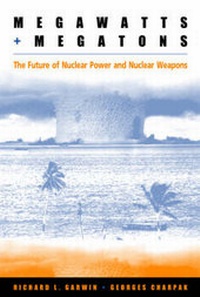
Megawatts and Megatons
A Turning Point for the Nuclear Age?
Published on 15. December 2002
Book
Paperback/Softback
412 pages
978-0-226-28427-9 (ISBN)
Description
In Megawatts and Megatons, world-renowned physicists Richard L. Garwin and Georges Charpak offer an accessible, eminently well-informed primer on two of the most important issues of our time: nuclear weapons and nuclear power. They begin by explaining clearly and concisely how nuclear fission and fusion work in both warheads and reactors, and how they can impact human health. Making a strong and eloquent argument in favor of arms control, Garwin and Charpak outline specific strategies for achieving this goal worldwide. But they also demonstrate how nuclear power can provide an assured, economically feasible, and environmentally responsible source of energy - in a way that avoids the hazards of weapons proliferation. Numerous figures enliven the text, including cartoons by Sempe.
Reviews / Votes
"A pleasure to read.... Should be studied by everyone concerned with the problems of nuclear power." - Stuart Young, Nature "The world certainly needs an authoritative introduction to issues of nuclear power and nuclear weapons for the intelligent and concerned layperson. With this book, Richard L. Garwin and Georges Charpak have done the best job at providing such an account to date." - Frank N. von Hippel, ScienceMore details
Language
English
Place of publication
Chicago
United States
Publishing group
The University of Chicago Press
Target group
Professional and scholarly
Illustrations
55 halftones, 16 tables
Dimensions
Height: 229 mm
Width: 152 mm
Weight
578 gr
ISBN-13
978-0-226-28427-9 (9780226284279)
Copyright in bibliographic data and cover images is held by Nielsen Book Services Limited or by the publishers or by their respective licensors: all rights reserved.
Schweitzer Classification
Persons
Richard L. Garwin is the Philip D. Reed Senior Fellow for Science and Technology at the Council on Foreign Relations and an adjunct professor of physics at Columbia University. In 1996 he received the Enrico Fermi Award. Georges Charpak has long worked at the European Center for Particle Physics at CERN in Geneva. He received the Nobel Prize in 1992 for his invention of electronic detectors of ionizing particles, used widely in science and industry.