

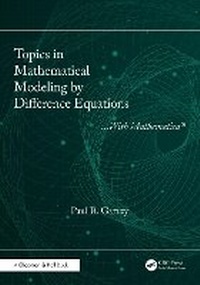
Topics in Mathematical Modeling by Difference Equations
With Mathematica
1st Edition
Will be published approx. on 23. October 2026
Book
Paperback/Softback
568 pages
978-1-041-11047-7 (ISBN)
Description
"This is the best introductory book that I have seen to help one learn about and understand the mathematics and applications of difference equations. I wish it was available when I was a student."
-Professor Ronald E. Mickens
"This book shows a wonderful synergism between difference equations and mathematical modeling."
-Professor Nancy Rallis
Across the vast array of topics in applied mathematics, difference equations stand out as essential tools for analyzing and understanding discrete systems and processes. Their applications span diverse fields: from modeling biological population dynamics to economic systems, numerical approximations of differential equations, and even supply chain optimization. The versatility of difference equations underscores their relevance in tackling a wide range of disciplines and real-world challenges.
Mathematical Modeling by Difference Equation with Mathematica seeks to illuminate this powerful framework by integrating theoretical insights with practical applications. It serves two primary goals: to provide a clear introduction to the calculus of finite differences and first-order difference equations, and to guide readers toward advanced methods for deeper exploration. This text is written for undergraduate students in mathematics, business, economics, and other quantitative sciences.
Researchers and professionals who use mathematical modeling in their work, and anyone intrigued by the role of mathematics in understanding discrete systems, will also find tremendous value in this text.
Features
Numerous exercises and worked examples with solutions provided
Appendix including samples of the Mathematica code used in the book
Extensive real-world applications with examples from fields as diverse as physics, biology, and economics.
-Professor Ronald E. Mickens
"This book shows a wonderful synergism between difference equations and mathematical modeling."
-Professor Nancy Rallis
Across the vast array of topics in applied mathematics, difference equations stand out as essential tools for analyzing and understanding discrete systems and processes. Their applications span diverse fields: from modeling biological population dynamics to economic systems, numerical approximations of differential equations, and even supply chain optimization. The versatility of difference equations underscores their relevance in tackling a wide range of disciplines and real-world challenges.
Mathematical Modeling by Difference Equation with Mathematica seeks to illuminate this powerful framework by integrating theoretical insights with practical applications. It serves two primary goals: to provide a clear introduction to the calculus of finite differences and first-order difference equations, and to guide readers toward advanced methods for deeper exploration. This text is written for undergraduate students in mathematics, business, economics, and other quantitative sciences.
Researchers and professionals who use mathematical modeling in their work, and anyone intrigued by the role of mathematics in understanding discrete systems, will also find tremendous value in this text.
Features
Numerous exercises and worked examples with solutions provided
Appendix including samples of the Mathematica code used in the book
Extensive real-world applications with examples from fields as diverse as physics, biology, and economics.
Reviews / Votes
"This is the best introductory book that I have seen to help one learn about and understand the mathematics and applications of difference equations. I wish it was available when I was a student."-Professor Ronald E. Mickens
"This book shows a wonderful synergism between difference equations and mathematical modeling."
-Professor Nancy Rallis
More details
Language
English
Place of publication
London
United Kingdom
Publishing group
Taylor & Francis Ltd
Target group
College/higher education
Undergraduate Advanced
Illustrations
84 farbige Abbildungen, 3 Farbfotos bzw. farbige Rasterbilder, 28 s/w Zeichnungen, 81 farbige Zeichnungen, 10 s/w Tabellen, 1 farbige Tabelle, 28 s/w Abbildungen
1 Tables, color; 10 Tables, black and white; 81 Line drawings, color; 28 Line drawings, black and white; 3 Halftones, color; 84 Illustrations, color; 28 Illustrations, black and white
Dimensions
Height: 254 mm
Width: 178 mm
ISBN-13
978-1-041-11047-7 (9781041110477)
Copyright in bibliographic data and cover images is held by Nielsen Book Services Limited or by the publishers or by their respective licensors: all rights reserved.
Schweitzer Classification
Other editions
Additional editions
Book
approx. 10/2026
1st Edition
CRC Press
€197.50
Not yet published
E-Book
approx. 10/2026
Chapman and Hall
€78.99
Not yet available
E-Book
approx. 10/2026
Chapman and Hall
€78.99
Not yet available
Person
Paul R. Garvey, Ph.D., is a Distinguished Chief Scientist at The MITRE Corporation, a not-for-profit organization that operates federally funded research and development centers in support of the U.S. government. He is the author of more than 30 peer-reviewed publications and four textbooks published by Chapman & Hall/CRC Press.
His academic and teaching experience spans both mathematics and systems engineering. At Boston College, he designed and taught the upper-level mathematics major elective Mathematical Modeling for many years. He also served as an adjunct associate professor in the Department of Engineering Management and Systems Engineering at Old Dominion University, where he taught the graduate course Engineering Systems Risk Analysis.
His academic and teaching experience spans both mathematics and systems engineering. At Boston College, he designed and taught the upper-level mathematics major elective Mathematical Modeling for many years. He also served as an adjunct associate professor in the Department of Engineering Management and Systems Engineering at Old Dominion University, where he taught the graduate course Engineering Systems Risk Analysis.
Content
1. Elements of the Difference Calculus 1.1 Introduction 1.2 Finite Difference Operators and Operations 1.3 A Bouncing Ball Model 2. First-Order Difference Equations 2.1 Introduction 2.2 Autonomous and Nonautonomous Linear Difference Equations 2.3 A Tour of First-Order Nonlinear Difference Equations 2.4 Linear Systems of Difference Equations 2.5 A Supply Chain Linear System 3. Difference Equation Models 3.1 Loan Amortization Model 3.2 Modeling Differential Equations by Finite Differences 3.3 LaborManagement Negotiation Model 3.4 RuralUrban Migration Model 3.5 Discrete-Time Markov Models 3.5.1 Gambler's Ruin 3.5.2 Disease Transmission 3.5.3 Product Manufacturing and Distribution 4. Behavior of Difference Equation Models 4.1 Sequences, Fixed Points, and Model Behavior 4.2 Periodic Points, Cycles, and Stability 4.3 Ricker Model of Population Dynamics 4.4 Higher-Dimensional Discrete Models 4.4.1 Nicholson-Bailey Host-Parasitoid Model 4.4.2 Elementary Epidemic Models