

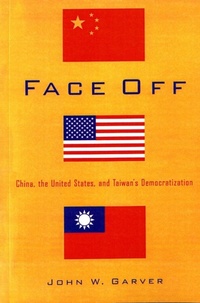
Face Off
China, the United States, and Taiwan's Democratization
Published on 1. July 1997
Book
Paperback/Softback
200 pages
978-0-295-97617-4 (ISBN)
Description
Taiwan's first presidential election, in 1996, sparked a Sino-U.S. military showdown that resulted in the biggest show of U.S. naval force in East Asia since the Vietnam War. This book is the first to explore the origins and triangular dynamics of that historic confrontation. Analyzing the key decisions and misperceptions that led to the Taiwan Strait crisis, Garver warns that it may usher in a more confrontational era of Sino-U.S. relations.
China is already emerging as an economic powerhouse and fears of its becoming an expansionist military power have grown in recent years as China has rapidly built up its armed forces since 1989. It has also adopted a more assertive stance in several territorial disputes with its neighbors, arousing new security concerns for Asia as a whole.
When China tried to intimidate Taiwan's voters by firing missiles and conducting large-scale military exercises off its coasts in the period preceding the 1996 election, the U.S. dispatched two aircraft carrier battle groups to Taiwan. The prestige of all sides was fully engaged as powerful do domestic interests demanded an assertive posture. Eventually, China adopted a more cautious stance and the crisis passed. But it marked the first instance of Chinese nuclear coercion of the U.S. and gave the "China threat" new credence in the U.S. and elsewhere in Asia.
The author has studied the Taiwan question for more than 30 years and has witnessed first-hand the growth and culmination of Taiwan's democratization. This sober, mature reflection of decades of thought is certain to inform the debate on the "China threat" and the future of Sino-U.S. relations.
China is already emerging as an economic powerhouse and fears of its becoming an expansionist military power have grown in recent years as China has rapidly built up its armed forces since 1989. It has also adopted a more assertive stance in several territorial disputes with its neighbors, arousing new security concerns for Asia as a whole.
When China tried to intimidate Taiwan's voters by firing missiles and conducting large-scale military exercises off its coasts in the period preceding the 1996 election, the U.S. dispatched two aircraft carrier battle groups to Taiwan. The prestige of all sides was fully engaged as powerful do domestic interests demanded an assertive posture. Eventually, China adopted a more cautious stance and the crisis passed. But it marked the first instance of Chinese nuclear coercion of the U.S. and gave the "China threat" new credence in the U.S. and elsewhere in Asia.
The author has studied the Taiwan question for more than 30 years and has witnessed first-hand the growth and culmination of Taiwan's democratization. This sober, mature reflection of decades of thought is certain to inform the debate on the "China threat" and the future of Sino-U.S. relations.
Reviews / Votes
"Analytically organized, ably argued and well documented, and very readable."(Book Reviews-China) "An excellent in-depth analysis of the 1996 crisis. . . . Garver also raises thought-provoking policy issues with regard to China and Taiwan, challenging American policy makers to define U.S. policy interests in Taiwan clearly and think through the problem of how to cope with a rising China."
(China Review International)
More details
Series
Language
English
Place of publication
Seattle
United States
Target group
Professional and scholarly
Product notice
Paperback (trade)
Dimensions
Height: 229 mm
Width: 153 mm
Thickness: 14 mm
Weight
299 gr
ISBN-13
978-0-295-97617-4 (9780295976174)
Copyright in bibliographic data and cover images is held by Nielsen Book Services Limited or by the publishers or by their respective licensors: all rights reserved.
Schweitzer Classification
Other editions
Additional editions
E-Book
10/2011
1st Edition
University of Washington Press
€33.99
Available for download
Person
John W. Garver is professor of international affairs at the Georgia Institute of Technology. His previous books include Foreign Relations of the People's Republic of China and China's Decision for Rapprochement with the United States.
Content
Acknowledgments
Abbreviations
1) The Significance of the 1996 Crisis
2) Taiwan's 'Drifting Away'
3) Taiwan's 'Pragmatic Diplomacy'
4) Beijing's Objections to U.S. Policy
5) The Taiwan Issue in Chinese Domestic Politics
6) The U.S. Visa Decision and Beijing's Reaction
7) Beijing's Probing of U.S. Intentions
8) The December Legislative Yuan Elections
9) The Confrontation
10) Were China's Leaders Surprised by U.S. Intervention?
11) PRC Strategy
12) Nuclear Coercion with Chinese Characteristics
13) The International Effect of the Crisis
14) Appraising the Gains and Costs of Beijing's Coercive Exercises
15) Conclusions
Notes
Bibliography
Index
Abbreviations
1) The Significance of the 1996 Crisis
2) Taiwan's 'Drifting Away'
3) Taiwan's 'Pragmatic Diplomacy'
4) Beijing's Objections to U.S. Policy
5) The Taiwan Issue in Chinese Domestic Politics
6) The U.S. Visa Decision and Beijing's Reaction
7) Beijing's Probing of U.S. Intentions
8) The December Legislative Yuan Elections
9) The Confrontation
10) Were China's Leaders Surprised by U.S. Intervention?
11) PRC Strategy
12) Nuclear Coercion with Chinese Characteristics
13) The International Effect of the Crisis
14) Appraising the Gains and Costs of Beijing's Coercive Exercises
15) Conclusions
Notes
Bibliography
Index