

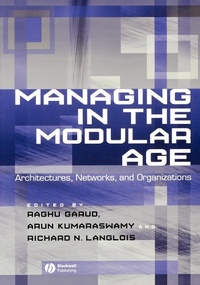
Managing in the Modular Age
Architectures, Networks, and Organizations
1st Edition
Published on 13. September 2002
Book
Paperback/Softback
420 pages
978-0-631-23316-9 (ISBN)
Description
This book brings together seminal articles by leading scholars of technological and organizational systems, exploring the impact of 'modularity'.
Modularity refers to an ability to take apart and put together differenct products and networks, or to 'mix and match' components in order to meet different user specifications. This is of key importance today where new systems such as the World Wide Web and many areas of the computer industry depend on it. The volume pulls together and defines an exciting new area of inquiry: into how our 'modular age' is reshaping the business eco-system.
Includes contributions from leading scholars of technology and organization
Modularity refers to an ability to take apart and put together different products and systems, or to 'mix and match' components in order to meet different user specifications.
Consolidates and defines an area of inquiry that is becoming increasingly important with the development of web-based and 'network' industries.
Sensitizes readers to the complexity of issues surrounding new modular products and systems created by e-business
Encourages readers to make connections among different levels and disciplines.
Initiates a debate around issues of modularity.
Includes a commentary co-authored by the late Nobel Laureate Herbert A. Simon to whom the book is dedicated.
Modularity refers to an ability to take apart and put together differenct products and networks, or to 'mix and match' components in order to meet different user specifications. This is of key importance today where new systems such as the World Wide Web and many areas of the computer industry depend on it. The volume pulls together and defines an exciting new area of inquiry: into how our 'modular age' is reshaping the business eco-system.
Includes contributions from leading scholars of technology and organization
Modularity refers to an ability to take apart and put together different products and systems, or to 'mix and match' components in order to meet different user specifications.
Consolidates and defines an area of inquiry that is becoming increasingly important with the development of web-based and 'network' industries.
Sensitizes readers to the complexity of issues surrounding new modular products and systems created by e-business
Encourages readers to make connections among different levels and disciplines.
Initiates a debate around issues of modularity.
Includes a commentary co-authored by the late Nobel Laureate Herbert A. Simon to whom the book is dedicated.
Reviews / Votes
"This is a very topical issue... and this reader will be very welcome.... The list of people that the editors have lined up is simply outstanding. Their work in this area and their updates will be invaluable." Professor Peter Karnoe, Copenhagen Business School"The selection of readings is good, and it is pertinent: modularity is becoming an increasingly important subject." Professor Max Boisot, ESADE, Spain
More details
Language
English
Place of publication
New York
United States
Target group
Professional and scholarly
Product notice
Paperback (trade)
Unsewn / adhesive bound
Dimensions
Height: 254 mm
Width: 178 mm
Thickness: 23 mm
Weight
786 gr
ISBN-13
978-0-631-23316-9 (9780631233169)
Copyright in bibliographic data and cover images is held by Nielsen Book Services Limited or by the publishers or by their respective licensors: all rights reserved.
Schweitzer Classification
Other editions
Additional editions
Raghu Garud | Arun Kumaraswamy | Richard Langlois
Managing in the Modular Age
Architectures, Networks, and Organizations
E-Book
02/2009
Wiley
€84.99
Available for download
Raghu Garud | Arun Kumaraswamy | Richard Langlois
Managing in the Modular Age
Architectures, Networks, and Organizations
Book
09/2002
1st Edition
Wiley
€124.50
Article exhausted; check different version
Persons
Raghu Garud is Associate Professor of Management and Organizational Behavior at Leonard N. Stern School of Business, New York University. Besides authoring many articles on modularity that have been published in leading management journals, Raghu has co-edited and co-authored several books, including Path Dependence and Creation (2001), The Innovation Journey (1999), and Technological Innovation: Oversights and Foresights (1997). He was Program Chair for the Technology and Innovation Management Division for the 2001 Academy of Management meetings.
Arun Kumaraswamy is Assistant Professor of Management at the School of Business ? Camden, Rutgers University. He has published several papers on modularity and standards in journals such as the Academy of Management Journal and the Strategic Management Journal.
Richard N. Langlois is Professor of Economics at the University of Connecticut. He is the author of numerous articles and books, including Firms, Markets, and Economic Change: A Dynamic Theory of Business Institutions (1995). His history of the microcomputer industry won the Newcomen Award as the best article in Business History Review in 1992.
Arun Kumaraswamy is Assistant Professor of Management at the School of Business ? Camden, Rutgers University. He has published several papers on modularity and standards in journals such as the Academy of Management Journal and the Strategic Management Journal.
Richard N. Langlois is Professor of Economics at the University of Connecticut. He is the author of numerous articles and books, including Firms, Markets, and Economic Change: A Dynamic Theory of Business Institutions (1995). His history of the microcomputer industry won the Newcomen Award as the best article in Business History Review in 1992.
Content
Acknowledgments. Introduction: Managing in The Modular Age: Architectures, Networks and Organizations. (R. Garud, A. Kumaraswamy, R. Langlois).
Part I: Overview.
1. The Architecture of Complexity. (H. A. Simon).
Commentary. (M. Augier and H. A. Simon).
2. Technological and Organizational Designs to Achieve Economies of Substitution. (R. Garud and A. Kumaraswamy).
Commentary.
3. Networks And Innovation In A Modular System: Lessons From The Microcomputer And Stereo Component Industries. (R. N. Langlois and P. L. Robertson).
Commentary.
Part II: Modularity And Architectures.
4. The Role of Product Architecture in the Manufacturing Firm. (K. Ulrich).
Commentary.
5. Managing in an Age of Modularity. (C. Y. Baldwin and K. B. Clark).
Commentary.
6. Towards a General Modular Systems Theory and Its Application to Interfirm Product Modularity. (M. A. Schilling).
Commentary.
Part III: Networks And Standards.
7. The Economics of Networks. (N. Economides).
Commentary.
8. The Art of Standards Wars. (C. Shapiro and H. R. Varian).
Commentary.
Part IV: Field-Level And Organizational Dynamics.
9. Dynamics of Organizational Communities and Technological Bandwagons: An Empirical Investigation of Community Evolution in the Microprocessor Market. (J. Wade).
Commentary.
10. Dominant Designs, Technological Cycles and Organizational Outcomes. (M. L. Tushman and J. P. Murmann).
Commentary. (G. Westerman and M. L. Tushman).
11. Modularity, Flexibility and Knowledge Management in Product and Organizational Design. (R. Sanchez and J. T. Mahoney).
Commentary. (R. Sanchez).
Index.
Part I: Overview.
1. The Architecture of Complexity. (H. A. Simon).
Commentary. (M. Augier and H. A. Simon).
2. Technological and Organizational Designs to Achieve Economies of Substitution. (R. Garud and A. Kumaraswamy).
Commentary.
3. Networks And Innovation In A Modular System: Lessons From The Microcomputer And Stereo Component Industries. (R. N. Langlois and P. L. Robertson).
Commentary.
Part II: Modularity And Architectures.
4. The Role of Product Architecture in the Manufacturing Firm. (K. Ulrich).
Commentary.
5. Managing in an Age of Modularity. (C. Y. Baldwin and K. B. Clark).
Commentary.
6. Towards a General Modular Systems Theory and Its Application to Interfirm Product Modularity. (M. A. Schilling).
Commentary.
Part III: Networks And Standards.
7. The Economics of Networks. (N. Economides).
Commentary.
8. The Art of Standards Wars. (C. Shapiro and H. R. Varian).
Commentary.
Part IV: Field-Level And Organizational Dynamics.
9. Dynamics of Organizational Communities and Technological Bandwagons: An Empirical Investigation of Community Evolution in the Microprocessor Market. (J. Wade).
Commentary.
10. Dominant Designs, Technological Cycles and Organizational Outcomes. (M. L. Tushman and J. P. Murmann).
Commentary. (G. Westerman and M. L. Tushman).
11. Modularity, Flexibility and Knowledge Management in Product and Organizational Design. (R. Sanchez and J. T. Mahoney).
Commentary. (R. Sanchez).
Index.