

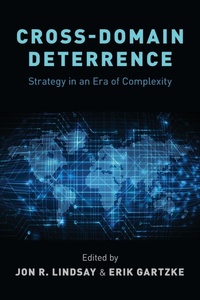
Cross-Domain Deterrence
Strategy in an Era of Complexity
Published on 21. March 2019
Book
Paperback/Softback
408 pages
978-0-19-090865-2 (ISBN)
Description
The complexity of the twenty-first century threat landscape contrasts markedly with the bilateral nuclear bargaining context envisioned by classical deterrence theory. Nuclear and conventional arsenals continue to develop alongside anti-satellite programs, autonomous robotics or drones, cyber operations, biotechnology, and other innovations barely imagined in the early nuclear age. The concept of cross-domain deterrence (CDD) emerged near the end of the George W. Bush administration as policymakers and commanders confronted emerging threats to vital military systems in space and cyberspace. The Pentagon now recognizes five operational environments or so-called domains (land, sea, air, space, and cyberspace), and CDD poses serious problems in practice. In Cross-Domain Deterrence, Erik Gartzke and Jon R. Lindsay assess the theoretical relevance of CDD for the field of International Relations. As a general concept, CDD posits that how actors choose to deter affects the quality of the deterrence they achieve. Contributors to this volume include senior and junior scholars and national security practitioners. Their chapters probe the analytical utility of CDD by examining how differences across, and combinations of, different military and non-military instruments can affect choices and outcomes in coercive policy in historical and contemporary cases.
Reviews / Votes
These strong essays show that cyber, conventional weapons, and diplomacy can be employed in complex mixes. This deeper understanding of how things are likely to unfold should inform scholars, policy-makers, and anyone interested in these fascinating issues of increasing importance. * Robert Jervis, author of How Statesmen Think * The study of deterrence is back after a post-cold war hiatus. With it comes rising appreciation of how much the deterrence landscape has changed. The nuclear problem is not as central as before; but it remains, deceptively familiar. And military competition has expanded into cyber space and outer space. In recent years, much work has been done on these new dynamics. Some of the best of this work is captured here, and this fine collection makes a compelling case that cross domain deterrence is an organizing concept with enduring value. * Brad Roberts, Director, Center for Global Security Research * This excellent and unique volume is a must-have for both scholars and practitioners, especially in the face of a rapidly evolving threat environment. * Kimberly Marten, Professor and Chair of Political Science, Barnard College * This very useful book pulls together scholars confronting the new complexities of cross-domain deterrence, when multiple kinds of attack can now be directed at us, as well as at our adversaries. Essential reading. * George H. Quester, Professor Emeritus of Government and Politics, University of Maryland *More details
Language
English
Place of publication
New York
United States
Target group
Professional and scholarly
Illustrations
3
Dimensions
Height: 234 mm
Width: 156 mm
Thickness: 24 mm
Weight
692 gr
ISBN-13
978-0-19-090865-2 (9780190908652)
Copyright in bibliographic data and cover images is held by Nielsen Book Services Limited or by the publishers or by their respective licensors: all rights reserved.
Schweitzer Classification
Other editions
Additional editions
Book
03/2019
Oxford University Press Inc
€176.20
Shipment within 15-20 days
E-Book
02/2019
1st Edition
OUP eBook
€35.99
Available for download
E-Book
02/2019
1st Edition
OUP eBook
€18.99
Available for download
Persons
Jon R. Lindsay is Assistant Professor at the Munk School of Global Affairs and Public Policy and the Department of Political Science at the University of Toronto. He previously served in the U.S. Navy with operational assignments in Europe, Latin America, and the Middle East. He is a co-editor of China and Cybersecurity (with Tai Ming Cheung, Derek S. Reveron, Oxford).
Erik Gartzke is Professor of Political Science and Director of the Center for Peace and Security Studies at the University of California, San Diego, where he has been a member of the research faculty since 2007. He is a co-editor of Nonproliferation Policy and Nuclear Posture (with Neil Narang and Matthew Kroenig) and Causes and Consequences of Nuclear Proliferation (with Robert Rauchhaus and Matthew Kroenig).
Erik Gartzke is Professor of Political Science and Director of the Center for Peace and Security Studies at the University of California, San Diego, where he has been a member of the research faculty since 2007. He is a co-editor of Nonproliferation Policy and Nuclear Posture (with Neil Narang and Matthew Kroenig) and Causes and Consequences of Nuclear Proliferation (with Robert Rauchhaus and Matthew Kroenig).
Content
Introduction
1. Cross-Domain Deterrence, from Practice to Theory
Jon Lindsay and Erik Gartzke
The Concept of Cross-Domain Deterrence
2. Cross-Domain Deterrence in American Foreign Policy
Michael Nacht, Patricia Schuster, and Eva Uribe
3. The Past and Future of Deterrence Theory
Patrick M. Morgan
4. Simplicity and Complexity in the Nth Nuclear Era
Ron Lehman
Strategic Implications of Different Military Domains
5. Deterrence in and through Cyberspace
Jacquelyn Schneider
6. Anti-Satellite Weapons and the Instability of Deterrence
Benjamin Bahney, Jonathan Pearl, and Michael Markey
7. Air Power Versus Ground Forces: Deterrence at the Operational Level of War
Phil Haun
8. Sea Power Versus Land Power: Cross-Domain Deterrence in the Peloponnesian War
Joshua Rovner
Communication and Credibility across Domains
9. International Law and the Common Knowledge Requirements of Cross-Domain Deterrence
James Morrow
10. Signaling with Secrets: Evidence on Soviet Perceptions and Counterforce Developments in the Late Cold War
Brendan Rittenhouse Green and Austin G. Long
11. Extended Deterrence and Assurance in Multiple Domains
Rupal Mehta
Interactions across Military and Nonmilitary Domains
12. Asymmetric Advantage: Weaponizing People as Non-Military Instruments of Cross-Domain Coercion
Kelly Greenhill
13. Linkage Politics: Managing the End of the Cold War
Joshua R. Itzkowitz Shifrinson
14. Beyond Military Deterrence: The Multidimensionality of International Relations in East Asia
Chin-Hao Huang and David Kang
Conclusion
15. The Analytic Potential of Cross-Domain Deterrence
Jon Lindsay and Erik Gartzke
1. Cross-Domain Deterrence, from Practice to Theory
Jon Lindsay and Erik Gartzke
The Concept of Cross-Domain Deterrence
2. Cross-Domain Deterrence in American Foreign Policy
Michael Nacht, Patricia Schuster, and Eva Uribe
3. The Past and Future of Deterrence Theory
Patrick M. Morgan
4. Simplicity and Complexity in the Nth Nuclear Era
Ron Lehman
Strategic Implications of Different Military Domains
5. Deterrence in and through Cyberspace
Jacquelyn Schneider
6. Anti-Satellite Weapons and the Instability of Deterrence
Benjamin Bahney, Jonathan Pearl, and Michael Markey
7. Air Power Versus Ground Forces: Deterrence at the Operational Level of War
Phil Haun
8. Sea Power Versus Land Power: Cross-Domain Deterrence in the Peloponnesian War
Joshua Rovner
Communication and Credibility across Domains
9. International Law and the Common Knowledge Requirements of Cross-Domain Deterrence
James Morrow
10. Signaling with Secrets: Evidence on Soviet Perceptions and Counterforce Developments in the Late Cold War
Brendan Rittenhouse Green and Austin G. Long
11. Extended Deterrence and Assurance in Multiple Domains
Rupal Mehta
Interactions across Military and Nonmilitary Domains
12. Asymmetric Advantage: Weaponizing People as Non-Military Instruments of Cross-Domain Coercion
Kelly Greenhill
13. Linkage Politics: Managing the End of the Cold War
Joshua R. Itzkowitz Shifrinson
14. Beyond Military Deterrence: The Multidimensionality of International Relations in East Asia
Chin-Hao Huang and David Kang
Conclusion
15. The Analytic Potential of Cross-Domain Deterrence
Jon Lindsay and Erik Gartzke