

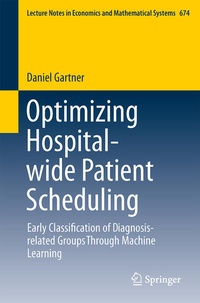
Optimizing Hospital-wide Patient Scheduling
Early Classification of Diagnosis-related Groups Through Machine Learning
Published on 9. June 2015
Book
Paperback/Softback
XIV, 119 pages
978-3-319-04065-3 (ISBN)
Description
Diagnosis-related groups (DRGs) are used in hospitals for the reimbursement of inpatient services. The assignment of a patient to a DRG can be distinguished into billing- and operations-driven DRG classification. The topic of this monograph is operations-driven DRG classification, in which DRGs of inpatients are employed to improve contribution margin-based patient scheduling decisions. In the first part, attribute selection and classification techniques are evaluated in order to increase early DRG classification accuracy. Employing mathematical programming, the hospital-wide flow of elective patients is modelled taking into account DRGs, clinical pathways and scarce hospital resources. The results of the early DRG classification part reveal that a small set of attributes is sufficient in order to substantially improve DRG classification accuracy as compared to the current approach of many hospitals. Moreover, the results of the patient scheduling part reveal that the contribution margin can be increased as compared to current practice.
More details
Series
Language
English
Place of publication
Cham
Switzerland
Publishing group
Springer International Publishing
Target group
Professional and scholarly
Research
Illustrations
22 s/w Abbildungen
XIV, 119 p. 22 illus.
Dimensions
Height: 235 mm
Width: 155 mm
Thickness: 8 mm
Weight
219 gr
ISBN-13
978-3-319-04065-3 (9783319040653)
DOI
10.1007/978-3-319-04066-0
Schweitzer Classification
Other editions
Additional editions
Daniel Gartner
Optimizing Hospital-wide Patient Scheduling
Early Classification of Diagnosis-related Groups Through Machine Learning
E-Book
05/2015
1st Edition
Springer
€53.49
Available for download
Person
Daniel Gartner earned his doctoral degree in Operations Management at the TUM School of Management, Technische Universität München, Germany. His research examines optimization problems in health care and machine learning techniques to improve hospital-wide scheduling decisions. Prior to joining TUM he received his university diploma (Master's equivalent) in medical informatics from the University of Heidelberg, Germany, and a M.Sc. in Networks and Information Systems from the Université Claude Bernard Lyon, France.
Content
Introduction.- Machine learning for early DRG classification.- Scheduling the hospital-wide flow of elective patients.- Experimental analyses.- Conclusion.