

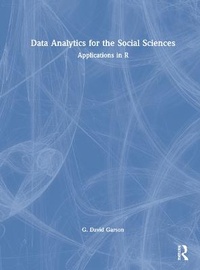
Data Analytics for the Social Sciences
Applications in R
1st Edition
Published on 30. November 2021
Book
Hardback
686 pages
978-0-367-62429-3 (ISBN)
Description
Data Analytics for the Social Sciences is an introductory, graduate-level treatment of data analytics for social science. It features applications in the R language, arguably the fastest growing and leading statistical tool for researchers.
The book starts with an ethics chapter on the uses and potential abuses of data analytics. Chapters 2 and 3 show how to implement a broad range of statistical procedures in R. Chapters 4 and 5 deal with regression and classification trees and with random forests. Chapter 6 deals with machine learning models and the "caret" package, which makes available to the researcher hundreds of models. Chapter 7 deals with neural network analysis, and Chapter 8 deals with network analysis and visualization of network data. A final chapter treats text analysis, including web scraping, comparative word frequency tables, word clouds, word maps, sentiment analysis, topic analysis, and more. All empirical chapters have two "Quick Start" exercises designed to allow quick immersion in chapter topics, followed by "In Depth" coverage. Data are available for all examples and runnable R code is provided in a "Command Summary". An appendix provides an extended tutorial on R and RStudio. Almost 30 online supplements provide information for the complete book, "books within the book" on a variety of topics, such as agent-based modeling.
Rather than focusing on equations, derivations, and proofs, this book emphasizes hands-on obtaining of output for various social science models and how to interpret the output. It is suitable for all advanced level undergraduate and graduate students learning statistical data analysis.
The book starts with an ethics chapter on the uses and potential abuses of data analytics. Chapters 2 and 3 show how to implement a broad range of statistical procedures in R. Chapters 4 and 5 deal with regression and classification trees and with random forests. Chapter 6 deals with machine learning models and the "caret" package, which makes available to the researcher hundreds of models. Chapter 7 deals with neural network analysis, and Chapter 8 deals with network analysis and visualization of network data. A final chapter treats text analysis, including web scraping, comparative word frequency tables, word clouds, word maps, sentiment analysis, topic analysis, and more. All empirical chapters have two "Quick Start" exercises designed to allow quick immersion in chapter topics, followed by "In Depth" coverage. Data are available for all examples and runnable R code is provided in a "Command Summary". An appendix provides an extended tutorial on R and RStudio. Almost 30 online supplements provide information for the complete book, "books within the book" on a variety of topics, such as agent-based modeling.
Rather than focusing on equations, derivations, and proofs, this book emphasizes hands-on obtaining of output for various social science models and how to interpret the output. It is suitable for all advanced level undergraduate and graduate students learning statistical data analysis.
More details
Language
English
Place of publication
London
United Kingdom
Publishing group
Taylor & Francis Ltd
Target group
College/higher education
Illustrations
163 farbige Abbildungen, 163 Farbfotos bzw. farbige Rasterbilder
163 Halftones, color; 163 Illustrations, color
Dimensions
Height: 280 mm
Width: 210 mm
Weight
2100 gr
ISBN-13
978-0-367-62429-3 (9780367624293)
Copyright in bibliographic data and cover images is held by Nielsen Book Services Limited or by the publishers or by their respective licensors: all rights reserved.
Schweitzer Classification
Other editions
Additional editions
Book
11/2021
1st Edition
Routledge
€188.60
Shipment within 15-20 days
E-Book
11/2021
1st Edition
Routledge
€125.99
Available for download
E-Book
11/2021
1st Edition
Routledge
€125.99
Available for download
Person
G. David Garson teaches advanced research methodology in the School of Public and International Affairs, North Carolina State University, USA. Founder and longtime editor emeritus of the Social Science Computer Review, he is president of Statistical Associates Publishing, which provides free digital texts worldwide. His degrees are from Princeton University (BA, 1965) and Harvard University (PhD, 1969).
Content
1. Using and Abusing Data Analytics in Social Science 2. Statistical Analytics with R, Part 1 3. Statistical Analytics with R, Part 2 4. Classification and Regression Trees in R 5. Random Forests 6. Modeling and Machine Learning 7. Neural Network Models and Deep Learning 8. Network Analysis 9. Text Analytics; Appendix 1. Introduction to R and R Studio Appendix 2. Data Used in this Book