

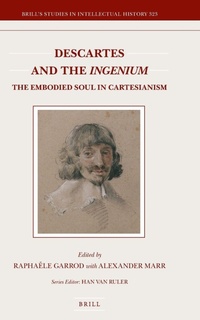
Descartes and the Ingenium
The Embodied Soul in Cartesianism
Published on 26. November 2020
Book
Hardback
256 pages
978-90-04-43761-6 (ISBN)
Description
Descartes and the 'Ingenium' tracks the significance of embodied thought (ingenium) in the philosophical trajectory of the founding father of dualism. The first part of the book defines the notion of ingenium in relation to core concepts of Descartes's philosophy, such as memory and enumeration. It focuses on Descartes's uses of this notion in methodical thinking, mathematics, and medicine. The studies in the second part place the Cartesian ingenium within preceding scholastic and humanist pedagogical and natural-philosophical traditions, and highlight its hitherto ignored social and political significance for Descartes himself as a member of the Republic of Letters. By embedding Descartes' notion of ingenium in contemporaneous medical, pedagogical, but also social and literary discourses, this volume outlines the fundamentally anthropological and ethical underpinnings of Descartes's revolutionary epistemology.
Contributors: Igor Agostini, Roger Ariew, Harold J. Cook, Raphaele Garrod, Denis Kambouchner, Alexander Marr, Richard Oosterhoff, David Rabouin, Dennis L. Sepper, and Theo Verbeek.
Contributors: Igor Agostini, Roger Ariew, Harold J. Cook, Raphaele Garrod, Denis Kambouchner, Alexander Marr, Richard Oosterhoff, David Rabouin, Dennis L. Sepper, and Theo Verbeek.
More details
Series
Language
English
Place of publication
Leiden
Netherlands
Target group
Professional and scholarly
Product notice
sewn/stitched
Cloth over boards
Dimensions
Height: 234 mm
Width: 155 mm
Thickness: 16 mm
Weight
531 gr
ISBN-13
978-90-04-43761-6 (9789004437616)
Copyright in bibliographic data and cover images is held by Nielsen Book Services Limited or by the publishers or by their respective licensors: all rights reserved.
Schweitzer Classification
Persons
Raphaele Garrod, Ph.D. Cantab (2010), is Associate Professor of Early Modern French at the University of Oxford and a Fellow of Magdalen College. She authored Cosmographical Novelties in French Renaissance Prose: Dialectic and Discovery (2016), and co-authored Logodaedalus: Word Histories of Ingenuity in Early Modern Europe (2019).
Alexander Marr is Reader in the History of Early Modern Art at the University of Cambridge and a Fellow of Trinity Hall. His recent books include Logodaedalus: Word Histories of Ingenuity in Early Modern Europe (2019) and Rubens's Spirit: From Ingenuity to Genius (forthcoming from Reaktion Books, 2021).
Alexander Marr is Reader in the History of Early Modern Art at the University of Cambridge and a Fellow of Trinity Hall. His recent books include Logodaedalus: Word Histories of Ingenuity in Early Modern Europe (2019) and Rubens's Spirit: From Ingenuity to Genius (forthcoming from Reaktion Books, 2021).
Content
Acknowledgements
List of Illustrations and Diagrams
Abbreviations and Note on the Text
Notes on Contributors
Introduction: Descartes Re-imagined: Ingenuity before and beyond Dualism
?Raphaele Garrod
Part 1: Rethinking the Ingenium in the Cartesian Corpus. Method, Mathematics, Medicine
1 Methodical Invention: The Cartesian Ingenium at Work
?Denis Kambouchner
2 Descartes and Logic: Perfecting the Ingenium
?Roger Ariew
3 Enumeratio in Descartes's Regulae ad directionem ingenii and Beyond
?Theo Verbeek
4 Ingenium, Phantasia and Mathematics in Descartes's Regulae ad directionem ingenii
?David Rabouin
5 The Post-Regulae Direction of Ingenium in Descartes: Toward a Pragmatic Psychological Anthropology
?Denis L. Sepper
6 Augustinian Souls and Epicurean Bodies? Descartes's Corporeal Mind in Motion
?Harold J. Cook
Part 2: The Cartesian Ingenium in Context: Predecessors, Contemporaries, Successors
7 Ingenium between Descartes and the Scholastics
?Igor Agostini
8 Methods of Ingenuity: The Renaissance Tradition behind Descartes's Regulae
?Richard J. Oosterhoff
9 La Politesse de L'esprit: Cartesian Pedagogy and the Ethics of Scholarly Exchanges
?Raphaele Garrod
10 Postface: The Face of Ingenium: Simon Vouet's Portrait of Descartes
?Alexander Marr
Bibliography
Index of Names
List of Illustrations and Diagrams
Abbreviations and Note on the Text
Notes on Contributors
Introduction: Descartes Re-imagined: Ingenuity before and beyond Dualism
?Raphaele Garrod
Part 1: Rethinking the Ingenium in the Cartesian Corpus. Method, Mathematics, Medicine
1 Methodical Invention: The Cartesian Ingenium at Work
?Denis Kambouchner
2 Descartes and Logic: Perfecting the Ingenium
?Roger Ariew
3 Enumeratio in Descartes's Regulae ad directionem ingenii and Beyond
?Theo Verbeek
4 Ingenium, Phantasia and Mathematics in Descartes's Regulae ad directionem ingenii
?David Rabouin
5 The Post-Regulae Direction of Ingenium in Descartes: Toward a Pragmatic Psychological Anthropology
?Denis L. Sepper
6 Augustinian Souls and Epicurean Bodies? Descartes's Corporeal Mind in Motion
?Harold J. Cook
Part 2: The Cartesian Ingenium in Context: Predecessors, Contemporaries, Successors
7 Ingenium between Descartes and the Scholastics
?Igor Agostini
8 Methods of Ingenuity: The Renaissance Tradition behind Descartes's Regulae
?Richard J. Oosterhoff
9 La Politesse de L'esprit: Cartesian Pedagogy and the Ethics of Scholarly Exchanges
?Raphaele Garrod
10 Postface: The Face of Ingenium: Simon Vouet's Portrait of Descartes
?Alexander Marr
Bibliography
Index of Names