

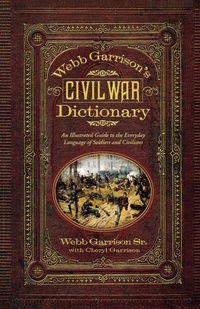
Webb Garrison's Civil War Dictionary
An Illustrated Guide to the Everyday Language of Soldiers and Civilians
Published on 16. October 2008
Book
Paperback/Softback
350 pages
978-1-58182-675-3 (ISBN)
Description
More than 2,500 Entries and 330 Illustrations
Based on the author's more than thirty years of research and study of original Civil War sources, Webb Garrison's Civil War Dictionary is an authoritative guide to the words and phrases (including nicknames and slang) commonly used during the conflict. Where appropriate, helpful, examples, anecdotes, and illustrations are included to clarify the meanings of some of the terms.
What did it mean "to cross the bar"? What was a soldier's "big ticket"? What did it mean "to see the elephant" or "to go South"? Who were the so-called ninety-day men and hundred-day men? What was a soldier supposed to do when his commander shouted, "Let her go, Gallagher!"? How did a person "pay tribute to Neptune"? What was a "picket pin"? Could you make a passable meal out of "possum beer" and "secession bread"? How did a person "vibrate the lines," and why would anyone want to?
The American language has changed dramatically in more than 140 years since the conflict. As the meanings of many words and phrases of that time have become obscure or lost, links with the vibrant language of the Civil War era have dissolved, and much of that which had meaning to our forefathers no longer retains the same meaning to us. Thus, this valuable reference work reconnects historians and students of the war with the words, equipment, and organization of the three and a half million soldiers who fought in the conflict.
Based on the author's more than thirty years of research and study of original Civil War sources, Webb Garrison's Civil War Dictionary is an authoritative guide to the words and phrases (including nicknames and slang) commonly used during the conflict. Where appropriate, helpful, examples, anecdotes, and illustrations are included to clarify the meanings of some of the terms.
What did it mean "to cross the bar"? What was a soldier's "big ticket"? What did it mean "to see the elephant" or "to go South"? Who were the so-called ninety-day men and hundred-day men? What was a soldier supposed to do when his commander shouted, "Let her go, Gallagher!"? How did a person "pay tribute to Neptune"? What was a "picket pin"? Could you make a passable meal out of "possum beer" and "secession bread"? How did a person "vibrate the lines," and why would anyone want to?
The American language has changed dramatically in more than 140 years since the conflict. As the meanings of many words and phrases of that time have become obscure or lost, links with the vibrant language of the Civil War era have dissolved, and much of that which had meaning to our forefathers no longer retains the same meaning to us. Thus, this valuable reference work reconnects historians and students of the war with the words, equipment, and organization of the three and a half million soldiers who fought in the conflict.
More details
Language
English
Place of publication
United States
Publishing group
Turner Publishing Company
Product notice
Paperback (trade)
Illustrations
Illustrations
Dimensions
Height: 216 mm
Width: 140 mm
Thickness: 19 mm
Weight
444 gr
ISBN-13
978-1-58182-675-3 (9781581826753)
Copyright in bibliographic data and cover images is held by Nielsen Book Services Limited or by the publishers or by their respective licensors: all rights reserved.
Schweitzer Classification
Persons
WEB GARRISON was a best-selling author of more than fifty books on the Civil War, which include A Treasury of Civil War Tales, Civil War Curiosities, The Lincoln No One Knows, Amazing Women of the Civil War, Friendly Fire in the Civil War, and The Unknown Civil War. Work on this book was completed shortly before the author's death in 2000. CHERYL L. GARRISON is a writer and editor who lives in Clyde, North Carolina.