

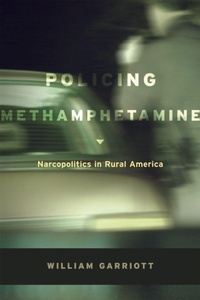
Policing Methamphetamine
Narcopolitics in Rural America
Published on 7. March 2011
Book
Hardback
201 pages
978-0-8147-3239-7 (ISBN)
Description
In its steady march across the United States, methamphetamine has become, to quote former Attorney General Alberto Gonzales, "the most dangerous drug in America." As a result, there has been a concerted effort at the local level to root out the methamphetamine problem by identifying the people at its source-those known or suspected to be involved with methamphetamine. Government-sponsored anti-methamphetamine legislation has enhanced these local efforts, formally and informally encouraging rural residents to identify meth offenders in their communities.
Policing Methamphetamine shows what happens in everyday life-and to everyday life-when methamphetamine becomes an object of collective concern. Drawing on interviews with users, police officers, judges, and parents and friends of addicts in one West Virginia town, William Garriott finds that this overriding effort to confront the problem changed the character of the community as well as the role of law in creating and maintaining social order. Ultimately, this work addresses the impact of methamphetamine and, more generally, the war on drugs, on everyday life in the United States.
Policing Methamphetamine shows what happens in everyday life-and to everyday life-when methamphetamine becomes an object of collective concern. Drawing on interviews with users, police officers, judges, and parents and friends of addicts in one West Virginia town, William Garriott finds that this overriding effort to confront the problem changed the character of the community as well as the role of law in creating and maintaining social order. Ultimately, this work addresses the impact of methamphetamine and, more generally, the war on drugs, on everyday life in the United States.
Reviews / Votes
"I commend Garriott for developing a theory of 'narcopolitics' that can be used in many other cultural settings to deconstruct the corrosive power of moral and 'actuarial' drug policies." - Howard Campbell (American Anthropologist) "Readers will gain insight into the significance of narcopolitics and its influence on the administration of justice in the United States." - Rashi K. Shukla (Criminal Law and Criminal Justice Book Review) "This book is an important contribution to the anthropology of drug use...it conveys a real sense of the bleakness and intractability of the problem, as well as the ultimate failure of policy and practice to meet this challenge." - Gilbert Quintero (Anthropological Quarterly) "In this brilliant ethnography, Garriott reveals that as the war on drugs extends from the inner city to rural Appalachia, suspicion and mistrust come to dominate small-town interactions. People one knows and everyday objects are quietly transformed into sources of danger and illegality by the state's desire to root out methamphetamine. A major contribution to law and society studies as well as to rural anthropology." - Mariana Valverde,author of Law and Order: Images, Meanings, Myths "Reveals how addiction is remaking rural America despite four decades of a & war on drugs. Garriott explores the day-to-day costs of policing drugs in a society increasingly organized around the illicit and the high. Compassionate and relentless, he demonstrates the brutal reality of narcopolitics in the United States. Essential reading." - Joseph Masco,The University of Chicago "This ethnography of methamphetamine is unusually gripping. The author's subtle and insightful analytic voice draws on the words, experiences, and emotions of residents of Baker County to detail the pathological embraces of & narcopolitics, the erosive relationships of narcotics-based governance through policing. As a study of how lives, laws, and morality interlock, this book provides a true-to-life mirror on the workings of the criminal justice system and its roles in American society and culture." - Philip Parnell,Indiana UniversityMore details
Language
English
Place of publication
New York
United States
Target group
Professional and scholarly
Product notice
Cloth over boards
Dimensions
Height: 229 mm
Width: 152 mm
Thickness: 16 mm
Weight
439 gr
ISBN-13
978-0-8147-3239-7 (9780814732397)
Copyright in bibliographic data and cover images is held by Nielsen Book Services Limited or by the publishers or by their respective licensors: all rights reserved.
Schweitzer Classification
Other editions
Additional editions
E-Book
03/2011
New York University Press
€142.99
Available for download
Person
Will Garriott is Associate Professor in the Law, Politics, and Society Program at Drake University. He is author or editor of numerous works, including Policing Methamphetamine: Narcopolitics in Rural America (NYU Press, 2011); Addiction Trajectories (Duke University Press, 2013); and The Anthropology of Police (Routledge, 2018).
Content
Acknowledgments Introduction 1 "The Most Dangerous Drug in America" 2 "It Could Be Here ... It Could Be My Neighbor" 3 "You Can Always Tell Who's Using Meth" 4 "The People You'd Never Suspect" 5 "Against the Peace and Dignity of the State" 6 "What Do You Do with Them?" Epilogue: "A Lot Happens in a Little Town" Notes Bibliography Index About the Author