

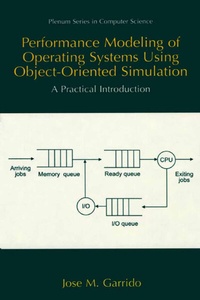
Performance Modeling of Operating Systems Using Object-Oriented Simulations
A Practical Introduction
Published on 10. April 2013
Book
Paperback/Softback
XIV, 279 pages
978-1-4757-7311-8 (ISBN)
Description
This book introduces the fundamental concepts and practical simulation te- niques for modeling different aspects of operating systems to study their g- eral behavior and their performance. The approaches applied are obje- oriented modeling and process interaction approach to discrete-event simu- tion. The book depends on the basic modeling concepts and is more specialized than my previous book: Practical Process Simulation with Object-Oriented Techniques and C++, published by Artech House, Boston 1999. For a more detailed description see the Web location: http://science.kennesaw.edu/~jgarrido/mybook,html. Most other books on performance modeling use only analytical approaches, and very few apply these concepts to the study of operating systems. Thus, the unique feature of the book is that it concentrates on design aspects of operating systems using practical simulation techniques. In addition, the book illustrates the dynamic behavior of different aspects of operating systems using the various simulation models, with a general hands-on approach.
More details
Series
Edition
Softcover reprint of the original 1st ed. 2000
Language
English
Place of publication
New York
United States
Target group
Professional and scholarly
Research
Illustrations
2 s/w Abbildungen
XIV, 279 p. 2 illus.
Dimensions
Height: 229 mm
Width: 152 mm
Thickness: 17 mm
Weight
432 gr
ISBN-13
978-1-4757-7311-8 (9781475773118)
DOI
10.1007/b116043
Schweitzer Classification
Other editions
Additional editions
José M. Garrido
Performance Modeling of Operating Systems Using Object-Oriented Simulations
A Practical Introduction
Book
10/2000
Kluwer Academic/Plenum Publishers
€85.59
Article exhausted; check different version
Content
Overview of System and Performance Modeling.- Object Oriented Modeling.- Basic Probability Theory and Random Numbers.- Single-Server Models.- Queuing Networks.- CPU Scheduling.- Process Synchronization.- Deadlock.- Inter-Process Communication.- Virtual Memory.- Device Management.- Additional Models.