

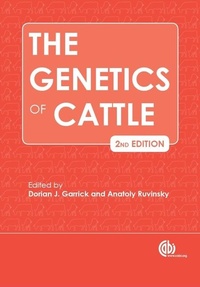
Genetics of Cattle, The
2nd Edition
Published on 28. November 2014
Book
Hardback
640 pages
978-1-78064-221-5 (ISBN)
Description
Since the time of domestication more than 10,000 years ago, cattle have played an increasingly crucial role in the development of human civilizations. Progress has been quite remarkable since the turn of the century; the sequencing of the bovine genome in 2009 launched new avenues for furthering our understanding of theoretical and practical aspects of cattle genetics. Covering a vast array of questions, this book reviews major topics from molecular and developmental genetics, disease resistance and immunogenetics to genetic improvement of dairy and beef breeds, addressing all current problems in the field. This second edition includes a new team of authors and completely new chapters on the genetics of fat production, nutrition, feed intake and efficiency, growth and body composition. Fully updated throughout, it provides a valuable resource on cattle genetics for researchers, breeders, veterinarians and postgraduate students.
More details
Edition
2nd edition
Language
English
Place of publication
Wallingford
United Kingdom
Target group
College/higher education
Product notice
sewn/stitched
Cloth over boards
Dimensions
Height: 251 mm
Width: 179 mm
Thickness: 43 mm
Weight
1590 gr
ISBN-13
978-1-78064-221-5 (9781780642215)
Copyright in bibliographic data and cover images is held by Nielsen Book Services Limited or by the publishers or by their respective licensors: all rights reserved.
Schweitzer Classification
Other editions
Additional editions
Dorian Garrick | Anatoly Ruvinsky
The Genetics of Cattle
E-Book
11/2014
2nd Edition
CABI Publishing
€281.99
Available for download
Previous edition

Anatoly Ruvinsky | Ruedi Fries | Anatoly Ruvinsky
Genetics of Cattle
Book
06/1999
CABI Publishing
€252.55
Article exhausted; check for reprint
Persons
Dorian J Garrick (Edited By)
graduated from Massey University in New Zealand in 1982 and embarked on his career in animal breeding and genetics. Much of his work has involved national genetic evaluation and its application to cost-effective improvement of livestock populations. Prior to undertaking a PhD at Cornell University, Garrick worked at Massey University on the application of animal models to evaluation and estimation of genetic trends in pig and sheep improvement. He returned to Massey in 1988 and worked on across-breed animal evaluation in dairy cattle. In 1994 he was appointed to the A.L. Rae Chair in animal breeding and genetics at Massey University, a position he has held part-time since 2002 when he relocated to the USA. In 2007 he took up the inaugural appointment to the J.L. Lush endowed chair at Iowa State University, a position named after the father of animal breeding. His current research focus involves the use of genomic information in animal improvement. Garrick has published 150 papers in refereed journals, over 200 conference papers, and 12 book chapters. He has supervised 21 PhD students and presented over 700 oral presentations at conference and industry meetings.
Anatoly Ruvinsky (Edited By)
Since graduation from Novosibirsk State University (Russia) in 1969 A. Ruvinsky has been working in several fields of genetics for more than 40 years. He received his PhD in 1974 and Dr.Sc. in 1985. In 1986 A. Ruvinsky was elected as head of laboratory of animal genetics and 1988 as Vice Director of the Institute of Cytology and Genetics of Russian Academy of Sciences. In 1993 A. Ruvinsky joined the University of New England, Australia. Professor Ruvinsky published more than 100 refereed papers in leading genetic journals and edited 14 books so far. This includes the series of books on mammalian genetics, which currently undergoes 2nd edition. His conceptual book "Genetics and Randomness" was published in 2009.
graduated from Massey University in New Zealand in 1982 and embarked on his career in animal breeding and genetics. Much of his work has involved national genetic evaluation and its application to cost-effective improvement of livestock populations. Prior to undertaking a PhD at Cornell University, Garrick worked at Massey University on the application of animal models to evaluation and estimation of genetic trends in pig and sheep improvement. He returned to Massey in 1988 and worked on across-breed animal evaluation in dairy cattle. In 1994 he was appointed to the A.L. Rae Chair in animal breeding and genetics at Massey University, a position he has held part-time since 2002 when he relocated to the USA. In 2007 he took up the inaugural appointment to the J.L. Lush endowed chair at Iowa State University, a position named after the father of animal breeding. His current research focus involves the use of genomic information in animal improvement. Garrick has published 150 papers in refereed journals, over 200 conference papers, and 12 book chapters. He has supervised 21 PhD students and presented over 700 oral presentations at conference and industry meetings.
Anatoly Ruvinsky (Edited By)
Since graduation from Novosibirsk State University (Russia) in 1969 A. Ruvinsky has been working in several fields of genetics for more than 40 years. He received his PhD in 1974 and Dr.Sc. in 1985. In 1986 A. Ruvinsky was elected as head of laboratory of animal genetics and 1988 as Vice Director of the Institute of Cytology and Genetics of Russian Academy of Sciences. In 1993 A. Ruvinsky joined the University of New England, Australia. Professor Ruvinsky published more than 100 refereed papers in leading genetic journals and edited 14 books so far. This includes the series of books on mammalian genetics, which currently undergoes 2nd edition. His conceptual book "Genetics and Randomness" was published in 2009.
Content
a: Preface Chapter 1: Systematics and phylogeny of cattle Chapter 2: Genetic aspects of domestication Chapter 3: Breeds of cattle Chapter 4: Molecular genetics of colour variation Chapter 5: Genetics of morphological traits and inherited disorders Chapter 6: Cytogenetics and chromosome maps Chapter 7: Bovine genomics Chapter 8: Bovine immunogenetics Chapter 9: Genetics of disease resistance Chapter 10: Molecular biology and genetics of bovine spongiform encephalopathy Chapter 11: Genetics of behaviour in cattle Chapter 12: Genetics of reproduction in cattle Chapter 13: Modern reproductive technologies and breed improvement Chapter 14: Developmental genetics Chapter 15: Genetic improvement of dairy cattle Chapter 16: Molecular genetics of milk protein production Chapter 17: Genetics fatty acids composition in bovine milk and beef Chapter 18: Genetic improvement in beef cattle Chapter 19: Genomic prediction and genome-wide association studies in beef and dairy cattle Chapter 20: Genetics of feed intake and efficiency. Chapter 21: Genetics of growth and body composition Chapter 22: Genetics of meat quality Chapter 23: Genetic aspects of cattle adaptation in the tropics Chapter 24: Standard genetic nomenclature b: Index