

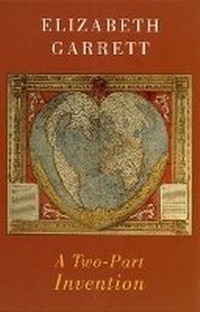
A Two-Part Invention
Published on 24. September 1998
Book
Paperback/Softback
64 pages
978-1-85224-462-0 (ISBN)
Description
The informing spirit of Garrett's second collection is music - in the cadences of the language, the forms and resolutions of the poems. For her, a memorable poem is a kind of two-part invention, an interplay of the reader's imagination and the poet's intention. As in Bach's deceptively simple studies of that name, when the two discrete melodic lines of reader's and poet's imagination run parallel, polyphony is suggested. Elizabeth Garrett's debut volume The Rule of Three was one of the 20 'New Generation Poets' titles in 1994. A Two-Part Invention was her second collection.
Reviews / Votes
It is a "metaphysical" poetry (John Donne is one of the few ascertainable in?uences), almost glacial in its composure, intangible and profoundly erotic. -- Francesco Rugnoni * L'Indice (Italy) * As near to a pure lyric poet as we'll get in our times. -- Peter Forbes * Poetry Review *More details
Language
English
Place of publication
Tyne and Wear
United Kingdom
Dimensions
Height: 216 mm
Width: 138 mm
Weight
97 gr
ISBN-13
978-1-85224-462-0 (9781852244620)
Copyright in bibliographic data and cover images is held by Nielsen Book Services Limited or by the publishers or by their respective licensors: all rights reserved.
Schweitzer Classification
Person
Elizabeth Garrett was born in London in 1958, and grew up in Channel Islands. Her first book of poems, The Rule of Three (Bloodaxe Books, 1991), was selected for the New Generation Poets promotion in 1994, and followed by a second collection, A Two-Part Invention, in 1998. Her poems appeared in Carol Rumens' anthology New Women Poets (Bloodaxe Books, 1990), and she was one of the writers featured in Poetry Review's 'New British Poets' special issue in 1987. A pamphlet selection of her poetry, The Mortal Light, was published by the Mandeville Press in 1990. After completing her D.Phil. at Oxford University on the Fool in modern English and French poetry, she worked in the Bodleian Library and for the Voltaire Foundation, later becoming a musician.