

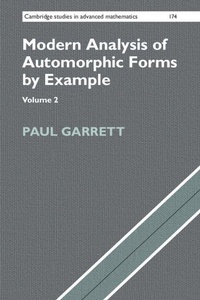
Modern Analysis of Automorphic Forms By Example
Published on 20. September 2018
Book
Hardback
364 pages
978-1-108-47384-2 (ISBN)
Description
This is Volume 2 of a two-volume book that provides a self-contained introduction to the theory and application of automorphic forms, using examples to illustrate several critical analytical concepts surrounding and supporting the theory of automorphic forms. The two-volume book treats three instances, starting with some small unimodular examples, followed by adelic GL2, and finally GLn. Volume 2 features critical results, which are proven carefully and in detail, including automorphic Green's functions, metrics and topologies on natural function spaces, unbounded operators, vector-valued integrals, vector-valued holomorphic functions, and asymptotics. Volume 1 features discrete decomposition of cuspforms, meromorphic continuation of Eisenstein series, spectral decomposition of pseudo-Eisenstein series, and automorphic Plancherel theorem. With numerous proofs and extensive examples, this classroom-tested introductory text is meant for a second-year or advanced graduate course in automorphic forms, and also as a resource for researchers working in automorphic forms, analytic number theory, and related fields.
Reviews / Votes
Review of Multi-volume Set: 'Any researcher working in the analytic theory of automorphic forms on higher rank groups will want to own this book. It is a treasure trove of examples and proofs that are well known to experts but very difficult to find in the open literature.' Dorian Goldfeld, Columbia University Review of Multi-volume Set: 'Written by a leading expert in the field, this volume provides a valuable account of the analytic theory of automorphic forms. The author chooses his examples to provide a middle road between the general theory and the most classical cases that do not exhibit all of the subject's more general phenomena. What makes this book special is this compromise and the subsequent aim, 'to discuss analytical issues at a technical level truly sufficient to convert appealing heuristics to persuasive, genuine proofs'.' John Friedlander, University of Toronto Review of Multi-volume Set: 'It is marvelous to see how Garrett goes about presenting such deep and broad material in what is certainly a superbly holistic manner. It's really a wonderful example of what I think is the right pedagogy for this part of number theory. The examples he uses are lynchpins for an increasingly elaborate development of the subject, and the reader has a number of accessible places to hang his hat as the story unfolds.' Michael Berg, MAA Reviews Review of Multi-volume Set: 'Garrett's volumes fill an important void in the literature of automorphic forms...' Matthew P. Young, Bulletin of the AMSMore details
Series
Language
English
Place of publication
Cambridge
United Kingdom
Target group
Professional and scholarly
Illustrations
Worked examples or Exercises
Dimensions
Height: 235 mm
Width: 157 mm
Thickness: 26 mm
Weight
744 gr
ISBN-13
978-1-108-47384-2 (9781108473842)
Copyright in bibliographic data and cover images is held by Nielsen Book Services Limited or by the publishers or by their respective licensors: all rights reserved.
Schweitzer Classification
Other editions
Additional editions
E-Book
10/2018
Cambridge University Press
€70.99
Available for download
E-Book
09/2018
Cambridge University Press
€58.99
Available for download
Complete work / Part of the work

Book
09/2018
Cambridge University Press
€163.42
No shipping information available
Person
Paul Garrett is Professor of Mathematics at the University of Minnesota. His research focuses on analytical issues in the theory of automorphic forms. He has published numerous journal articles as well as five books.
Content
1. Unbounded operators on Hilbert spaces; 2. Discrete decomposition of pseudo-cuspforms; 3. Meromorphic continuation of Eisenstein series; 4. Global automorphic Sobolev spaces, Green's functions; 5. Examples - topologies on natural function spaces; 6. Vector-valued integrals; 7. Differentiable vector-valued functions; 8. Asymptotic expansions.