

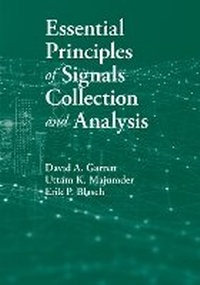
Essential Principles of Signals Collection and Analysis
Published on 31. July 2023
Book
Hardback
300 pages
978-1-63081-690-2 (ISBN)
Unfortunately, price unknown
Available (delivery time upon request)
Not available
Description
This book provides a clear and systematic introduction to the basic concepts, foundational mathematics principles, and application of signals collection and supporting technologies. It describes the essential principles of signals collection and analysis for both tactical and commercial applications, and applies the foundational principles and concepts pertaining to the collection and exploitation of uncooperative signals of interest. You will be equipped with the basic concepts and skills necessary to manage and develop signals collection systems, and benefit from the practical, hands-on information you can confidently implement and apply. You will also find abundant references included to guide you further in the areas of signals collection. The book uniquely presents the fundamental mathematics of the collection and processing of signals in a manner easily understood by newcomers to the field, while practitioners will find it to be a practical, go-to desktop reference for signal analysis. This is an ideal, one-of-a-kind text for graduate students, analysts, managers, and others who need a rapid introduction to the diverse and growing field of signals analytics.
More details
Edition
Unabridged edition
Language
English
Place of publication
Norwood
United States
Target group
Professional and scholarly
Edition type
Unabridged edition
Dimensions
Height: 254 mm
Width: 178 mm
ISBN-13
978-1-63081-690-2 (9781630816902)
Copyright in bibliographic data and cover images is held by Nielsen Book Services Limited or by the publishers or by their respective licensors: all rights reserved.
Schweitzer Classification
Other editions
Additional editions
David A. Garren | Uttam K. Majumder | Erik P. Blasch
Essential Principles of Signals Collection and Analysis
E-Book
07/2023
Artech House
€176.99
Available for download
Content
1.0 Signals Collection
1.1 Introduction
1.2 Important Terms
1.3 Signals Collection Functions and Processes
1.4 The Disciplines within Signals Collection
2.0 A Brief History of Signals Collection
2.1 World War 1 Radio Signals Collection
2.2 World War II Signals Collection, Bletchley Park and Enigma
2.3 NSA, GCHQ and the Cold War
2.4 NRO history of GRAB
3.0 Signals and Communication Fundamentals
3.1 Electromagnetic propagation of waveforms
3.2 Transmission and Antenna Theory
3.3 Communications Channels
3.4 Basic Modulation Theory
3.5 Collection Platforms on the Ground and in the Air and in Space
3.6 Kepler's laws
3.7 Orbital parameters
3.8 Precession of orbital parameters
4.0 Radar Fundamentals
4.1 Transmission and reception beam patterns
4.2 Radar beamwidth
4.3 Radar equation
4.4 Data Link Analysis
4.5 Electronic Counter Measures (ECM)
4.6 The Jamming Game
5.0 Geolocation of Non-Cooperative Emitters
5.1 Angle of Arrival Methods
5.2 Time Difference of Arrival Methods
5.3 Frequency Difference of Arrival Methods
5.4 Fusion of Geolocation Methods
6.0 Signal Detection and Estimation
6.1 Analog and Digital Signal Processing
6.2 Signals, Noise, Modulation, and the Spectrum
6.3 Detection Theory
6.4 Linear Recursive Sequences
6.5 Spread Spectrum Signals
7.0 Cryptology Fundamentals
7.1 Cryptologic Systems
7.2 Private Key Encryption Methods
7.3 Public Key Encryption Methods
7.4 Methods of Decryption
8.0 Signals Analysis Fundamentals
8.1 Spectral Search and Analysis
8.2 Traffic Analysis
8.3 Content Analysis
8.4 Content Decryption
8.5 Reporting Signals
8.6 Fusion
9.0 Cyber Operations
9.1 Computer Network Operations
9.2 The Role of Signals Collection
10.0 The Future of Signals Collection
10.1 Challenges Posed by Global Communications
10.2 Legal and Policy Considerations for Signals Collection
10.3 Signals Collection Technologies
Glossary of Terms
APPENDIX: Declassified Use Cases
1.1 Introduction
1.2 Important Terms
1.3 Signals Collection Functions and Processes
1.4 The Disciplines within Signals Collection
2.0 A Brief History of Signals Collection
2.1 World War 1 Radio Signals Collection
2.2 World War II Signals Collection, Bletchley Park and Enigma
2.3 NSA, GCHQ and the Cold War
2.4 NRO history of GRAB
3.0 Signals and Communication Fundamentals
3.1 Electromagnetic propagation of waveforms
3.2 Transmission and Antenna Theory
3.3 Communications Channels
3.4 Basic Modulation Theory
3.5 Collection Platforms on the Ground and in the Air and in Space
3.6 Kepler's laws
3.7 Orbital parameters
3.8 Precession of orbital parameters
4.0 Radar Fundamentals
4.1 Transmission and reception beam patterns
4.2 Radar beamwidth
4.3 Radar equation
4.4 Data Link Analysis
4.5 Electronic Counter Measures (ECM)
4.6 The Jamming Game
5.0 Geolocation of Non-Cooperative Emitters
5.1 Angle of Arrival Methods
5.2 Time Difference of Arrival Methods
5.3 Frequency Difference of Arrival Methods
5.4 Fusion of Geolocation Methods
6.0 Signal Detection and Estimation
6.1 Analog and Digital Signal Processing
6.2 Signals, Noise, Modulation, and the Spectrum
6.3 Detection Theory
6.4 Linear Recursive Sequences
6.5 Spread Spectrum Signals
7.0 Cryptology Fundamentals
7.1 Cryptologic Systems
7.2 Private Key Encryption Methods
7.3 Public Key Encryption Methods
7.4 Methods of Decryption
8.0 Signals Analysis Fundamentals
8.1 Spectral Search and Analysis
8.2 Traffic Analysis
8.3 Content Analysis
8.4 Content Decryption
8.5 Reporting Signals
8.6 Fusion
9.0 Cyber Operations
9.1 Computer Network Operations
9.2 The Role of Signals Collection
10.0 The Future of Signals Collection
10.1 Challenges Posed by Global Communications
10.2 Legal and Policy Considerations for Signals Collection
10.3 Signals Collection Technologies
Glossary of Terms
APPENDIX: Declassified Use Cases