

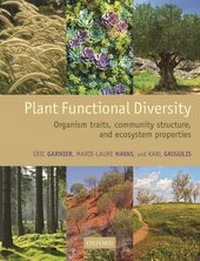
Plant Functional Diversity
Organism traits, community structure, and ecosystem properties
Published on 10. December 2015
Book
Paperback/Softback
256 pages
978-0-19-875737-5 (ISBN)
Description
Biological diversity, the variety of living organisms on Earth, is traditionally viewed as the diversity of taxa, and species in particular. However, other facets of diversity also need to be considered for a comprehensive understanding of evolutionary and ecological processes. This novel book demonstrates the advantages of adopting a functional approach to diversity in order to improve our understanding of the functioning of ecological systems and their components. The focus is on plants, which are major components of these systems, and for which the functional approach has led to major scientific advances over the last 20 years.
Plant Functional Diversity presents the rationale for a trait-based approach to functional diversity in the context of comparative plant ecology and agroecology. It demonstrates how this approach can be used to address a number of highly debated questions in plant ecology pertaining to plant responses to their environment, controls on plant community structure, ecosystem properties, and the services these deliver to human societies. This research level text will be of particular relevance and use to graduate students and professional researchers in plant ecology, agricultural sciences and conservation biology.
Plant Functional Diversity presents the rationale for a trait-based approach to functional diversity in the context of comparative plant ecology and agroecology. It demonstrates how this approach can be used to address a number of highly debated questions in plant ecology pertaining to plant responses to their environment, controls on plant community structure, ecosystem properties, and the services these deliver to human societies. This research level text will be of particular relevance and use to graduate students and professional researchers in plant ecology, agricultural sciences and conservation biology.
Reviews / Votes
Each of the ten chapters is excellently structured... The book is also nicely illustrated, extremely well referenced and has a useful index. In a nutshell, the book is an absolute must-read for graduate students, ecologists, agricultural scientists and conservation biologists interested in the functional approach to biological diversity. * Yvonne Buchholz, Basic and Applied Ecology Journal * The book is well written with good examples, figures and conceptual graphs to explain theoretical and applied concepts and effects of diversity... Plant functional diversity is likely to be a key reference when studying and synthesising information about plant functional diversity and its effects... I will certainly both use and recommend this book. * Paloma Ruiz-Benito, Frontiers of Biogeography * This book is a convincing synthesis of the principles of plant functional ecology in that it provides a profound introduction and theoretical background to the field and lists application possibilities ... It is an excellent textbook for students and will also be useful for researchers. * Conservation Biology * I expect this book to be the best entry point for any researcher interested in trait-based plant ecology. It provides an authoritative overview of trait-based ecology, while simultaneously revealing the power and limitations of this field as it currently stands. By providing a concise and nicely illustrated volume, the authors have done a tremendous service to the field. * Nathan G. Swenson, Ecology. * This book lays out with impressive clarity, depth, and breadth the conceptual framework of plant functional diversity as it stands today ... The book provides a definitive reading for a graduate-level seminar on plant functional diversity and an excellent desk reference for any biologist interested in the evolutionary and ecological implications of trait variation. * Martin J. Lechowicz, Bioscience * Functional ecology has proven productive in understanding ecosystem structure and function, but currently, it is often not widely addressed in general ecology texts. Therefore, this book will be useful to advanced undergraduates and graduate students. ... Highly recommended. * W. E. Williams, CHOICE *More details
Language
English
Place of publication
Oxford
United Kingdom
Target group
College/higher education
Dimensions
Height: 252 mm
Width: 204 mm
Thickness: 13 mm
Weight
484 gr
ISBN-13
978-0-19-875737-5 (9780198757375)
Copyright in bibliographic data and cover images is held by Nielsen Book Services Limited or by the publishers or by their respective licensors: all rights reserved.
Schweitzer Classification
Other editions
Additional editions
Eric Garnier | Marie-Laure Navas | Karl Grigulis
Plant Functional Diversity
Organism traits, community structure, and ecosystem properties
E-Book
12/2015
1st Edition
OUP eBook
€63.49
Available for download
Eric Garnier | Marie-Laure Navas | Karl Grigulis
Plant Functional Diversity
Organism traits, community structure, and ecosystem properties
E-Book
12/2015
1st Edition
OUP eBook
€63.49
Available for download
Persons
Eric Garnier is a researcher in plant functional ecology. His work on plant functional diversity is based on a combination of conceptual, experimental and methodological approaches, and contributes to the broad field of trait-based comparative ecology. He has pioneered some of the developments of conceptual models of relationships between plant functional traits, plant function, and biogeochemistry, and has participated in the development of standardized approaches to the measurement of plant traits towards a worldwide application. More recently, he has contributed to the emergence of ecoinformatics at the French national scale, especially through his work as the Director of CEntre for the Synthesis and Analysis of Biodiversity.
Marie-Laure Navas works on the identification of the functional diversity of plant species. More precisely, her work focuses on i) the identification of assembly rules of plant communities due to biotic and abiotic processes; ii) the characterization of changes in functional structure of plant communities along environmental gradients; iii) the identification of traits related to competition and facilitation ability of plants. These questions are addressed with the example of managed grasslands, especially in the French Mediterranean area. Recently, Marie-Laure Navas also developed collaborations with researchers in crop science and weed science, in order to test the relevance of the functional approach for developing new cropping systems based on more ecological-directed regulation of pests.
Karl Grigulis works as a research engineer in the Laboratoire d'Ecologie Alpine in Grenoble, France. Initially working as an agronomist in south-east Australia on topics of population ecology using pasture weeds as model systems, more recently in France he participates in projects focussed on functional and community ecology, in particular the field assessment of community functional structure as a determinant of ecosystem services.
Marie-Laure Navas works on the identification of the functional diversity of plant species. More precisely, her work focuses on i) the identification of assembly rules of plant communities due to biotic and abiotic processes; ii) the characterization of changes in functional structure of plant communities along environmental gradients; iii) the identification of traits related to competition and facilitation ability of plants. These questions are addressed with the example of managed grasslands, especially in the French Mediterranean area. Recently, Marie-Laure Navas also developed collaborations with researchers in crop science and weed science, in order to test the relevance of the functional approach for developing new cropping systems based on more ecological-directed regulation of pests.
Karl Grigulis works as a research engineer in the Laboratoire d'Ecologie Alpine in Grenoble, France. Initially working as an agronomist in south-east Australia on topics of population ecology using pasture weeds as model systems, more recently in France he participates in projects focussed on functional and community ecology, in particular the field assessment of community functional structure as a determinant of ecosystem services.
Author
Director of ResearchDirector of Research, Centre National de la Recherche Scientifique, Centre d'Ecologie Fonctionnelle et Evolutive, France
Professor of EcologyProfessor of Ecology, Montpellier SupAgro, France
Research EngineerResearch Engineer, Centre National de la Recherche Scientifique, Laboratoire d'Ecologie Alpine, Universite Joseph Fourier, France
Content
1. A functional approach to biological diversity ; 2. Trait-based ecology: definitions, methods, and a conceptual framework ; 3. The functional characterisation of plants ; 4. Gradients, response traits, and ecological strategies ; 5. A functional approach to plant community structure ; 6. Plant traits and ecosystem properties ; 7. Functional diversity and ecosystem services ; 8. Functional diversity in agriculture: the cases of grasslands and crop weeds ; 9. Managing functional diversity data ; 10. Perspectives for functional diversity research