

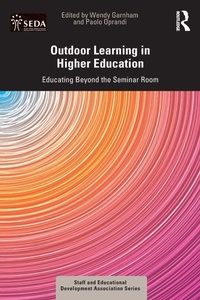
Outdoor Learning in Higher Education
Educating Beyond the Seminar Room
1st Edition
Published on 15. August 2024
Book
Paperback/Softback
202 pages
978-1-032-56737-2 (ISBN)
Description
Outdoor Learning in Higher Education is essential reading for educational developers and academic teachers of all disciplines interested in the theory behind, and benefits of, learning outdoors. Filled with practical case studies and backed by recent research, it provides educators with the tools needed to create an effective yet inclusive learning experience for their students beyond the lecture hall or seminar room.
In chapters which offer analysis, discussion of current debates and advice for good practice, the book is structured around five key themes:
Theoretical perspectives and research supporting outdoor learning.
Health and wellbeing benefits for learners and educators.
Tools and techniques for teaching outdoors, including new technology.
Examples of effective fieldwork.
Crossing educational borders and implementing sustainability and the natural world into the curriculum.
This key book covers issues which are relevant across all disciplines in higher education, including: experiential learning, sustainability, diversity and inclusion, and incorporating new technology. Outdoor Learning in Higher Education develops perspectives on these and other themes, while encouraging the creation of inspiring and effective learning environments.
In chapters which offer analysis, discussion of current debates and advice for good practice, the book is structured around five key themes:
Theoretical perspectives and research supporting outdoor learning.
Health and wellbeing benefits for learners and educators.
Tools and techniques for teaching outdoors, including new technology.
Examples of effective fieldwork.
Crossing educational borders and implementing sustainability and the natural world into the curriculum.
This key book covers issues which are relevant across all disciplines in higher education, including: experiential learning, sustainability, diversity and inclusion, and incorporating new technology. Outdoor Learning in Higher Education develops perspectives on these and other themes, while encouraging the creation of inspiring and effective learning environments.
Reviews / Votes
'Taking teaching and learning outside of the traditional classroom into urban and/or rural settings, has the potential to provide academic, personal and professional development benefits for both students and staff in higher educational settings. This book is a great platform into past, current and future directions of theory, research and applied practice related to this dynamic pedological approach. It also explores aspirational methods and opportunities to further develop and enhance current outdoor learning opportunities in HE and may just inspire you to take it outside!'Sally-Ann Starkey, Senior Lecturer, Liverpool John Moores University
'Outdoor learning, such as field trips, have been around in higher education for many years but recently I have become more interested in learning outside, not only in terms of curriculum content but also introducing alternative pedagogic approaches and considering the wellbeing of my students. Much of the current literature has focused on outdoor learning in the school environment, so for me this is a much-needed book bringing the spotlight to outdoor learning in higher education.'
Dr Isobel Gowers, Associate Professor, Anglia Ruskin University
'For university lecturers and students, outdoor learning opens up a wide range of creative possibilities for subverting and transcending traditional approaches to teaching and university education more broadly. The innovative pedagogies and real-world examples presented in this volume not only break down the walls of academia but also create a bridge that connects learners to the natural world and diverse ways of thinking. As someone deeply invested in humanistic pedagogies, inclusivity and the holistic development of my students, I found this book to be an invaluable resource for reimagining the possibilities of higher education in the great outdoors.'
Tabban Betts, Lecturer in Higher Education Pedagogy, University of Sussex
'The book comes at a time when the insightful exploration of outdoor learning and its impact on HE couldn't be needed more.'
George Robinson, Senior Learning Technologist, University of Sussex
More details
Series
Language
English
Place of publication
London
United Kingdom
Publishing group
Taylor & Francis Ltd
Target group
College/higher education
Professional and scholarly
Academic, Adult education, and Postgraduate
Illustrations
8 s/w Abbildungen, 8 s/w Photographien bzw. Rasterbilder, 6 s/w Tabellen
6 Tables, black and white; 8 Halftones, black and white; 8 Illustrations, black and white
Dimensions
Height: 234 mm
Width: 156 mm
Thickness: 12 mm
Weight
345 gr
ISBN-13
978-1-032-56737-2 (9781032567372)
Copyright in bibliographic data and cover images is held by Nielsen Book Services Limited or by the publishers or by their respective licensors: all rights reserved.
Schweitzer Classification
Other editions
Additional editions
Book
08/2024
1st Edition
Routledge
€206.20
Shipment within 10-20 days
E-Book
08/2024
1st Edition
Routledge
€44.99
Available for download
E-Book
08/2024
1st Edition
Routledge
€44.99
Available for download
Persons
Wendy Garnham is Professor of Psychology at the University of Sussex, UK. She is also co-founder of the Active Learning Network and has won several awards for innovative teaching. Currently, Wendy also acts as Director of Student Experience for the Central Foundation Year programmes.
Paolo Oprandi is a Doctor of Digital Pedagogy which he attained from the University of Sussex. He is a Senior Fellow of the Higher Education Academy and is currently the co-chair of the Active Learning Network. He has a research background and currently leads the implementation and operations of numerous digital environments and CPD programmes within the charity sector. He is a nature and wildlife enthusiast, Wikipedia editor and proponent of active learning pedagogies.
Paolo Oprandi is a Doctor of Digital Pedagogy which he attained from the University of Sussex. He is a Senior Fellow of the Higher Education Academy and is currently the co-chair of the Active Learning Network. He has a research background and currently leads the implementation and operations of numerous digital environments and CPD programmes within the charity sector. He is a nature and wildlife enthusiast, Wikipedia editor and proponent of active learning pedagogies.
Content
Introduction; Chapter 1: Contextual learning and the great outdoors: Pedagogic Biomes!; Chapter 2: Heutagogy and outdoor learning: designing postgraduate studies that support self-determined learners; Chapter 3: A good stick: An inquiry into creativity in Forest School; Chapter 4: The Great Equalizer: Learning in the outdoors.; Chapter 5: More than a walk in the park: Enhancing campus green space for student and staff learning and wellbeing; Chapter 6: Hope in the Garden: Outdoor learning as politics; Chapter 7: Enhancing learning outside the classroom with social media.; Chapter 8: Moving away from the desk: An introduction to Physically Active Learning (PAL); Chapter 9: Harnessing outdoor spaces in an urban university to promote student wellbeing; Chapter 10: Twalks: walking, talking and tweeting; Chapter 11: Tricks, practicalities and ethics of teaching outdoor walking research, including interviews and group tours; Chapter 12: Location-based learning: Case studies on technology-enhanced learning outdoors; Chapter 13: Research on the move: Walking as a research methodology and the importance of expeditioning; Chapter 14: Engaging undergraduate students in citizen science: Measuring air pollution as a pedagogical approach; Chapter 15: Embedding Education of Sustainable Development (ESD) and Universal Design for Learning (UDL) principles in a field trip to improve the student learning experience; Chapter 16: Aesthetic Harmonies: Nature, technology and holistic learning; Chapter 17: Found in translation: Developing students' skills and competencies to implement nature-based and place-based outdoor curricula; Conclusion