

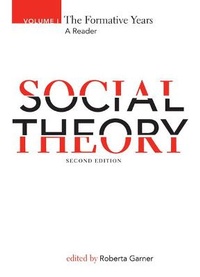
Social Theory, Volume I
The Formative Years, 2nd Edition
2nd Edition
Published on 15. February 2010
Book
Paperback/Softback
277 pages
978-1-4426-0153-6 (ISBN)
Description
This reader enables students to understand the historical flow of social theory and see how disagreements and confrontations shape theory. As in the first edition, many of the classical articles are paired with contemporary theoretical and empirical studies that illustrate the continuing value of the classical concepts. Garner continues to offer her concise introductions, all of which have been completely revised and updated for this edition.
More details
Edition
2nd New edition
Language
English
Place of publication
Toronto
Canada
Edition type
New edition
Product notice
Paperback (trade)
Dimensions
Height: 229 mm
Width: 167 mm
Thickness: 14 mm
Weight
400 gr
ISBN-13
978-1-4426-0153-6 (9781442601536)
Copyright in bibliographic data and cover images is held by Nielsen Book Services Limited or by the publishers or by their respective licensors: all rights reserved.
Schweitzer Classification
Other editions
New editions
Roberta Garner | Black Hawk Hancock
Social Theory, Volume I
From Classical to Modern Theory, Third Edition
Book
05/2014
3rd Edition
University of Toronto Press
€64.00
Article not available
Previous edition
Roberta Garner
Social Theory: From the Beginnings to the 1960s v. 1
Book
03/2004
University of Toronto Press
€44.79
No shipping information available
Person
Roberta Garner is a professor in the Department of Sociology at DePaul University.
Content
Preface
Reading Theory: A General Introduction
Part I: Beginnings
Introduction
Chapter One: Inventing the Lens
Introduction
1. Niccolo Machiavelli
The Prince
2. The Enlightenment and the Conservative Reaction
The Conservative Reaction, Irving Zeitlin
3. Edmund Burke
Reflections on the Revolution in France
4. Auguste Comte
Chapter Two: Classical Theory
Introduction
5. Karl Marx and Friedrich Engels
The Communist Manifesto
The German Ideology
Capital, Karl Marx
6. The Legacy of Marx and Engels: Stanley Aronowitz and William DiFazio
The Jobless Future
7. The Legacy of Marx and Engels: David Harvey
A Brief History of Neoliberalism
8. Emile Durkheim
The Rules of Sociological Method
9. The Legacy of Durkheim: Robert Merton
Social Structure and Anomie
10. Max Weber
Essays in Sociology
11. The Legacy of Weber: Jeff Goodwin and Theda Skocpol
Explaining Revolutions in the Contemporary Third World
12. The Legacy of Weber: Robert Reich
The Work of Nations
13. Georg Simmel
The Miser and the Spendthrift
The Metropolis and Mental Life
14. The Legacy of Simmel: David Riesman
The Lonely Crowd
Part II: The Middle Years
Introduction
Chapter Three: Pragmatism, Progress, Ethnicity: The United States in the Sociological Mirror
Introduction
15. Charles Cooley and George Herbert Mead
Mind, Self, and Society, George Herbert Mead
16. The Legacy of Cooley and Mead: Patricia Adler and Peter Adler
The Gloried Self
17. W.E.B. DuBois
The Souls of Black Folk
The Souls of White Folk
18. The Chicago School
Black Metropolis, St. Clair Drake and Horace Cayton
19. The Legacy of American Sociology: William Julius Wilson
When Work Disappears
Chapter Four: Marxism in the Interwar Period
Introduction
20. Walter Benjamin
The Work of Art in an Age of Mechanical Reproduction
21. Antonio Gramsci
The Prison Notebooks
22. The Legacy of Gramsci: Jean Anyon
Social Class and the Hidden Curriculum of Work
Sources
Reading Theory: A General Introduction
Part I: Beginnings
Introduction
Chapter One: Inventing the Lens
Introduction
1. Niccolo Machiavelli
The Prince
2. The Enlightenment and the Conservative Reaction
The Conservative Reaction, Irving Zeitlin
3. Edmund Burke
Reflections on the Revolution in France
4. Auguste Comte
Chapter Two: Classical Theory
Introduction
5. Karl Marx and Friedrich Engels
The Communist Manifesto
The German Ideology
Capital, Karl Marx
6. The Legacy of Marx and Engels: Stanley Aronowitz and William DiFazio
The Jobless Future
7. The Legacy of Marx and Engels: David Harvey
A Brief History of Neoliberalism
8. Emile Durkheim
The Rules of Sociological Method
9. The Legacy of Durkheim: Robert Merton
Social Structure and Anomie
10. Max Weber
Essays in Sociology
11. The Legacy of Weber: Jeff Goodwin and Theda Skocpol
Explaining Revolutions in the Contemporary Third World
12. The Legacy of Weber: Robert Reich
The Work of Nations
13. Georg Simmel
The Miser and the Spendthrift
The Metropolis and Mental Life
14. The Legacy of Simmel: David Riesman
The Lonely Crowd
Part II: The Middle Years
Introduction
Chapter Three: Pragmatism, Progress, Ethnicity: The United States in the Sociological Mirror
Introduction
15. Charles Cooley and George Herbert Mead
Mind, Self, and Society, George Herbert Mead
16. The Legacy of Cooley and Mead: Patricia Adler and Peter Adler
The Gloried Self
17. W.E.B. DuBois
The Souls of Black Folk
The Souls of White Folk
18. The Chicago School
Black Metropolis, St. Clair Drake and Horace Cayton
19. The Legacy of American Sociology: William Julius Wilson
When Work Disappears
Chapter Four: Marxism in the Interwar Period
Introduction
20. Walter Benjamin
The Work of Art in an Age of Mechanical Reproduction
21. Antonio Gramsci
The Prison Notebooks
22. The Legacy of Gramsci: Jean Anyon
Social Class and the Hidden Curriculum of Work
Sources