

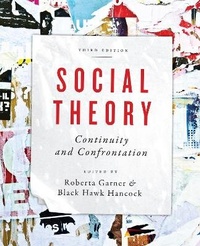
Social Theory: Continuity and Confrontation
A Reader, Third Edition
3rd Edition
Published on 29. April 2014
Book
Paperback/Softback
277 pages
978-1-4426-0648-7 (ISBN)
Description
The third edition of this popular reader reflects considerable changes. With over seventy readings representing a wide diversity of theorists, it offers a breadth of coverage not available in other collections. The framework for understanding theory as a set of conversations over time is maintained and deepened, with a focus on key transitional theorists who helped pave the way from classical to contemporary theory. New contextual and biographical materials surround the primary readings, and each chapter includes a study guide with key terms, discussion questions, and innovative classroom exercises. The result is a fresh and expansive take on social theory that foregrounds a plurality of perspectives and defines contemporary trends in the field, while being both an accessible and manageable teaching tool.
More details
Edition
3rd New edition
Language
English
Place of publication
Toronto
Canada
Target group
Professional and scholarly
College/higher education
Edition type
New edition
Product notice
Paperback (trade)
Dimensions
Height: 255 mm
Width: 202 mm
Thickness: 33 mm
Weight
1320 gr
ISBN-13
978-1-4426-0648-7 (9781442606487)
Copyright in bibliographic data and cover images is held by Nielsen Book Services Limited or by the publishers or by their respective licensors: all rights reserved.
Schweitzer Classification
Other editions
Previous edition
Book
05/2007
2nd Edition
Broadview Press Ltd
€60.84
Article exhausted; check for reprint
Persons
Roberta Garner is a professor in the Department of Sociology at DePaul University.
Black Hawk Hancock is Associate Professor of Sociology at DePaul University in Chicago. He is the co-author with Roberta Garner of Changing Theories: New Directions in Sociology (2009) and author of American Allegory: Lindy Hop and the Racial Imagination (2013).
Black Hawk Hancock is Associate Professor of Sociology at DePaul University in Chicago. He is the co-author with Roberta Garner of Changing Theories: New Directions in Sociology (2009) and author of American Allegory: Lindy Hop and the Racial Imagination (2013).
Content
Preface
Reading Theory: A General Introduction
Part I: Beginnings
Introduction
Chapter One: Inventing the Lens
Introduction
Niccolo` Machiavelli, The Prince
Irving Zeitlin, Ideology and the Development of Sociological Theory
Edmund Burke, Reflections on the Revolution in France
Kant, "What is Enlightenment?"
Nietzsche, The Genealogy of Morals
A word on Auguste Comte
Suggested Readings
Study Guide
Key Terms
Questions & Exercises
Part II: Classical Theory
Introduction
Suggested Readings
Chapter Two: Marxist Theory
Introduction
Marx:
The Communist Manifesto, Part I
The German Ideology
Capital: "Fetishism of Commodities"; "On Machinery and Technology"
The Legacy of Marx and Engels:
Aronowitz and DiFazio, The Jobless Future
David Harvey, A Brief History of Neo-Liberalism
Suggested Readings
Study Guide
Key Terms
Questions & Exercises
Chapter Three: The Social Theory of Emile Durkheim
Introduction
The Rules of Sociological Method ("crime")
Suicide (on anomie)
Elementary Forms of Religious Life (from the Conclusion)
The Legacy of Emile Durkheim
Robert Merton, "Social Structure and Anomie"
Suggested Readings
Study Guide
Key Terms
Questions & Exercises
Chapter Four: The Social Theory of Max Weber
Introduction
Economy and Society: An Outline of Interpretive Sociology: excerpts and "Science as Vocation"
The Legacy of Max Weber
George Ritzer: McDonaldization of Society
Skocpol, "The Narrowing of Civic Life"
Suggested Readings
Study Guide
Key Terms
Questions & Exercises
Chapter Five: The Individual in Society: Simmel and Freud
Introduction
Simmel, The Miser and the Spendthrift and "The Metropolis and Mental Life"
Legacy of Simmel: David Riesman, The Lonely Crowd
Freud, Introductory Lectures on Psychoanalysis (excerpts)
The Legacy of Sigmund Freud:
Juliet Mitchell, Psychoanalysis and Feminism
Suggested Readings
Study Guide
Key Terms
Questions & Exercises
Part II - Questions and Exercises
Part III: The Middle Years
Introduction
Suggested Readings, Part III
Chapter Six: American Emergence
Introduction
Cooley and Mead. Mind, Self and Society
The Legacy of Cooley and Mead:
Patricia Adler and Peter Adler, "The Gloried Self"
W.E.B. Du Bois, The Souls of Black Folk
Darkwater, "The Souls of White Folk"
The Chicago School, St. Clair Drake and Horace Cayton. Black Metropolis
The Legacy of American Sociology:
William Julius Wilson, When Work Disappears
Suggested Readings
Study Guide
Key Terms
Questions & Exercises
Chapter Seven: Reconstructed Marxism
Introduction
Walter Benjamin, "The Work of Art in an Age of Mechanical Reproduction"
Adorno, Horkheimer, and Marcuse, The Dialectic of Enlightenment
Antonio Gramsci, The Prison Notebooks
Legacy of Gramsci:
Jean Anyon, "Social Class and the Hidden Curriculum of Work"
Suggested Readings
Study Guide
Key Terms
Questions & Exercises
Chapter Eight: American Hegemony
Introduction
Talcott Parson
Structural Functionalism. Theories of Society
Mental Illness. "Illness and the Role of the Physician"
C. Wright Mills
Conflict Theory. The Power Elite
Howard S. Becker
Symbolic Interactionism. Outsiders
Herbert Marcuse
Consumerism & 'False Needs.' One Dimensional Man
Louis Althusser
Structural Marxism. "Ideology and Ideological State Apparatus"
Suggested Readings
Study Guide
Key Terms
Questions & Exercises
Part IV: Transitions and Changes
Introduction
Suggested Readings for Part IV
Chapter Nine: The Social Theory of Erving Goffman
Introduction
The Presentation of Self in Everyday Life
Frame Analysis
'The Interaction Order'
Suggested Readings
Study Guide
Key Terms
Questions & Exercises
Chapter Ten: Power, Bodies, and Subjects: The Social Theory of Michel Foucault
Introduction
Discipline and Punish "The Body of the Condemned" and "The Panopticon"
"The Subject and the Power"
Suggested Readings
Study Guide
Key Terms
Questions & Exercises
Chapter Eleven: The Social Theory of Pierre Bourdieu
Introduction
Sociology in Question
The Logic of Practice
Distinction
Suggested Readings
Study Guide
Key Terms
Questions & Exercises
Chapter Twelve: The Social Theory of Stuart Hall
Introduction
"Encoding, Decoding"
"Old and New Identities, Old and New Ethnicities"
Gramsci's "Relevance for the Study of Race and Ethnicity"
Suggested Readings
Study Guide
Key Terms
Questions & Exercises
Part V: Dispersion and Difference
Introduction
Chapter Thirteen: Issues of Race and Ethnicity in a Post-Colonial World
Introduction
Frantz Fanon, The Wretched of the Earth
Edward W. Said, Orientalism
Michael Omi and Howard Winant, Racial Formation in the United States
David Roediger, The Wages of Whiteness
Suggested Readings
Study Guide
Key Terms
Questions & Exercises
Chapter Fourteen: Highlighting Gender and Sexuality
Introduction
Dorothy E. Smith, The Conceptual Practices of Power
Judith Butler, Bodies That Matter
Angela Davis. Lisa Lowe's Interview with Angela Davis (1995)
Raewynn W. Connell, Masculinities
John D'Emilio, "Capitalism and Gay Identity"
Suggested Readings
Study Guide
Key Terms
Questions & Exercises
Chapter Fifteen: Conceptions of Culture
Introduction
Raymond Williams, Marxism and Literature
Dick Hebdige, Subculture: The Meaning of Style
Jurgen Habermas, Legitimation Crises
The Theory of Communicative Action;
Frederic Jameson, Postmodernism or the Cultural Logic of Late Capitalism
Suggested Readings
Study Guide
Key Terms
Questions & Exercises
Chapter Sixteen: Media and Culture in the Information Age
Introduction
Guy Debord, The Society of the Spectacle
Jean Baudrillard, Simulacra and Simulation
Paul Willis, The Ethnographic Imagination
Roland Barthes, "Mythologies"
Suggested Readings
Study Guide
Key Terms
Questions & Exercises
Chapter Seventeen: Global Views
Introduction
Immanuel Wallerstein, The Modern World-System
Arjun Appadurai, "Disjuncture and Difference in the Global Cultural Economy"
Saskia Sassen, "The Global City: Strategic Site/New Frontier"
Nestor Garcia-Canclini, Hybrid Cultures: Strategies for Entering and Leaving Modernity
Suggested Readings
Study Guide
Key Terms
Questions & Exercises
Sources
Index
Reading Theory: A General Introduction
Part I: Beginnings
Introduction
Chapter One: Inventing the Lens
Introduction
Niccolo` Machiavelli, The Prince
Irving Zeitlin, Ideology and the Development of Sociological Theory
Edmund Burke, Reflections on the Revolution in France
Kant, "What is Enlightenment?"
Nietzsche, The Genealogy of Morals
A word on Auguste Comte
Suggested Readings
Study Guide
Key Terms
Questions & Exercises
Part II: Classical Theory
Introduction
Suggested Readings
Chapter Two: Marxist Theory
Introduction
Marx:
The Communist Manifesto, Part I
The German Ideology
Capital: "Fetishism of Commodities"; "On Machinery and Technology"
The Legacy of Marx and Engels:
Aronowitz and DiFazio, The Jobless Future
David Harvey, A Brief History of Neo-Liberalism
Suggested Readings
Study Guide
Key Terms
Questions & Exercises
Chapter Three: The Social Theory of Emile Durkheim
Introduction
The Rules of Sociological Method ("crime")
Suicide (on anomie)
Elementary Forms of Religious Life (from the Conclusion)
The Legacy of Emile Durkheim
Robert Merton, "Social Structure and Anomie"
Suggested Readings
Study Guide
Key Terms
Questions & Exercises
Chapter Four: The Social Theory of Max Weber
Introduction
Economy and Society: An Outline of Interpretive Sociology: excerpts and "Science as Vocation"
The Legacy of Max Weber
George Ritzer: McDonaldization of Society
Skocpol, "The Narrowing of Civic Life"
Suggested Readings
Study Guide
Key Terms
Questions & Exercises
Chapter Five: The Individual in Society: Simmel and Freud
Introduction
Simmel, The Miser and the Spendthrift and "The Metropolis and Mental Life"
Legacy of Simmel: David Riesman, The Lonely Crowd
Freud, Introductory Lectures on Psychoanalysis (excerpts)
The Legacy of Sigmund Freud:
Juliet Mitchell, Psychoanalysis and Feminism
Suggested Readings
Study Guide
Key Terms
Questions & Exercises
Part II - Questions and Exercises
Part III: The Middle Years
Introduction
Suggested Readings, Part III
Chapter Six: American Emergence
Introduction
Cooley and Mead. Mind, Self and Society
The Legacy of Cooley and Mead:
Patricia Adler and Peter Adler, "The Gloried Self"
W.E.B. Du Bois, The Souls of Black Folk
Darkwater, "The Souls of White Folk"
The Chicago School, St. Clair Drake and Horace Cayton. Black Metropolis
The Legacy of American Sociology:
William Julius Wilson, When Work Disappears
Suggested Readings
Study Guide
Key Terms
Questions & Exercises
Chapter Seven: Reconstructed Marxism
Introduction
Walter Benjamin, "The Work of Art in an Age of Mechanical Reproduction"
Adorno, Horkheimer, and Marcuse, The Dialectic of Enlightenment
Antonio Gramsci, The Prison Notebooks
Legacy of Gramsci:
Jean Anyon, "Social Class and the Hidden Curriculum of Work"
Suggested Readings
Study Guide
Key Terms
Questions & Exercises
Chapter Eight: American Hegemony
Introduction
Talcott Parson
Structural Functionalism. Theories of Society
Mental Illness. "Illness and the Role of the Physician"
C. Wright Mills
Conflict Theory. The Power Elite
Howard S. Becker
Symbolic Interactionism. Outsiders
Herbert Marcuse
Consumerism & 'False Needs.' One Dimensional Man
Louis Althusser
Structural Marxism. "Ideology and Ideological State Apparatus"
Suggested Readings
Study Guide
Key Terms
Questions & Exercises
Part IV: Transitions and Changes
Introduction
Suggested Readings for Part IV
Chapter Nine: The Social Theory of Erving Goffman
Introduction
The Presentation of Self in Everyday Life
Frame Analysis
'The Interaction Order'
Suggested Readings
Study Guide
Key Terms
Questions & Exercises
Chapter Ten: Power, Bodies, and Subjects: The Social Theory of Michel Foucault
Introduction
Discipline and Punish "The Body of the Condemned" and "The Panopticon"
"The Subject and the Power"
Suggested Readings
Study Guide
Key Terms
Questions & Exercises
Chapter Eleven: The Social Theory of Pierre Bourdieu
Introduction
Sociology in Question
The Logic of Practice
Distinction
Suggested Readings
Study Guide
Key Terms
Questions & Exercises
Chapter Twelve: The Social Theory of Stuart Hall
Introduction
"Encoding, Decoding"
"Old and New Identities, Old and New Ethnicities"
Gramsci's "Relevance for the Study of Race and Ethnicity"
Suggested Readings
Study Guide
Key Terms
Questions & Exercises
Part V: Dispersion and Difference
Introduction
Chapter Thirteen: Issues of Race and Ethnicity in a Post-Colonial World
Introduction
Frantz Fanon, The Wretched of the Earth
Edward W. Said, Orientalism
Michael Omi and Howard Winant, Racial Formation in the United States
David Roediger, The Wages of Whiteness
Suggested Readings
Study Guide
Key Terms
Questions & Exercises
Chapter Fourteen: Highlighting Gender and Sexuality
Introduction
Dorothy E. Smith, The Conceptual Practices of Power
Judith Butler, Bodies That Matter
Angela Davis. Lisa Lowe's Interview with Angela Davis (1995)
Raewynn W. Connell, Masculinities
John D'Emilio, "Capitalism and Gay Identity"
Suggested Readings
Study Guide
Key Terms
Questions & Exercises
Chapter Fifteen: Conceptions of Culture
Introduction
Raymond Williams, Marxism and Literature
Dick Hebdige, Subculture: The Meaning of Style
Jurgen Habermas, Legitimation Crises
The Theory of Communicative Action;
Frederic Jameson, Postmodernism or the Cultural Logic of Late Capitalism
Suggested Readings
Study Guide
Key Terms
Questions & Exercises
Chapter Sixteen: Media and Culture in the Information Age
Introduction
Guy Debord, The Society of the Spectacle
Jean Baudrillard, Simulacra and Simulation
Paul Willis, The Ethnographic Imagination
Roland Barthes, "Mythologies"
Suggested Readings
Study Guide
Key Terms
Questions & Exercises
Chapter Seventeen: Global Views
Introduction
Immanuel Wallerstein, The Modern World-System
Arjun Appadurai, "Disjuncture and Difference in the Global Cultural Economy"
Saskia Sassen, "The Global City: Strategic Site/New Frontier"
Nestor Garcia-Canclini, Hybrid Cultures: Strategies for Entering and Leaving Modernity
Suggested Readings
Study Guide
Key Terms
Questions & Exercises
Sources
Index