

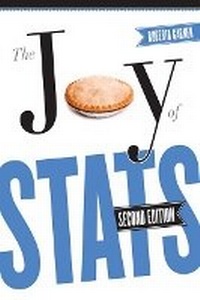
The Joy of Stats
A Short Guide to Introductory Statistics in the Social Sciences
2nd Edition
Published on 1. July 2010
Book
Paperback/Softback
352 pages
978-1-4426-0188-8 (ISBN)
Description
As a stand-alone text, a self-study manual, or a supplement to a lab manual or comprehensive text, The Joy of Stats is a unique and versatile resource. A "Math Refresher" section and self-assessment test offer a concise review of the needed math background. A "How-To?" section provides short, handy summaries of data analysis techniques and explains when to apply them. Each chapter offers key terms, numerous examples-including real-world data-practice exercises and answers, and verbal algorithms as well as formulas. The result is an unrivalled guide for students of social science as well as for practitioners and policy-makers. The second edition has been revised throughout and includes many new examples. A new companion website, garnerjoyofstats.com, features a data set covering close to 120 countries and 10 variables, student exercises, and a full suite of instructor support materials, including power points for lectures, lab guides, and a test bank. For more information visit www.garnerjoyofstats.com.
More details
Edition
2nd Edition
Language
English
Place of publication
Toronto
Canada
Product notice
Paperback (trade)
Dimensions
Height: 230 mm
Width: 180 mm
Thickness: 17 mm
Weight
520 gr
ISBN-13
978-1-4426-0188-8 (9781442601888)
Copyright in bibliographic data and cover images is held by Nielsen Book Services Limited or by the publishers or by their respective licensors: all rights reserved.
Schweitzer Classification
Other editions
New editions
Sandra Kirby | Lorraine Greaves | Colleen Reid
Experience Research Social Change
Methods Beyond the Mainstream, Second Edition
Book
07/2006
2nd Edition
Garamond Press
€60.84
Article exhausted; check for reprint
Previous edition
Book
04/2005
2nd Edition
University of Toronto Press
€44.75
No shipping information available
Person
Roberta Garner is Professor of Sociology at DePaul University in Chicago. She is the author of The Joy of Stats: A Short Guide to Introductory Statistics in the Social Sciences, Second Edition (2010). She teaches courses on theory, research design, statistics, and Greek mythology.
Content
List of Figures and Tables Acknowledgments Preface Chapter One: Basic Concepts Part I: Variables Level of Measurement Dichotomous Variables Operationalized Variables Independent (IV) and Dependent (DV) Variables Causality Units of Analysis: Individual and Place-level Data Part II: Thinking about Procedures Descriptive and Inferential Statistics Difference Observing and Estimating Conclusion Key terms Chapter Two: Describing Distributions Part I: Frequency Distributions Part II: Summary Measures Measures of Central Tendency (Mean, Median, Mode) Measures of Dispersion (or Variability) Categoric Variables: Index of Diversity and Index of Qualitative Variation Part III: Graphing and Visual Displays of Distributions Part IV: Standardized Scores or Z-scores The Mathematical Imagination: The Magic of Z-scores Math Interlude: Chebycheff's Inequality Conclusion Key Terms Chapter Three: Statistical Inference Part I: Thinking about Statistical Inference Statistical Inference: What Are We Trying To Do? Variability The Mathematical Imagination: A World Without Variability The Normal Curve The Mathematical Imagination: Mild and Wild Randomness Sampling Distributions and the Normal Curve Sampling Error: Variability of the Sampling Distribution The Central Limit Theorem Math Thoughts Underlying Distributions and Sampling Distributions The Sampling Distribution of a Proportion Part II: Doing Statistical Inference The Logic of Statistical Inference Confidence Intervals Hypothesis Testing (The Null Hypothesis and T-tests) Conclusion Key Terms Chapter Four: Relationships Among Variables Part I: An Overview - Thinking About Variable Relationships Four Types of Data Analysis Techniques Beyond Bivariate Analysis: Adding Variables and Staying Alert Part II: Data Analysis Techniques Section One: Regression Analysis Math Interlude: The Natural Log Transformation Section Two: Crosstabs Section Three: ANOVA Section Four: Logistic Regression Conclusion Key Terms Conclusion How To? Choosing a Data Analysis Technique Regression Analysis Pearson's Correlation Coefficient The Bivariate Regression Equation Coefficient of Determination (aka "R-squared") Crosstabs and Related Procedures Computing Chi-Square Joint and Marginal Distributions More about Running Percentages Measures of Association ANOVA and the F-test T-tests One-Sample T-test Independent Samples T-test Exercises Questions Answers Math Refresher Tips for Studying Math Estimating From Common Sense to Formula The Number Line Greater and Lesser Absolute Value Fractions and Other Proportions Decimal Fractions Percent Comparing Fractions Computing Percent Change and Percentage Point Change Operations Addition Multiplication Subtraction Division Word or Story Problems Squaring, Higher Powers, and Square Roots Squaring Higher Powers Square Roots Scientific Notation Manipulating Formulas The Coordinate Plane, Ordered Pairs, and Functions Appendix Tables of Probability Distributions Table 26: Critical Values for the Z-distribution Table 27: Critical Values for the T-distribution Table 28: Critical Values for the Chi-Square Distribution Table 29: Critical Values for the F-distribution Bibliography, Reading Suggestions, and Works Cited Index