

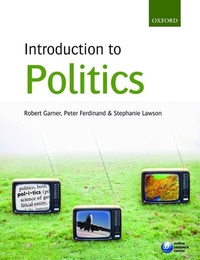
Introduction to Politics
Published on 25. December 2008
Book
Paperback/Softback
560 pages
978-0-19-923133-1 (ISBN)
Description
Introduction to Politics brings together an expert team of authors to produce the definitive introductory politics textbook. The book's broad coverage includes concepts and ideologies, comparative politics, and international relations, making this an ideal text for politics modules. Each section is written by an expert in the field. This is an intellectually stimulating, yet accessible, introduction to the subject, which reflects the realities of current global politics. The book avoids focus on Western democracies and assumptions of liberal democratic supremacy, instead illustrating points by using examples from a wide range of countries. Further, it moves beyond a descriptive account of the subject; througout the text, students are introduced to the debates and inherent complexities of the topics covered. Introduction to Politics' analytical approach will challenge students, rather than providing them with one definite line of argument.
Introduction to Politics is accompanied by an innovative Online Resource Centre, which includes: For students: Multiple choice questions Expanded case studies from the book with embedded video links to relevant news articles, web video and research Flashcard glossary Further information on key thinkers Web links Political scenario activities Additional case study on the role of the Internet in politics For registered adopters of the text: Summary of each chapter Discussion points based on each chapter PowerPoint slides
Introduction to Politics is accompanied by an innovative Online Resource Centre, which includes: For students: Multiple choice questions Expanded case studies from the book with embedded video links to relevant news articles, web video and research Flashcard glossary Further information on key thinkers Web links Political scenario activities Additional case study on the role of the Internet in politics For registered adopters of the text: Summary of each chapter Discussion points based on each chapter PowerPoint slides
Reviews / Votes
This book provides authoritative and accessible coverage of the three main building blocks of the modern study of politics. Professor Wyn Grant, University of Warwick Introduction to Politics is an outstanding textbook... I found it to be perfectly tuned to our students. Unlike many introductory books, it nicely balances political theory, comparative politics and international relations [and] combines history, theory and empirical data in just the right measures...Overall, an outstanding text that will serve teachers and students in the UK, North America and more widely, well. Dr Anthony F. Lang, University of St Andrews A tour de force of relevant and important information woven into a contemporary framework. Ken Duckett, University of Kent An absolute must for anyone interested in politics. It achieves the invaluable task of successfully demonstrating the pervasiveness of politics and will get all readers thinking politically... An invigorating back-to-basics read that reminded me why I first got interested in politics. Dr Liam Weeks, University College, Cork A first class introduction to the study of politics that is informed, incisive and accessible. Gillian Peele, University of OxfordMore details
Language
English
Place of publication
Oxford
United Kingdom
Target group
College/higher education
Illustrations
Illustrations
Dimensions
Height: 245 mm
Width: 189 mm
Thickness: 23 mm
Weight
1211 gr
ISBN-13
978-0-19-923133-1 (9780199231331)
Copyright in bibliographic data and cover images is held by Nielsen Book Services Limited or by the publishers or by their respective licensors: all rights reserved.
Schweitzer Classification
Other editions
New editions
Robert Garner
Introduction to Politics
Book
04/2012
2nd Edition
Oxford University Press
€40.84
Article is exhausted; no reprint
Content
Introduction: Politics and Political Analysis; CONCEPTS AND IDEOLOGIES; Politics and the State; Political Power and Authority; Democracy; Freedom and Justice; Traditional Ideologies; Challenges to the Dominant Ideologies; COMPARATIVE POLITICS; Institutions and States; Constitutions, Law and Judiciaries; Executives and Legislators; Bureaucracies, Policy Studies and Governance; Votes, Elections, Parties; Civil Society, Interest Groups and the Media; Political Culture; INTERNATIONAL RELATIONS; Sovereignty, the State and International Order; Traditional Theories of International Relations; Alternative Approaches to International Relations; Security and Insecurity; Diplomacy and Foreign Policy; International Organizations; International Political Economy; Conclusion