

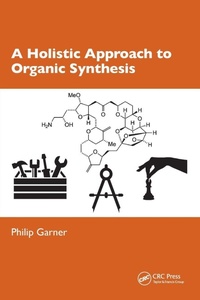
A Holistic Approach to Organic Synthesis
1st Edition
Published on 23. February 2024
Book
Paperback/Softback
172 pages
978-1-032-43843-6 (ISBN)
Description
Synthesis is one of the distinguishing features of chemistry as a science. It is the synthetic chemist who uses their intimate understanding of molecular structure and properties to produce materials of great value to society. Thus, it is important for students of chemistry to study synthesis and acquire a working knowledge that enables them to address the following question: given a specific molecular target, how does one formulate a plan for its synthesis? This synthesis primer provides students who have taken introductory organic chemistry with a set of tools that can be used to plan a synthesis. It may be used in conjunction with a synthetic methods course, or it can stand alone.
Features:
Provides students who have taken introductory organic chemistry with a set of tools that can be used to plan a synthesis
Serves to help organic chemists at all levels to better understand published syntheses
Focuses on natural products, their complexity, and diverse structures which challenge and inspire the chemists preparing them
Succinct, readable treatment of important concepts and applications geared towards advanced undergraduates and graduate students
Each synthesis covered begins with a brief discussion of the target molecule and challenges they present, followed by retrosynthetic considerations
Features:
Provides students who have taken introductory organic chemistry with a set of tools that can be used to plan a synthesis
Serves to help organic chemists at all levels to better understand published syntheses
Focuses on natural products, their complexity, and diverse structures which challenge and inspire the chemists preparing them
Succinct, readable treatment of important concepts and applications geared towards advanced undergraduates and graduate students
Each synthesis covered begins with a brief discussion of the target molecule and challenges they present, followed by retrosynthetic considerations
Reviews / Votes
A Holistic Approach to Organic Synthesis by Professor Phil Garner is an excellent approachto teaching the intricacies of synthesizing organic molecules. Classic syntheses are provided along
with pertinent reactions in a pedological approach that students will find both useful and inspiring.
Tutorials are provided to reinforce the approach. I highly recommend this book for both senior
undergraduate and graduate level courses.
- Michael B. Smith, Professor Emeritus, The University of Connecticut (March, 2024)
More details
Language
English
Place of publication
London
United Kingdom
Publishing group
Taylor & Francis Ltd
Target group
College/higher education
Professional and scholarly
Academic, Postgraduate, Professional Practice & Development, Undergraduate Advanced, and Undergraduate Core
Illustrations
142 s/w Abbildungen, 60 farbige Abbildungen, 5 Farbfotos bzw. farbige Rasterbilder, 142 s/w Zeichnungen, 55 farbige Zeichnungen
55 Line drawings, color; 142 Line drawings, black and white; 5 Halftones, color; 60 Illustrations, color; 142 Illustrations, black and white
Dimensions
Height: 234 mm
Width: 156 mm
Thickness: 10 mm
Weight
295 gr
ISBN-13
978-1-032-43843-6 (9781032438436)
Copyright in bibliographic data and cover images is held by Nielsen Book Services Limited or by the publishers or by their respective licensors: all rights reserved.
Schweitzer Classification
Other editions
Additional editions
Philip Garner
A Holistic Approach to Organic Synthesis
E-Book
02/2024
1st Edition
Taylor & Francis
€59.49
Available for download
Philip Garner
A Holistic Approach to Organic Synthesis
E-Book
02/2024
1st Edition
Taylor & Francis
€59.49
Available for download

Philip Garner
A Holistic Approach to Organic Synthesis
Book
02/2024
1st Edition
CRC Press
€169.30
Shipment within 10-20 days
Person
Philip Garner received his Ph.D. degree from the University of Pittsburgh under the guidance of (the late) Paul Dowd. This was followed by postdoctoral training in Paul Grieco's laboratory at Indiana University. In 1983, he took up his first faculty position at the Illinois Institute of Technology in Chicago. He moved to Case Western Reserve University in Cleveland, Ohio in 1985 where he established a research program that focused on methodology for the synthesis of bioactive molecules. In 2007, he moved across the country to join the Department of Chemistry at Washington State University. Over the course of his career, Dr. Garner has trained more than fifty undergraduate researchers, graduate students, and postdoctoral fellows. He has published over 100 papers. His scientific accomplishments include the development of a widely used serinal derivative that has come to bear his name. He currently holds the rank of Professor Emeritus.
Content
Chapter 1 A Simple Holistic Approach to Planning a Synthesis
Chapter 2 Vying for Control: The Synthesis of Reserpine and Quinine
Chapter 3 A Helping Hand from Nature? Bioinspired Synthesis and Semi-synthesis
Chapter 4 Prostaglandins and Triquinanes: Fertile Ground for Method Development
Chapter 5 Polyketide Synthesis: The Challenge of Acyclic Stereocontrol
Chapter 2 Vying for Control: The Synthesis of Reserpine and Quinine
Chapter 3 A Helping Hand from Nature? Bioinspired Synthesis and Semi-synthesis
Chapter 4 Prostaglandins and Triquinanes: Fertile Ground for Method Development
Chapter 5 Polyketide Synthesis: The Challenge of Acyclic Stereocontrol