

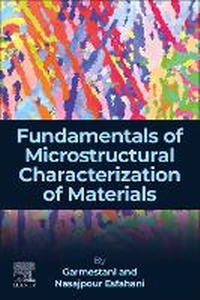
Fundamentals of Microstructural Characterization of Materials
Published on 14. November 2025
Book
Paperback/Softback
518 pages
978-0-443-34189-2 (ISBN)
Description
Fundamentals of Microstructure Characterization of Materials is an essential resource for understanding the various techniques and methods used in material characterization. This book delves into spectroscopic methods involving electromagnetic radiation, X-ray photoelectron analysis, atomic emission spectroscopy, and more. It provides thorough explanations of scanning electron microscopy and sample preparation techniques, including cutting, grinding, polishing, and etching.
Other important points covered in the book include microscopy fundamentals such as lens types, optical image formation principles, depth of field, and depth of focus. Statistical analysis methods, including cumulative distribution function, probability density function, and Gaussian distribution, are also discussed. Additionally, the application of X-ray diffraction in phase analysis of materials is explored in detail.
Other important points covered in the book include microscopy fundamentals such as lens types, optical image formation principles, depth of field, and depth of focus. Statistical analysis methods, including cumulative distribution function, probability density function, and Gaussian distribution, are also discussed. Additionally, the application of X-ray diffraction in phase analysis of materials is explored in detail.
More details
Language
English
Place of publication
Philadelphia
United States
Target group
Professional and scholarly
Dimensions
Height: 229 mm
Width: 152 mm
Weight
450 gr
ISBN-13
978-0-443-34189-2 (9780443341892)
Copyright in bibliographic data and cover images is held by Nielsen Book Services Limited or by the publishers or by their respective licensors: all rights reserved.
Schweitzer Classification
Other editions
Additional editions
Hamid Garmestani | Navid Nasajpour Esfahani
Fundamentals of Microstructural Characterization of Materials
E-Book
11/2025
Elsevier
€140.99
Available for download
Persons
Dr. Hamid Garmestani is a Professor in the School of Materials Science and Engineering at the Georgia Institute of Technology and a fellow of ASM International and American Society of Mechanical Engineering (ASME). His main research and teaching interests focus on the relationships between microstructure and properties in textured polycrystalline materials, composites, superplastic, magnetic, and thin film layered structures. He employs models based on phenomenological and statistical mechanics within a computational framework to study the evolution of microstructure and texture (micro-texture) during fabrication processes and to forecast their effective properties, including mechanical, transport, and magnetic characteristics. Presently he is focused on modeling of processing and manufacturing processes specifically 3D manufacturing. Navid Nasajpour-Esfahani is a Ph.D. candidate distinguished by his extensive expertise in nanotechnology, materials science, and fluid mechanics. His research spans a broad spectrum of critical topics, such as the modeling and simulation of heat transfer processes, exploration of the mechanical properties of nanomaterials, and the advancement of sophisticated numerical methods to simulate complex fluid dynamics. His current focus is on assessing residual stress in additive manufacturing, aiming to enhance the quality and performance of 3D printed materials.
Content
1. Wave Properties
2. Spectroscopy Techniques
3.Sample Preparation Background Materials
4. Elementary Crystallography
5. Microscopy in Materials Characterization
6. Scanning Electron Microscopy
7. Statistical Analysis in Materials Science and Engineering
8. X-ray Diffraction and its Applications in Phase Analysis of Materials
9. Crystallographic Texture Analysis: Pole Figures, Stereographic Projections, and Texture Characterization
10. Comprehensive Questions Bank
2. Spectroscopy Techniques
3.Sample Preparation Background Materials
4. Elementary Crystallography
5. Microscopy in Materials Characterization
6. Scanning Electron Microscopy
7. Statistical Analysis in Materials Science and Engineering
8. X-ray Diffraction and its Applications in Phase Analysis of Materials
9. Crystallographic Texture Analysis: Pole Figures, Stereographic Projections, and Texture Characterization
10. Comprehensive Questions Bank