

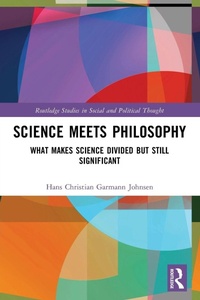
Science Meets Philosophy
What Makes Science Divided but Still Significant
1st Edition
Published on 4. October 2024
Book
Paperback/Softback
290 pages
978-1-032-35436-1 (ISBN)
Description
The book is an attempt to bring together what are often seen as incommensurable scientific and philosophical positions. Its core argument is that a main reason for the divisions about what constitutes scientific knowledge relates to disagreements on philosophical issues. The book explores what these disagreements are about, and discusses whether they can be overcome.
Taking a historical perspective, the book traces the divides in science back to three main philosophical traditions: realism, idealism, and scepticism. It maps how these have inspired three main current positions in science: logical empiricism, phenomenology, and sociology of scientific knowledge.
The book is intended for a general audience concerned with today's debates on scientific knowledge and society. It will be useful for students and researchers studying philosophy of science, sociology of scientific knowledge, realism, phenomenology, positivism, logical empiricism, analytical philosophy, and sustainable scientific knowledge.
Taking a historical perspective, the book traces the divides in science back to three main philosophical traditions: realism, idealism, and scepticism. It maps how these have inspired three main current positions in science: logical empiricism, phenomenology, and sociology of scientific knowledge.
The book is intended for a general audience concerned with today's debates on scientific knowledge and society. It will be useful for students and researchers studying philosophy of science, sociology of scientific knowledge, realism, phenomenology, positivism, logical empiricism, analytical philosophy, and sustainable scientific knowledge.
More details
Series
Language
English
Place of publication
London
United Kingdom
Publishing group
Taylor & Francis Ltd
Target group
College/higher education
Professional and scholarly
Academic, General, and Postgraduate
Illustrations
13 s/w Tabellen
13 Tables, black and white
Dimensions
Height: 234 mm
Width: 156 mm
Thickness: 16 mm
Weight
459 gr
ISBN-13
978-1-032-35436-1 (9781032354361)
Copyright in bibliographic data and cover images is held by Nielsen Book Services Limited or by the publishers or by their respective licensors: all rights reserved.
Schweitzer Classification
Other editions
Additional editions
Hans Christian Garmann Johnsen
Science Meets Philosophy
What Makes Science Divided but Still Significant
E-Book
04/2023
1st Edition
Routledge
€55.49
Available for download
Hans Christian Garmann Johnsen
Science Meets Philosophy
What Makes Science Divided but Still Significant
E-Book
04/2023
1st Edition
Routledge
€55.49
Available for download
Hans Christian Garmann Johnsen
Science Meets Philosophy
What Makes Science Divided but Still Significant
Book
04/2023
1st Edition
Routledge
€196.60
Shipment within 10-20 days
Person
Hans Christian Garmann Johnsen is Professor at the Department of Working Life and Innovation at the School of Business and Law at the University of Agder, Norway. He has been Visiting Professor at Deusto University in Spain, Adjunct Professor at the Norwegian University of Science and Technology (NTNU), Senior Researcher at NORCE (previously Agderforskning), and Visiting Scholar at several universities including UC Berkeley and Cornell in the USA, and Kingston University in the UK. His latest books are Coping With the Future: Rethinking Assumptions for Society, Business and Work with Holtskog, Halvor; Ennals, Richard (2018); Applied Social Science Research in a Regional Knowledge System with Hauge, Elisabeth S.; Magnussen, May-Linda; Ennals, Richard (2016).
Content
1. A king's art
2. Antiquity and the origin of the divides in philosophy of science
3. The realist track towards logical empiricism: the problem of conceptualising reality
4. The idealist track towards phenomenology: the problem of objectivity of thinking
5. The scepticism towards the sociology of science: The problem with the concept of knowing
6. Still a role for philosophy?
2. Antiquity and the origin of the divides in philosophy of science
3. The realist track towards logical empiricism: the problem of conceptualising reality
4. The idealist track towards phenomenology: the problem of objectivity of thinking
5. The scepticism towards the sociology of science: The problem with the concept of knowing
6. Still a role for philosophy?