

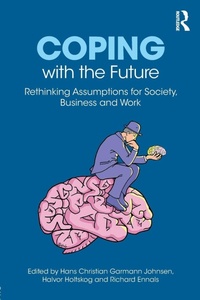
Coping with the Future
Rethinking Assumptions for Society, Business and Work
1st Edition
Published on 28. March 2018
Book
Paperback/Softback
286 pages
978-1-138-55932-5 (ISBN)
Description
Coping with the Future has been written in response to widespread international awareness that the future is not predictable. In political and economic terms, we are in unknown territory, with daily developments around Brexit and the Trump Presidency, and "Kodak moments" in business. On the other hand, business leaders demand certainty, which is not available.
This book redefines the nature of modern business. In contrast to recent trends, it has a focus on human-centred manufacturing and on decision-making which goes beyond a focus on short-term profit. The liberal capitalism of the USA and the UK is not the only current variety of capitalism. Business is not just about managers, but requires participation and engagement by workers.
Since the financial crash of 2008, there has been much talk about the need for fresh approaches to business, but little has changed. This book pulls together current research and practice and poses new questions based on case studies. There is no one simple best way, but an uncertain future can be addressed, drawing on diverse past experience and cases.
The book addresses an intended audience in business and universities, including business schools, around the world. The debate takes a broader approach, involving research in the social sciences and approaches from philosophy. The world has always been unpredictable, but we have allowed ourselves to be comforted by convenient myths. It is time to wake up.
This book redefines the nature of modern business. In contrast to recent trends, it has a focus on human-centred manufacturing and on decision-making which goes beyond a focus on short-term profit. The liberal capitalism of the USA and the UK is not the only current variety of capitalism. Business is not just about managers, but requires participation and engagement by workers.
Since the financial crash of 2008, there has been much talk about the need for fresh approaches to business, but little has changed. This book pulls together current research and practice and poses new questions based on case studies. There is no one simple best way, but an uncertain future can be addressed, drawing on diverse past experience and cases.
The book addresses an intended audience in business and universities, including business schools, around the world. The debate takes a broader approach, involving research in the social sciences and approaches from philosophy. The world has always been unpredictable, but we have allowed ourselves to be comforted by convenient myths. It is time to wake up.
Reviews / Votes
"Overall the book can contribute and be very useful for those researchers, policy makers, business professional and practitioners willing to understand the times we are living through, and offers an open-minded attitude to current and future societal challenges. Readers with interest in philosophy, political science, sociology, economics and technology will find theoretical foundations, but also well contextualised examples, allowing an epistemological navigation in a structured route. Its reading could help in exploring, in a reflective and deeply ingrained manner, about the past, present and future. Submerged in this stage readers will find familiar routes that offer new landscapes, allowing to rethink normal and alternative models." - Egoitz PomaresMore details
Language
English
Place of publication
London
United Kingdom
Publishing group
Taylor & Francis Ltd
Target group
College/higher education
Professional and scholarly
Postgraduate and Professional
Illustrations
18 s/w Abbildungen, 16 s/w Photographien bzw. Rasterbilder, 2 s/w Zeichnungen, 11 s/w Tabellen
11 Tables, black and white; 2 Line drawings, black and white; 16 Halftones, black and white; 18 Illustrations, black and white
Dimensions
Height: 234 mm
Width: 156 mm
Thickness: 17 mm
Weight
471 gr
ISBN-13
978-1-138-55932-5 (9781138559325)
Copyright in bibliographic data and cover images is held by Nielsen Book Services Limited or by the publishers or by their respective licensors: all rights reserved.
Schweitzer Classification
Other editions
Additional editions
Hans Christian Garmann Johnsen | Halvor Holtskog | Richard Ennals
Coping with the Future
Rethinking Assumptions for Society, Business and Work
Book
03/2018
1st Edition
Routledge
€206.80
Shipment within 10-20 days
Hans Christian Garmann Johnsen | Halvor Holtskog | Richard Ennals
Coping with the Future
Rethinking Assumptions for Society, Business and Work
E-Book
03/2018
1st Edition
Routledge
€55.49
Available for download
Hans Christian Garmann Johnsen | Halvor Holtskog | Richard Ennals
Coping with the Future
Rethinking Assumptions for Society, Business and Work
E-Book
03/2018
1st Edition
Routledge
€55.49
Available for download
Persons
Hans Christian Garmann Johnsen is a Professor at the University of Agder, Norway.
Halvor Holtskog is a Professor at the Norwegian University of Science and Technology (NTNU), Norway.
Richard Ennals is a Professor at the University of Agder, Norway and Linnaeus University, Sweden.
Halvor Holtskog is a Professor at the Norwegian University of Science and Technology (NTNU), Norway.
Richard Ennals is a Professor at the University of Agder, Norway and Linnaeus University, Sweden.
Content
Introduction: A disruptive world and ways of knowing 1. Coping with politics: From post-nationalism to re-nationalism 2. Coping with structural change: Understanding framework conditions 3. Coping with globalisation: Local knowledge and multinational companies 4. Coping with economic policy: Innovation policy in times of disruption 5. Coping with ways of knowing: A pluralist perspective on knowledge 6. Coping with decisions: First I imagine then I know 7. Coping with sustainability: The need for non-instrumental thinking 8. Coping with methodology: Validity and knowledge about the future 9. Coping with technology: A future of robots? 10. Coping with Humanism: A Posthuman future? 11. Coping with social learning: Social and economic change through engagement 12. Coping with organisations: Socio-technical, dialogical and beyond 13. Coping with leadership: The role of judgement 14. Coping with work: Redefining relations between work life and society Conclusion