

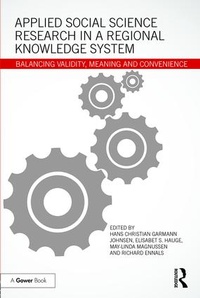
Applied Social Science Research in a Regional Knowledge System
Balancing validity, meaning and convenience
1st Edition
Published on 12. October 2016
Book
Hardback
336 pages
978-1-4724-8782-7 (ISBN)
Description
This book illustrates how applied social scientists and their research are integrated with stakeholders and practitioners in a local/regional setting, and how knowledge development is a mutual concern, made in, and dependent on, ongoing dialogue. Focusing on the Agder region, the southernmost region in Norway, researchers and contributors question what impact the changing economic environment will have on applied researchers around the world. Applied research is seen as a vital part of the infrastructure for economic and social development, in the Agder region and beyond. The chapters are divided into four parts:
the spatial dimension of knowledge development;
understanding regional practice;
explaining regional practice;
influencing regional social practice.
A useful resource for both policy makers and researchers, the book helps readers reflect on the type of mutual competence building that applied social science research implies, and depends on, in a regional knowledge development process. It represents a voice on how to understand the development of the knowledge society at regional and global levels.
the spatial dimension of knowledge development;
understanding regional practice;
explaining regional practice;
influencing regional social practice.
A useful resource for both policy makers and researchers, the book helps readers reflect on the type of mutual competence building that applied social science research implies, and depends on, in a regional knowledge development process. It represents a voice on how to understand the development of the knowledge society at regional and global levels.
More details
Language
English
Place of publication
London
United Kingdom
Publishing group
Taylor & Francis Ltd
Target group
College/higher education
Illustrations
15 s/w Abbildungen, 15 s/w Zeichnungen, 40 s/w Tabellen
40 Tables, black and white; 15 Line drawings, black and white; 15 Illustrations, black and white
Dimensions
Height: 234 mm
Width: 156 mm
Weight
780 gr
ISBN-13
978-1-4724-8782-7 (9781472487827)
Copyright in bibliographic data and cover images is held by Nielsen Book Services Limited or by the publishers or by their respective licensors: all rights reserved.
Schweitzer Classification
Other editions
Additional editions
Hans Christian Garmann Johnsen | Elisabet S. Hauge | May-Linda Magnussen
Applied Social Science Research in a Regional Knowledge System
Balancing validity, meaning and convenience
Book
12/2019
1st Edition
Routledge
€51.98
Shipment within 15-20 days
Hans Christian Garmann Johnsen | Elisabet S. Hauge | May-Linda Magnussen
Applied Social Science Research in a Regional Knowledge System
Balancing validity, meaning and convenience
E-Book
10/2016
Routledge
€59.49
Available for download
Hans Christian Garmann Johnsen | Elisabet S. Hauge | May-Linda Magnussen
Applied Social Science Research in a Regional Knowledge System
Balancing validity, meaning and convenience
E-Book
10/2016
Routledge
€59.49
Available for download
Persons
Hans Christian Garmann Johnsen is a professor in the Faculty of Economics and Social Sciences at the University of Agder in Norway. He is a specialist in the study of working life and innovation. For 15 years Garmann Johnsen has been involved in a national research programme into collaborative innovation. He has written and presented papers and authored journal articles published worldwide. Richard Ennals is a visiting professor at the Swedish Royal institute of Technology, and a director of the UK Work Organisation Network. He is Vice-Chair of the World Council for Total Quality and Excellence in Education. Ennals is Review Editor of the journal AI and Society and has himself authored many books, papers and journal articles.
Content
Part I: The special dimension of knowledge development
1. Developing a sustainable business model in a changing economy
Roger Henning Normann, Eugene Guribye and Kristin Wallevik
2. Why Norway has to develop its own innovation policy
Arne Isaksen
3. Knowledge transfer in different regional contexts
Nina Kyllingstad and Elisabet S. Hauge
4. Collective knowing
James Karlsen and Miren Larrea
Part II: Understanding regional practice
5. Opening or reproducing understandings
Mikaela Vasstrom
6. Social integration of refugees
May-Linda Magnussen and Ingunn Kvamme
7. Comparative reflection
Hanne Haaland and Hege Wallevik
8. Phenomenology of music students
Elisabet S. Hauge
9. Power and knowledge
Jorn Cruickshank and Hege Wallevik
Part III: Explaining regional practice
10. Network ties between universities and cultural and creative industries
Barbara Zyzak, Romulo Pinheiro and Elisabet S. Hauge
11. The usefulness of applied research
Christine Svarstad and Ellen Nyhus
12. Regional knowledge infrastructure
Sissel Strickert
13. The Mittelstand
Michael Ricke, Kristin Wallevik and Geir Jorgensen
Part IV: Influencing regional social practice
14. Getting China-ready
Sarah Holst Kjaer
15. Business models for new experiential services
Tor Helge Aas and Geir Jorgensen
16. Commitment to sustainability in Agder
Stina Torjesen and Karen Landmark
17. Universities' external relations
Hans Chr. Garmann Johnsen, Roger Normann and Romulo Pinheiro
Conclusion: Applied social science research in the regional knowledge system
Hans Chr. Garmann Johnsen, Elisabet Sorfjorddal Hauge, May-Linda Magnussen and Richard Ennals
References
1. Developing a sustainable business model in a changing economy
Roger Henning Normann, Eugene Guribye and Kristin Wallevik
2. Why Norway has to develop its own innovation policy
Arne Isaksen
3. Knowledge transfer in different regional contexts
Nina Kyllingstad and Elisabet S. Hauge
4. Collective knowing
James Karlsen and Miren Larrea
Part II: Understanding regional practice
5. Opening or reproducing understandings
Mikaela Vasstrom
6. Social integration of refugees
May-Linda Magnussen and Ingunn Kvamme
7. Comparative reflection
Hanne Haaland and Hege Wallevik
8. Phenomenology of music students
Elisabet S. Hauge
9. Power and knowledge
Jorn Cruickshank and Hege Wallevik
Part III: Explaining regional practice
10. Network ties between universities and cultural and creative industries
Barbara Zyzak, Romulo Pinheiro and Elisabet S. Hauge
11. The usefulness of applied research
Christine Svarstad and Ellen Nyhus
12. Regional knowledge infrastructure
Sissel Strickert
13. The Mittelstand
Michael Ricke, Kristin Wallevik and Geir Jorgensen
Part IV: Influencing regional social practice
14. Getting China-ready
Sarah Holst Kjaer
15. Business models for new experiential services
Tor Helge Aas and Geir Jorgensen
16. Commitment to sustainability in Agder
Stina Torjesen and Karen Landmark
17. Universities' external relations
Hans Chr. Garmann Johnsen, Roger Normann and Romulo Pinheiro
Conclusion: Applied social science research in the regional knowledge system
Hans Chr. Garmann Johnsen, Elisabet Sorfjorddal Hauge, May-Linda Magnussen and Richard Ennals
References