

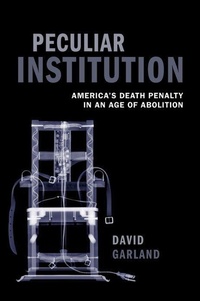
Peculiar Institution
America's Death Penalty in an Age of Abolition
1st Edition
Published on 30. September 2010
Book
Hardback
428 pages
978-0-19-959499-3 (ISBN)
Description
For many Europeans, the persistence of America's death penalty is a stark reminder of American otherness. The practice of state killing is an archaic relic, a hollow symbol that accomplishes nothing but reflects a puritanical, punitive culture - bloodthirsty in its pursuit of retribution. In debating capital punishment, the usual rhetoric points to America's deviance from the western norm: civilized abolition and barbaric retention; 'us' and 'them'.
This remarkable new study by a leading social thinker sweeps aside the familiar story and offers a compelling interpretation of the culture of American punishment. It shows that the same forces that led to the death penalty's abolition in Europe once made America a pioneer of reform. That democracy and civilization are not the enemies of capital punishment, though liberalism and humanitarianism are. Making sense of today's differences requires a better understanding of American society and its punishments than the standard rhetoric allows.
Taking us deep inside the world of capital punishment, the book offers a detailed picture of a peculiar institution - its cultural meaning and symbolic force for supporters and abolitionists, its place in the landscape of American politics and attitudes to crime, its constitutional status and the legal struggles that define it. Understanding the death penalty requires that we understand how American society is put together - the legacy of racial violence, the structures of social power, and the commitment to radical, local majority rule.
Shattering current stereotypes, the book forces us to rethink our understanding of the politics of death and of punishment in America and beyond.
This remarkable new study by a leading social thinker sweeps aside the familiar story and offers a compelling interpretation of the culture of American punishment. It shows that the same forces that led to the death penalty's abolition in Europe once made America a pioneer of reform. That democracy and civilization are not the enemies of capital punishment, though liberalism and humanitarianism are. Making sense of today's differences requires a better understanding of American society and its punishments than the standard rhetoric allows.
Taking us deep inside the world of capital punishment, the book offers a detailed picture of a peculiar institution - its cultural meaning and symbolic force for supporters and abolitionists, its place in the landscape of American politics and attitudes to crime, its constitutional status and the legal struggles that define it. Understanding the death penalty requires that we understand how American society is put together - the legacy of racial violence, the structures of social power, and the commitment to radical, local majority rule.
Shattering current stereotypes, the book forces us to rethink our understanding of the politics of death and of punishment in America and beyond.
Reviews / Votes
Students and practitioners in law, sociology, criminology, or for that matter, American studies will find this book a fascinating as well as useful provider of insights into why the death penalty unfortunately survives in America in an age of abolition. * Phillip Taylor http://www.flickr.com/photos/phillip_taylor/5488685982/ * This book provides an excellent resource and critical survey of the death penalty and its history in America and Europe. Some of his eminently readable prose reminds me of Alexis de Tocqueville's nineteenth-century narrative about his visit to America; it has the objective, thought-provoking quality of an astute observer rather than that of an interested participant in American politics. * John Paul Stevens, The New York Review of Books *More details
Language
English
Place of publication
Oxford
United Kingdom
Target group
College/higher education
Professional and scholarly
Academics and students working in criminology, sociology or American politics. General readers interested in current affairs, especially American politics, society, and culture.
Product notice
Laminated cover
Dimensions
Height: 240 mm
Width: 167 mm
Thickness: 33 mm
Weight
788 gr
ISBN-13
978-0-19-959499-3 (9780199594993)
Copyright in bibliographic data and cover images is held by Nielsen Book Services Limited or by the publishers or by their respective licensors: all rights reserved.
Schweitzer Classification
Person
David Garland is Professor of Sociology at New York University. He is one of the leading sociologists writing on punishment and crime control, his major works including Punishment and Modern Society, and The Culture of Control.
Content
Prologue ; 1. Thinking about capital punishment ; 2. The American way of death ; 3. Capital punishment in the shadow of lynching ; 4. Capital punishment in long-term perspective ; 5. The decline of the death penalty in Europe and America ; 6. The causes of capital punishment's decline ; 7. The American state in comparative perspective ; 8. American society, American violence, American culture ; 9. Capital punishment and the American social structure ; 10. An American abolition: Furman v Georgia in context ; 11. Backlash: the new meanings of capital punishment ; 12. Rationalize, civilize, democratize: the Supreme Court strategies ; 13. The uses of capital punishment ; 14. The peculiar institution explained