

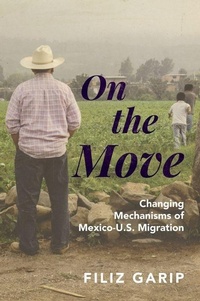
On the Move
Changing Mechanisms of Mexico-U.S. Migration
Published on 1. November 2016
Book
Hardback
312 pages
978-0-691-16106-8 (ISBN)
Description
Why do Mexicans migrate to the United States? Is there a typical Mexican migrant? Beginning in the 1970s, survey data indicated that the average migrant was a young, unmarried man who was poor, undereducated, and in search of better employment opportunities. This is the general view that most Americans still hold of immigrants from Mexico. On the Move argues that not only does this view of Mexican migrants reinforce the stereotype of their undesirability, but it also fails to capture the true diversity of migrants from Mexico and their evolving migration patterns over time. Using survey data from over 145,000 Mexicans and in-depth interviews with nearly 140 Mexicans, Filiz Garip reveals a more accurate picture of Mexico-U.S migration. In the last fifty years there have been four primary waves: a male-dominated migration from rural areas in the 1960s and '70s, a second migration of young men from socioeconomically more well-off families during the 1980s, a migration of women joining spouses already in the United States in the late 1980s and '90s, and a generation of more educated, urban migrants in the late 1990s and early 2000s.
For each of these four stages, Garip examines the changing variety of reasons for why people migrate and migrants' perceptions of their opportunities in Mexico and the United States. Looking at Mexico-U.S. migration during the last half century, On the Move uncovers the vast mechanisms underlying the flow of people moving between nations.
For each of these four stages, Garip examines the changing variety of reasons for why people migrate and migrants' perceptions of their opportunities in Mexico and the United States. Looking at Mexico-U.S. migration during the last half century, On the Move uncovers the vast mechanisms underlying the flow of people moving between nations.
Reviews / Votes
"Winner of the 2018 Mirra Komarovsky Book Award, Eastern Sociological Society" "Co-Winner of the 2017 Best Book Award, Migration and Citizenship Section of the American Political Science Association" "Winner of the 2017 Otis Dudley Duncan Award, Section on Population of the American Sociological Association" "Honorable Mention for the 2019 ENMISA Distinguished Book Award, Ethnicity, Nationalism, and Migration Section the International Studies Association" "Garip's analysis is focused and fresh, representing an innovative approach to understand which theories of migration work for whom, when, and why. . . . [On the Move] provides an intricate and thorough analysis of the conditions, contexts, and composition of Mexican cohorts of migration since 1965, providing readers with a comprehensive understanding of the complex social, economic, and political processes that have led to this particular point in the trajectory of Mexican migration. This is a must read for anyone seeking to understand the history of Mexican migration to the United States over the past 50 years."---Elizabeth Aranda, American Journal of SociologyMore details
Series
Language
English
Place of publication
New Jersey
United States
Target group
College/higher education
Professional and scholarly
Product notice
Trade binding
Illustrations
4 Maps
Dimensions
Height: 231 mm
Width: 157 mm
Thickness: 25 mm
Weight
635 gr
ISBN-13
978-0-691-16106-8 (9780691161068)
Copyright in bibliographic data and cover images is held by Nielsen Book Services Limited or by the publishers or by their respective licensors: all rights reserved.
Schweitzer Classification
Other editions
Additional editions

E-Book
11/2016
1st Edition
Princeton University Press
from
€120.95
Available for download
Person
Filiz Garip is professor of sociology at Cornell University.
Content
List of Illustrations ix List of Tables xi Acknowledgments xiii Introduction 1 1 Why Do People Migrate? Identifying Diverse Mechanisms of Migration 10 2 "Go Work Over There and Come Do Something Here" Circular Migrants 39 3 "We Leave to Help Our Parents Economically" Crisis Migrants 67 4 "Your Place Is Where Your Family Is" Family Migrants 95 5 "Putting Down Roots" Urban Migrants 122 6 Where Do We Go from Here? Conditional Theories and Diverse Policies 153 Appendixes 181 Notes 225 References 259 Index 289