

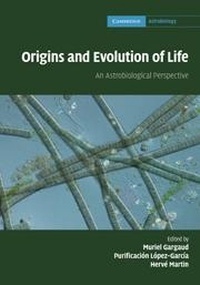
Origins and Evolution of Life
An Astrobiological Perspective
Published on 6. January 2011
Book
Hardback
546 pages
978-0-521-76131-4 (ISBN)
Description
Devoted to exploring questions about the origin and evolution of life in our Universe, this highly interdisciplinary book brings together a broad array of scientists. Thirty chapters assembled in eight major sections convey the knowledge accumulated and the richness of the debates generated by this challenging theme. The text explores the latest research on the conditions and processes that led to the emergence of life on Earth and, by extension, perhaps on other planetary bodies. Diverse sources of knowledge are integrated, from astronomical and geophysical data, to the role of water, the origin of minimal life properties and the oldest traces of biological activity on our planet. This text will not only appeal to graduate students but to the large body of scientists interested in the challenges presented by the origin of life, its evolution, and its possible existence beyond Earth.
More details
Series
Language
English
Place of publication
Cambridge
United Kingdom
Target group
Professional and scholarly
Product notice
sewn/stitched
Cloth over boards
Illustrations
19 Tables, black and white; 123 Line drawings, black and white
Dimensions
Height: 259 mm
Width: 181 mm
Thickness: 30 mm
Weight
1224 gr
ISBN-13
978-0-521-76131-4 (9780521761314)
Copyright in bibliographic data and cover images is held by Nielsen Book Services Limited or by the publishers or by their respective licensors: all rights reserved.
Schweitzer Classification
Other editions
Additional editions
E-Book
01/2011
1st Edition
Cambridge University Press
€87.49
Available for download
Muriel Gargaud | Purificacion Lopez-Garcia | Herve Martin
Origins and Evolution of Life
An Astrobiological Perspective
E-Book
12/2010
1st Edition
Cambridge University Press
€103.99
Available for download
Persons
Muriel Gargaud is a research scientist at the Laboratoire d'Astrophysique de Bordeaux, CNRS-Universite Bordeaux 1, and is vice-president of the Societe Francaise d'Exobiologie, which is associated with the NASA Astrobiology Institute. Purificacion Lopez-Garcia is a research director at the CNRS, Universite Paris-Sud, and leads a research team exploring microbial diversity and evolution in different ecosystems, including extreme environments. Herve Martin is Professor at the Laboratoire Magmas et Volcans at the Universite Blaise Pascal in Clermont-Ferrand. He has been in charge of several international research programs on the geochemistry and geodynamic processes on early Earth.
Content
Part I. What Is Life?: 1. Problems raised by a definition of life M. Morange; 2. Some remarks about uses of cosmological anthropic 'principles' D. Lambert; 3. Minimal cell: the biologist point of view C. Brochier-Armanet; 4. Minimal cell: the computer scientist point of view H. Bersini; 5. Origins of life: computing and simulation approaches B. Billoud; Part II. Astronomical and Geophysical Context of the Emergence of Life: 6. Organic molecules in interstellar medium C. Ceccarelli and C. Cernicharo; 7. Cosmochemical evolution and the origin of life: insights from meteorites S. Pizzarello; 8. Astronomical constraints on the emergence of life M. Gounelle and T. Montmerle; 9. Formation of habitable planets J. Chambers; 10. The concept of galactic habitable zone N. Prantzos; 11. The young Sun and its influence on planetary atmospheres M. Guedel and J. Kasting; 12. Climates of the Earth G. Ramstein; Part III. Role of Water in the Emergence of Life: 13. Liquid water: a necessary condition to all forms of life K. Bartik, G. Bruylants, E. Locci and J. Reisse; 14. The role of water in the formation and evolution of planets T. Encrenaz; 15. Water on Mars J. P. Bibring; Part IV. From Non-Living Systems to Life: 16. Energetic constraints on prebiotic pathways: application to the emergence of translation R. Pascal and L. Boiteau; 17. Comparative genomics and early cell evolution A. Lazcano; 18. Origin and evolution of metabolisms J. Pereto; Part V. Mechanisms for Life Evolution: 19. Molecular phylogeny: inferring the patterns of evolution E. Douzery; 20. Horizontal gene transfer: mechanisms and evolutionary consequences D. Moreira; 21. The role of symbiosis in eukaryotic evolution A. Latorre, A. Durban, A. Moya and J. Pereto; Part VI. Life in Extreme Conditions: 22. Life in extreme conditions: Deinococcus radiodurans, an organism able to survive prolonged desiccation and high doses of ionising radiation S. Sommer and M. Toueille; 23. Molecular effects of UV and ionizing radiations on DNA J. Cadet and T. Douki; 24. Molecular adaptations to life at high salt: lessons from Haloarcula marismortui G. Zaccai; Part VII. Traces of Life and Biosignatures: 25. Early life: nature, distribution and evolution F. Westall; 26. Early eukaryotes in precambrian oceans E. Javaux; 27. Biomineralisation mechanisms K. Benzerara and J. Miot; 28. Limits of life and biosphere: lesson from detection of microorganisms in deep sea and deep subsurface in the Earth K. Takai; Part VIII. Life Elsewhere?: 29. Titan and the Cassini-Huygens mission J. Lunine and F. Raulin; 30. The role of terrestrial analogue environments in astrobiology R. Leveille; Index.